


 Shkruar nga Pamfleti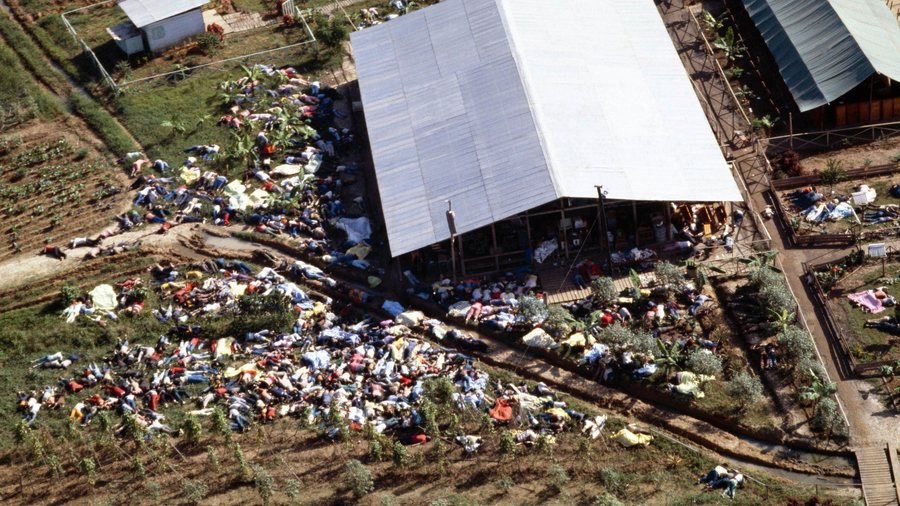
November 18, 1978 - 909 people are sacrificed in the Jonestown sect
On November 18, 1978, the founder of the Peoples Temple sect, Jim Jones, led hundreds of his followers in a mass murder-suicide on their farm in a remote area of Guyana, South America.
Many of Jones' followers willingly swallowed a poisonous mixture, while others were forced to do so at gunpoint. The final death toll in Jonestown that day was 909; a third of them were children.
Jim Jones was a charismatic clergyman who founded the Peoples Temple, a Christian sect in Indianapolis, in the 1950s. He preached against racism, and his integrated congregation attracted many African Americans.
In 1965, he moved his group of followers to Northern California, settling in Ukiah, and after 1971 in San Francisco. During the 1970s, his church was accused by the media of financial fraud, physical abuse of members, and child abuse.
Due to mounting criticism, Jones, who was becoming increasingly paranoid, invited the congregation to move with him to Guyana, where he promised to build a utopian, egalitarian society.
Three years earlier, a small group of followers had traveled to Guyana to establish what would become Jonestown, a secret jungle retreat. But it did not turn out to be the promised paradise.
Members worked long hours in the fields and were severely punished if they questioned Jim Jones' authority. Their passports were confiscated, letters to their families were censored, and members were encouraged to spy on each other's actions.
They were also forced to attend long meetings, often late at night. Jim Jones, who suffered from mental health problems and drug addiction, believed that the US government and others were trying to destroy him.
For this reason, he forced members to participate in midnight suicide drills. In 1978, former members and their relatives convinced U.S. Congressman Leo Ryan, a Democrat from California, to visit the Jonestown ranch to investigate what was really happening there.
On November 17, Ryan arrived in Jonestown, accompanied by several journalists and other observers. The visit initially went well, but on November 18, as the delegation was preparing to leave, several residents contacted them, asking for permission to cross from Guyana to the United States.
Jones was greatly alarmed by a mass desertion, and one of his most loyal followers attacked Ryan with a knife. The congressman managed to escape unharmed, but he was later ordered to have himself and his companions killed on the airstrip while attempting to flee.
Ryan and four others were killed as they boarded the plane. When Jim Jones returned to Jonestown, he ordered members to gather on the main farm square and perform what he called a “revolutionary act.”
The children were the first to die, as parents and nurses used syringes to give them a poisonous mixture of cyanide, sedatives and fruit juice. Adults were also forced to drink the poisoned mixture, while armed guards surrounded the farm on all sides.
When Guyanese officials arrived at the Jonestown compound the next day, they found hundreds of bodies, many of whom had embraced each other in their final act in this life.
Some residents managed to escape by hiding in the jungle during the suicides, while at least several dozen other members, including some of Jones' children, survived after being in other parts of Guyana.
Other important events that occurred on November 18:
November 18, 1421 - A great storm struck the coast of the North Sea. The sea rushed inland, breaking dikes and flooding villages in what is now the Netherlands. By the next day, nearly 10,000 people had died in the resulting floods.
November 18, 1863 - U.S. President Abraham Lincoln delivered the famous Gettysburg Address during the American Civil War, a key moment in the country's history.
November 18, 1916 - The British commander, Sir Douglas Haig, decided to end the long offensive of the Battle of the Somme in northwestern France. The battle, which began on July 1, 1916, was one of the bloodiest of the First World War, and was characterized by the first use of tanks and heavy casualties, over a million killed and wounded. Despite heavy bombardment and continuous attacks, the Allies managed to advance only a few kilometers.
November 18, 1918 - Latvia declared independence from the Soviet Union. Karlis Ulmanis was appointed as the head of the provisional government.
November 18, 1926 - The famous British writer George Bernard Shaw refused the money for his Nobel Prize, saying the famous phrase: "Better give it to people in need!".
November 18, 1940 - Nazi leader Adolf Hitler meets with Italian Foreign Minister Galeazzo Ciano regarding Mussolini's disastrous invasion of Greece.
According to Ciano's diaries, their meeting took place in "a very tense atmosphere." Mussolini had surprised everyone with his attack on Greece. His ally, Hitler, was taken by surprise because the Duce had led him to believe that he had no such intention./ Pamphlet




Lini një Përgjigje