


 Shkruar nga Pamfleti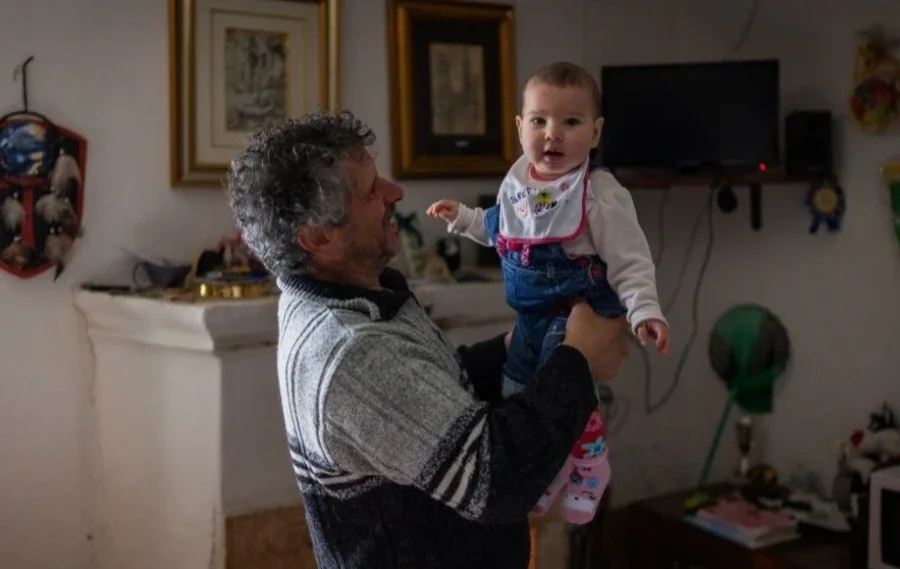
In the ancient village of Pagliara dei Marsi, on the slopes of Mount Girifalco in Italy's Abruzzo region, the decades-long silence has been broken by the birth of a baby. In a place where cats outnumber people and the narrow alleys are buzzing with meows, Lara Busi Trabucco has become a symbol of hope, the first baby born there in almost 30 years.
With her birth, the number of residents increased to about 20, and her baptism in the church opposite the house brought the entire community together, even the cats. The presence of a baby has turned Lara into a real attraction for tourists who visit the village simply because they have heard about her.
Her mother, Cinzia Trabucco, who is a music teacher from Frascati near Rome, says nine-month-old Lara is already famous.
But its story is also a reflection of Italy's demographic crisis. In 2024, the country recorded a record low number of births, just 369,944, marking the 16th consecutive year of declining birth rates. The fertility rate fell to 1.18 children per woman of reproductive age, one of the lowest in the European Union.
The causes are numerous: job insecurity, large-scale youth emigration, lack of support for working mothers, rising male infertility, and a growing tendency not to have children.
Preliminary data for the first seven months of 2025 show a further decline in births, especially in sparsely populated areas such as Abruzzo, where births fell by 10.2% compared to the same period a year earlier. Pagliara dei Marsi, although a small village, represents a wider reality: an aging population, empty schools and serious challenges for local and national authorities.
The Trabucco family received a bonus of 1,000 euros after Lara's birth, as well as a monthly allowance of around 370 euros, but they face great difficulties in managing childcare and work, due to the weak nursery system. Lara's educational future is also uncertain: the last school in the village has been closed for decades and even in the nearest town, Castellafiume, the existence of schools is at risk due to the lack of children.
According to Trabucco, financial aid is not enough to reverse this trend. It requires a revolution in the entire system, citing high taxes and inadequate public services. In the region, the city of Sulmona is trying to keep open the maternity ward at the Annunziata hospital, which serves the entire surrounding area. Closing it would force pregnant women to travel more than an hour to L'Aquila, a major risk in case of emergency.
Experts also emphasize the importance of fertility preservation, including the method of egg freezing, warning that without sufficient information and adequate infrastructure, efforts to increase fertility will be insufficient.






Lini një Përgjigje