


 Shkruar nga Pamfleti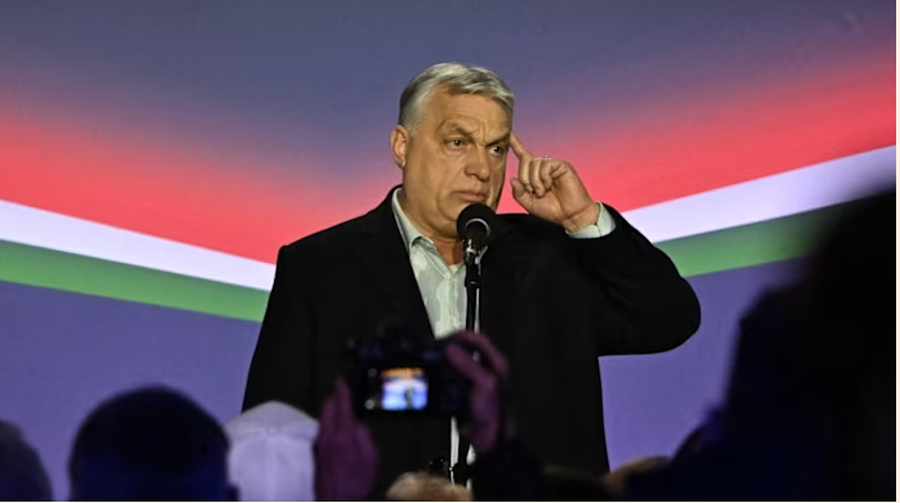
A possible defeat of the right-wing populist prime minister would have consequences for Hungary and for the political balance in Europe.
Hungarian Prime Minister Viktor Orban, who for 16 years has exerted an influence greater than his country's real weight, is entering an electoral race that could prove decisive for the future of his rule.
According to an editorial in the Financial Times, for the first time since 2010 he faces a real possibility of losing in next Sunday's elections. This also explains the wide international attention to an electoral process in an EU member state with fewer than 10 million inhabitants.
According to the same source, Orban has become a model for authoritarian leaders over the years, building what he calls “illiberal democracy.” He has emerged as a central figure of nationalist conservatism against immigration, as an obstacle to European support for Ukraine, and as a persistent dissenting voice within the European Union. On the international front, he maintains close relations with Russian President Vladimir Putin and at the same time enjoys support from Donald Trump.
The Financial Times estimates that, in building what the European Parliament has called an “electoral autocracy,” Orban has not only taken examples from other authoritarian regimes, but has also exported new methods. According to the newspaper, his model of “state capture” has relied on placing loyalists in public office, distributing contracts and economic opportunities to oligarchs close to power, and weakening the independence of institutions.
This approach, writes the FT, has subsequently been reflected in other countries, while critics in the US have paralleled some elements of the conservative project "Project 2025" with an attempt to "Orbanize" the American administration.
Ideologically, Orban has crafted a political message that combines conservative values of religion and family with opposition to immigration and rejection of foreign influence. He has also played a role in bringing together far-right forces in Europe, including Marine Le Pen in France, Geert Wilders in the Netherlands, Vox in Spain, and the Freedom Party in Austria.
According to the Financial Times, both Moscow and Washington are interested in a fifth consecutive term for Orban. The newspaper writes that the Kremlin has supported a disinformation campaign in favor of his re-election, while senior officials close to Donald Trump, including Vice President JD Vance, are planning a high-profile visit to Hungary to strengthen the Hungarian prime minister's campaign.
However, growing dissatisfaction among Hungarian citizens with cronyism and corruption could turn against him. The Financial Times recalls that during Orban's government, a limited group of businessmen close to the government have benefited from a significant share of public contracts in the country.
Rising living costs and a stagnant economy are adding to the pressure on the government. In this climate, voters are also paying closer attention to the roughly 20 billion euros in EU funds for Hungary, which Brussels has kept blocked due to concerns over the rule of law, public procurement and corruption.
Orban's main challenger, Péter Magyar, a former Fidesz party politician and leader of the Tisza party, has managed to politically link Budapest's clash with the EU and the freezing of funds to the deterioration of the economy and public services in the country.
However, Tisza's victory is not considered certain. According to the Financial Times, Magyar's lead in the polls could be narrowed by a relentless discrediting campaign in the media close to Orbán. The newspaper notes that previous elections in Hungary have been described as "free but not fair" due to Fidesz's heavy media dominance.
Opposition activists fear that the ruling party could resort to even stronger forms of manipulation or challenge the result in the event of a loss. Even if the opposition wins, dismantling the political and institutional network built by Fidesz could prove difficult.
However, an opposition victory would open the prospect of reviving open democracy in Hungary and remove one of the frequent obstacles to EU decision-making, particularly on aid to Ukraine.
Such a development would be a blow to the populist right at a time when it is gaining ground in large parts of Western Europe. Above all, it would show that authoritarian-leaning regimes are not necessarily as consolidated as they seem. /Adapted from Pamphlet /






Lini një Përgjigje