


 Shkruar nga Pamfleti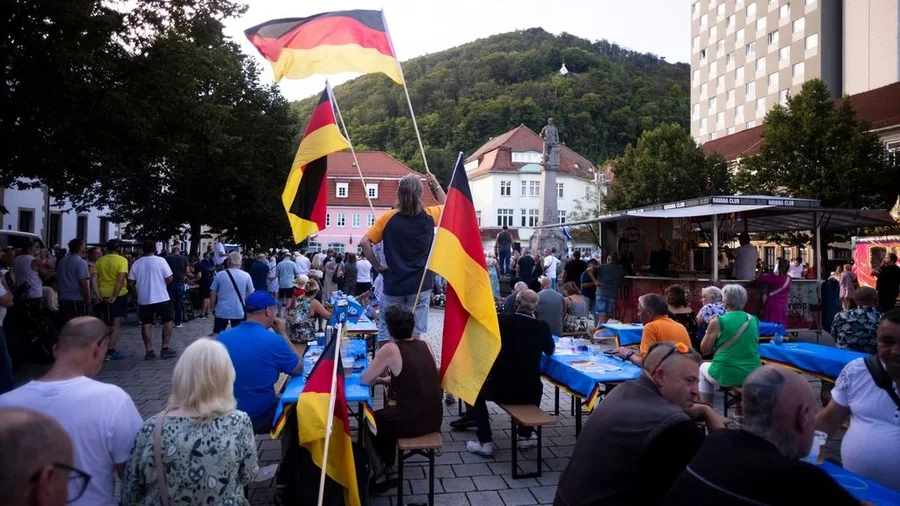
The far-right Alternative for Germany party AFD leads with more than 30% and looks set to win state elections in Germany's Thuringia for the first time since World War II.
According to a poll, the AfD leads in Thuringia with 33.5%, followed by the Christian Democratic Party "CDU" with 24.5%.
"For us, this is a historic success," said one of the far-right party's leaders, Alice Weidel.
In third place is the newly founded Alliance Zara Wagenknecht (BSW) with 16%, while the left follows with 12.5%.
The CDU appears to secure 31.5% of the vote, with the AfD on 30% and the BSW on 12%. The SPD wins 8.5%, the Greens 5.5% and the Left 4%.
As expected, dramatic results in both #Saxony and #Thuringia ????????
— Cas Mudde (@CasMudde) September 1, 2024
Interesting difference in Linke-BSW dynamic, undoubtedly linked to difference in AfD growth. ???? pic.twitter.com/ulxauwhdml
"Message to the German Government"
The rise of the far right is likely to be seen as another blow to the already weak three-party coalition government of German Chancellor Olaf Scholz.
The far-right movement in the eastern German states appears to have been strengthened by the anti-immigrant current that prevailed recently after the latest attacks.
It is typical of the attack that took place last week in the German city of Solingen, when during the local festival a Syrian attacked the crowd with a knife, killing three people and injuring eight others.
The AfD came second in Germany during this year's European elections, campaigning with the issue of immigration as its central axis.
However, despite AfD's increased percentages, the party is unlikely to succeed in taking power, which would only be possible by creating a coalition of forces. This is because all the other parties that will go to the state parliaments refused to govern in coalitions with the AfD./CNN






Lini një Përgjigje