


 Shkruar nga Pamfleti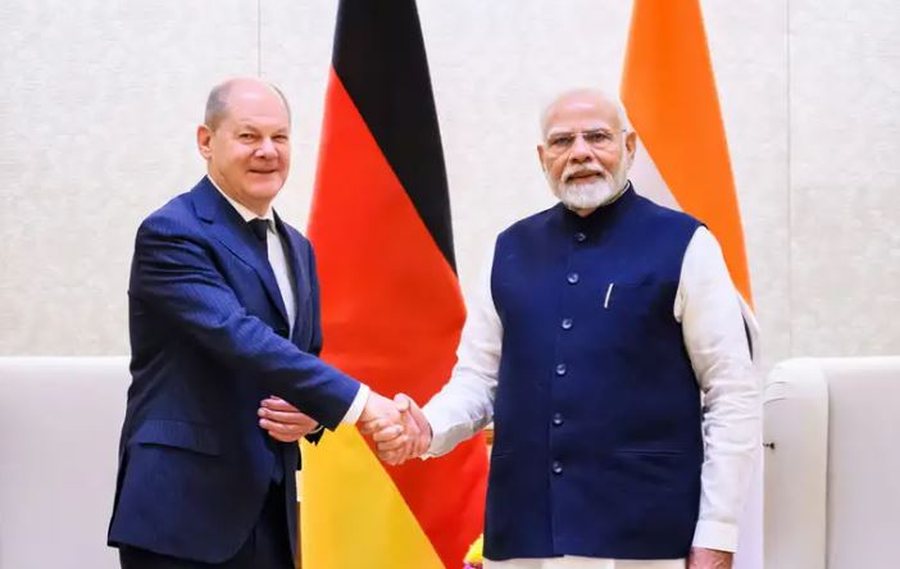
Top German business leaders and politicians have traveled to India this week for a major meeting where they will seek ways to further strengthen economic ties between Germany and the Asian region.
"The region is becoming increasingly important for Germany and the EU due to geopolitical changes and the growing desire to diversify," Friedolin Strack, head of international markets at the Association of German Industries (BDI), told DW. "The growing importance is evident in the value of exports from Germany to this region, because exports reached 214.6 billion euros ($231.9 billion) in 2023," he says.
The German Economy Asia-Pacific Conference officially opened on Thursday (24 October) in New Delhi. The event coincides this year with intergovernmental consultations between Germany and India, which will be co-chaired by German Chancellor Olaf Scholz and Indian Prime Minister Narendra Modi.
Increased focus on India
Underscoring the growing importance of India to Germany, the Scholz government last week approved a document called "Focus on India", with the aim of further strengthening the strategic partnership between the two sides covering all areas of ties, including trade, migration, climate and foreign policy.
Berlin also adopted a series of 30 measures to encourage immigration from India in a bid to attract skilled workers to fill gaps in the German labor market. On Friday, Scholz and Modi will address hundreds of business leaders attending a business conference in New Delhi. The biennial meeting comes at a time when Germany's economy is in decline and there are problems with businesses and companies. But German companies remain optimistic about their prospects in the Asia Pacific.
A recent survey by the German Chamber of Foreign Trade (AHK) and the German Chamber of Commerce and Industry (DIHK) showed a positive sentiment among German companies operating in the region, although optimism in China is not as good as before.
Reducing dependence on China
China has long been the main focus of German companies in Asia. German industrial companies, especially in the automotive, machinery and chemical industry sectors, have relied on the demands of the Asian giant, which has helped produce and employ thousands of well-paid workers. But China's slowing economic development has hit these companies hard, forcing them to restructure and cut costs.
Rising geopolitical tensions between Beijing and the West have also increased calls for companies to reduce dependence on China and diversify their investments and production. In response, many German companies have begun efforts to conquer new markets.
"Over the past 40 years, the German economy has established itself in the Chinese market and built a complex and well-functioning network of supply chains, production routes and product distribution channels," Volker Treier, head of the DIHK, told DW.
"This network cannot be easily transferred to other markets. It is also important that about 90% of German companies in China produce for the Chinese market — so there is a close connection with the Chinese domestic market,” he added.
India presents opportunities and challenges
However, India is becoming increasingly important for German companies, as its economy is growing rapidly. At the same time, trade between the two sides is growing, reaching a record of 30.8 billion euros in 2023.
German companies plan to expand their investments in India in the coming years, attracted by the country's low labor costs, political stability and sufficient number of skilled workers," said the study titled "Business Outlook Germany- India 2024”.
But companies also face challenges in the Indian market, the report said, citing bureaucratic hurdles, corruption and a complex tax system, among others. “Despite these challenges, German companies are confident about their long-term prospects in India. India's economy is expected to grow strongly in the coming years, while German companies are well positioned to benefit from the growth,” the report said.
BDI's Friedolin Strack believes that India is an "extremely important growth market for German industry". Investment conditions there have improved significantly in recent years, due to the expansion of infrastructure, the availability of skilled labor and the rapid adoption of digital technologies. German companies are very interested in deepening their involvement there."
Experts say that India should not become the "new China" for German business. "It's never either/or - global trade doesn't work like that." German businesses should promote strong economic ties between Germany and India, but also Germany and China.
German company surveys conducted by the DIHK state that they are aware of the risks and benefits associated with their business activities in China and India. "But — at least for now — the risks don't seem to outweigh the benefits," Treier noted.
Other attractive countries in Asia and the Pacific
Most German companies looking to relocate outside of China choose to relocate their activities to other countries in Asia. “India, Japan and South Korea are particularly benefiting from this trend. In Southeast Asia, it's Thailand, Singapore and Vietnam,” Treier said.
"However, the real relocation of production has not yet happened," he says, adding that barriers to relocation, such as regulatory requirements, high costs and difficulties in finding suitable business partners.
Strack said the size of the market is important for German companies looking for additional markets, along with their growth potential. "Looking at these factors, Japan, South Korea and ASEAN countries are particularly attractive for German companies"./DW






Lini një Përgjigje