


 Shkruar nga Pamfleti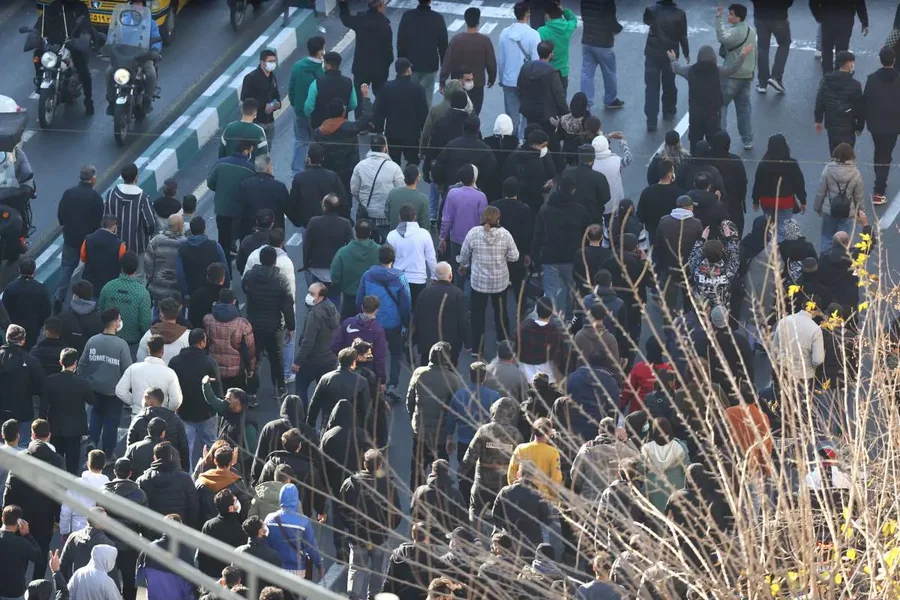
On the fifth day, the authorities have fallen silent. It is an uncomfortable silence, that of the ayatollahs and that of those who await their movements. The Internet in Iran has always seemed like a deadly game. A door that the regime opens and closes whenever it wants, an oxygen tube to freedom that can be pressed with a finger.
Now, however, something shocking, almost unbelievable, is happening: videos generated by artificial intelligence are circulating on social media, chronicling the fall of the theocratic rule. And Tehran, for once, has not turned off the switch. Maybe someone was distracted. Or maybe they understand the trick perfectly: if the future doesn’t exist, there’s no point in censoring it.
Every dictatorship has an invisible crack that corrodes it from within: the loss of its monopoly on imagination. As long as people cannot imagine a consequence, everything remains static.
But if you start to see the end, even in just a three-minute video, reality cracks. The women who burned their veils for Mahsa Amini are not waiting for instructions from a computer program. They are the ones teaching machines what it means to disobey. These videos are a preview of an era that has not yet come. No one knows if it will actually come. The regime could become even more savage, heading straight for the Middle Ages. Or it could find itself tomorrow with a public square on its doorstep, not the simulated one, but the real one, which you cannot stop.
The present is a fire that burns in the silence of university halls, in the eyes of girls, in the fear of fathers who no longer know how to protect their daughters, and in the fury of a country that has stopped kneeling. The images arrive filtered through social media, gathered by voices that risk their lives to be heard.
The Pasdaran raid women's dormitories, take away female students, and load them into unmarked white vans. Every broken door is a sentence that says: The Islamic Republic is afraid. This is not another demonstration against the high cost of living. It is much more. It is a people calling their tyrant by name and demanding his end.
"Death to the dictator" is no longer a clandestine slogan whispered by a few. It is a public cry, a chorus of thousands who do not want to live with their heads bowed. Iran has reached the point where revolts are no longer extinguished by repression.
The beatings, the bullets, the tear gas have lost their power to terrorize. Ayatollah Khamenei has not been seen for weeks. He is 86 years old and the future is slipping from his hands like sand.
Women are at the forefront. As in 2022, as after the death of Mahsa Amini, women are leading the uprising. The videos are a catalogue of courage: girls resisting arrest, young men defending them by surrounding officers, students who do not retreat even when guns arrive. It is the generation that has nothing left to lose. They either live free or not live at all.
All this is happening with closed markets and traders taking to the streets. The rial, sinking to unknown values, says the system is broken. The fraud is also evident in the exchange rates. One dollar is officially worth 42,000 Iranian rials, but in reality it is exchanged for 1.5 million rials.
In early December, it was still 800,000. It’s all fake, absurd. Work isn’t enough to live on. Families that once generated wealth are now scrambling for a way to survive, and when that money crumbles, so is fear. Where does the end begin? This is a revolt without an elite, without a leading party, without any specific heroes. The leadership is collective. The streets spontaneously light up, from the poorest neighborhoods to the largest cities. In Isfahan, Tehran, Yazd, Arak, Hamadan, everywhere the same idea for the future is heard: the overthrow of the Islamic Republic. The words are unmistakable. The forbidden names return: Reza Pahlavi, the prince in exile.
A segment of the population, after 40 years of darkness, sees the monarchy as an alternative. Not because there are saints in the history of power, but because sometimes memory is better than the present. The regime responds as it knows how: lies, accusations against external enemies, the usual conspiracy theory. The United States, Israel, the West, the international press, satellites and demons. It is all their fault. The theocracy never accepts its responsibility for the desert it has created. That is why it pretends to be a dialogue, announces concessions, promises to listen to criticism. In the meantime, it sends armed men to the dormitories.
Double-tongued is the hallmark of a leadership on the brink of war. So let’s go back to that scene that keeps people awake at night. The militia breaking down doors. The screams. The hands grabbing their hair. The terrified faces of young women being dragged away. This is the true face of the regime. It is not an ideological battle. It is a question of basic human rights: the right to the body, the right to the voice, the right to freedom. In Iran, women are second-class citizens by law. The world will have to choose which side it is on.
Not with powers, not with states, but with people, with that girl who refused to cover her hair, with that boy who filmed the raid instead of running away, with the crowd that freed a comrade from the hands of the army, with a generation that wants to breathe.
Sometimes history moves forward in small steps, barefoot and uncovered.




Lini një Përgjigje