


 Shkruar nga Joseph Epstein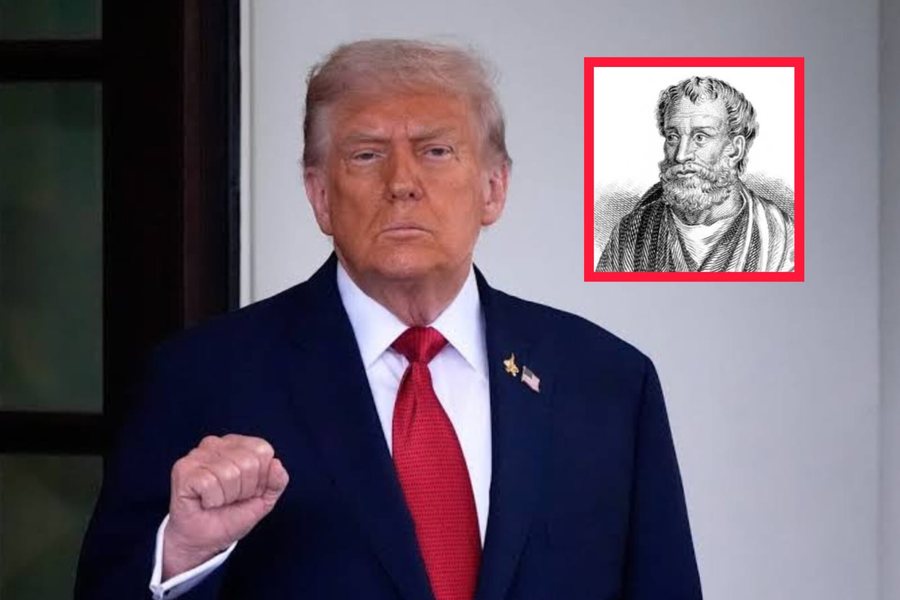
Theophrastus' "Boastful", "Babbler" and "Boring" live in the White House today...
The Greek philosopher Theophrastus (c. 371–287 BC) succeeded Aristotle as head of the philosophical school in Athens, known as the Academy, then the Lyceum. Today he is best known for his essays on moral conduct. Rarely more than two or three pages long, published in English under the title "Characters ", the essays present weaknesses and defects, minor sins rather than major vices.
The essay on “The Braggarts” begins: “ Braggart is the pretense of possessing qualities that you do not actually possess.” The essay on “Boredom” says that “we can define boredom as a person who cannot refrain from talking.” These essays read with particular relevance in the age of Donald Trump.
Among Theophrastus' other essays are; "The Tactless Man", "The Impudent Man", "The Foolish Man", "The Rude Man", "The Ungrateful Man", "The Chatty Man", "The Ugly Man", "The Miserly Man", "The Oligarch" and "The Wicked Man".
The strange aspect of Trump for many of us lies in his ability to downplay his often quite real achievements with persistent flaws in his character. I have heard it said that in private he can be pleasant, even winning. But in public, the president qualifies as Theophrastus' " Pompous Man ," where " pomposity is contempt for everyone but oneself."
Trump can’t even say Biden’s name without sounding like he’s spitting bile, never showing even the slightest bit of sympathy for Joe Biden, in his old age. Half a decade later, Trump continues to insist that the 2020 presidential election was stolen from him. Does he really believe that? Or is he simply imitating the work of Theophrastus’ “ Deceiver ,” who has “ a pretense, whether in word or deed, of making things appear other than they really are . ”
Meanwhile, the men and women who work for Trump are, in his words, " fantastic," "incredible," "wonderful ," until they're no longer so, at which point he fires them. His ideal cabinet member is Theophrastus' " Flattery Man," who engages in " a kind of awkward behavior intended to promote the flatterer's advantage ."
Does Trump’s endless insults to “fake news ” fall into the category of “The Man in Solitude” or “ The Man in Shame”? It’s not easy to determine. But to cover Trump’s case, Theophrastus needed more characters, because the president is also a reputable member of that large group of men (mostly) who overestimate their own charm. He is also without measure or modesty. Has there ever been a president who consistently says he led America to greatness instead of waiting for history to declare it?
Perhaps we should simply associate Trump with the " Unpleasant Man ," who engages in " a type of behavior that is annoying, though it may not be harmful ." The Trump Disorder Syndrome crowd thinks otherwise, preferring to consider Trump dangerous, a dictator, an authoritarian, even a Nazi, detestable in every way. I believe that Theophrastus, with his portraits of many human flaws, comes closer to the truth./ Adapted from "Pamphlet" from "Wall Street Journal"








Fantastike, si komeditë e Goldonit. Tre Amerikat, e Washingtonit, Kenedit dhe Trampit, që për ta përcaktuar duhet shpikur fjala Tramp.