


 Shkruar nga Andrea Mason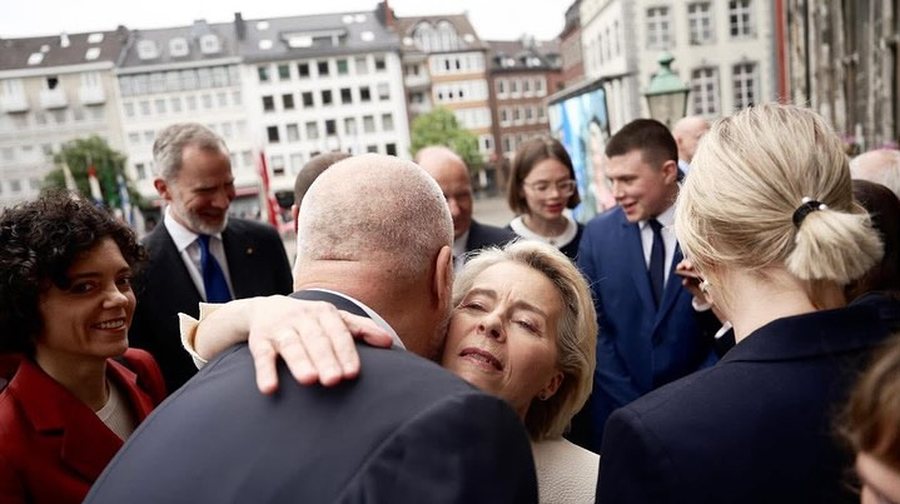
Symbol of European failure receives the Father of Europe award
Today, the city of Aachen – the favorite residence of the creator of the Carolingian Empire and the modern idea of Europe – presented the Charlemagne Prize to none other than Ursula von der Leyen, president of the European Commission and former defense minister of Germany, of which the city itself is a part.
A prize for a united Europe in the name of Charlemagne
In 1949, the city of Aachen established the Charlemagne Prize Foundation to support efforts for European reconciliation and to start from the noble goal of appreciating the lessons of European history to build the Europe of tomorrow – a united Europe, leaving behind the disasters of two world wars and finding a new unity. The ideal was that this would be achieved through the Franco-German axis, from the synergy between two lands that for centuries – from the Thirty Years' War to the Second World War – had been a crossroads of armies and clashes, but which referred to the common heritage of the Frankish king who became emperor.
Charlemagne is the symbol of a united and unifying Europe in the collective narrative. A Frankish, or “barbarian,” emperor who shifted the center of the continent towards his heartland, incorporating the Christian heritage and teachings of Rome, restoring an Empire based on the West three centuries after the fateful year 476 AD, the year of the fall of the Western Roman Empire. The Holy Roman Empire, born on Christmas Eve 800 with the coronation of Charlemagne by Pope Leo III, is considered the first embryo of today’s Europe, and from this continuity arose the ancestors of modern France and Germany. The symbolic weight of this award is, therefore, great, and the winners in history have been extraordinary.
The long tradition of distinguished winners of the “Charlemagne” Prize
Some names? From 1952 to 1954, the three builders of a united Europe won: Alcide De Gasperi, Jean Monnet and Konrad Adenauer. In 1956, Sir Winston Churchill received it, shortly after his last term as British prime minister; in 1982, King Juan Carlos of Spain was honored for restoring democracy to the country; in 1991, Vaclav Havel for restoring democracy to Czechoslovakia.
In the new millennium, Pope John Paul II was honored in 2004, the first pope to receive the prize, followed twelve years later by Pope Francis. In 2005, Italian President Carlo Azeglio Ciampi was honored with this important award, which, in recent years, has become increasingly sensitive to current political dynamics. In 2008 and 2012, Angela Merkel and Wolfgang Schäuble were honored – who, with their strong pro-austerity political push, did everything but unite Europe. In 2018, Emmanuel Macron was honored more for future confidence than for concrete actions, while it is noteworthy that Donald Tusk – now Prime Minister of Poland – received the award in 2010, at the beginning of his governing career, before heading the European Council.
From Merkel onwards, the names mentioned are indistinguishable from past winners, with the exception of Francis himself. It is a logical consequence of an era of decline of the political elite. But it is difficult to imagine von der Leyen below: the Commission president, with the shadows and problems of her mandate, represents the opposite of what this prize should represent.
Ursula, the Misfit
Inadequate in economic policy, late at the beginning of the pandemic in responding to Covid-19, ambivalent in green industrial policies, a staunch Atlanticist and an obstacle to an autonomous European defense, before becoming a supporter of a delayed rearmament through institutional deviations and emergency rhetoric; locked for a year and a half in a deeply pro-Israeli rhetoric on Gaza, with little or no understanding of the Russian-Ukrainian challenge; and, finally, always late in the face of the American challenge of Donald Trump – Mrs. Ursula has been an obstacle to European development.
Her leadership, from 2019 to the present, has been characterized by a decline in the EU's global geopolitical influence, which was also influenced by the controversial choices of associates: we recall Vice President Valdis Dombrovskis, the Latvian "hawk" on budgetary issues who has fanatically defended the logic of austerity; or the disaster of European foreign policy under the leadership of the High Representative for Foreign Policy, former Estonian Prime Minister Kaja Kallas.
We also add the shadows of suspicions like the "Pfizergate" case, which only further damage the European cause in the eyes of its citizens, and we have the portrait of a simply disastrous Commission president from 2019 to today.
If the Europe inspired by Charlemagne should unite and inspire hope, von der Leyen's risks doing the opposite. If the reference to the sovereign of the past should be an element of unification, then Ursula does not embody this idea at all. And, for those who identify with a Europe that conveys high values, the current Commission is by no means the ideal choice. It is difficult to imagine an interpreter further from the dream of the founding fathers of a united Europe than von der Leyen, who dreamed of an Old Continent as a high political, economic, moral and ideological reference for the world. This no longer exists today. And among the culprits is Ursula von der Leyen – to whom this prize seems to give undeserved prestige, given the high level of previous winners. / Adapted “Pamphlet” from “Inside Over”


Lini një Përgjigje