


 Shkruar nga Jamie Dettmer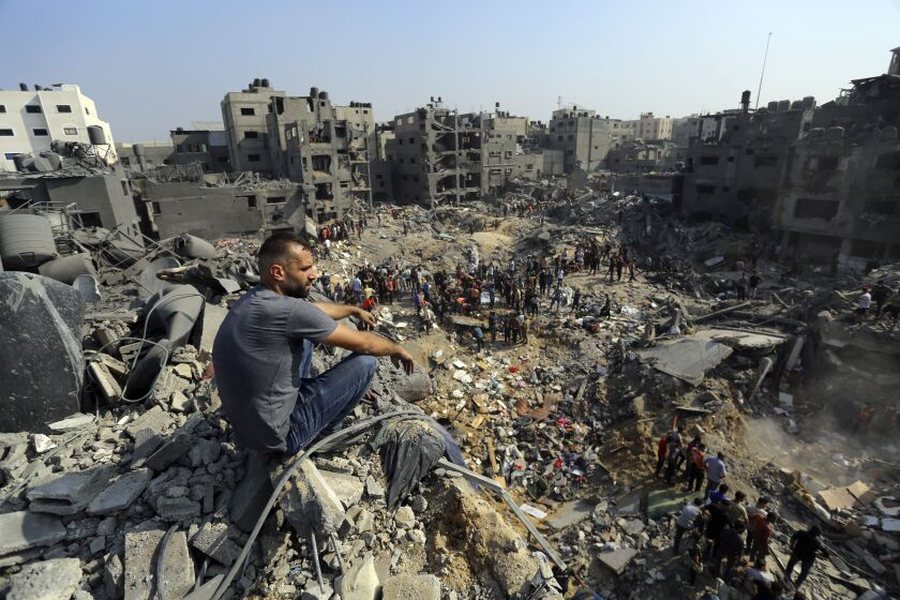
Not all Israelis may be happy with this approach. Most of the old political forces have started conspiring...
Israelis today do not believe that a Jewish state can coexist with a neighboring Palestinian state. They have lost all faith in a possible solution to the conflict through the creation of 2 states. Although even before the attacks of Hamas on October 7 in Southern Israel, they did not have any great illusions in this regard.
Instead, they now want bigger and better fortifications, and greater vigilance after the blunders of the secret and security services that failed to prevent what was clearly a long-planned massacre.
"Now the Israelis have their minds on the war" - pollster Dahlia Scheindlin says for "Politico". She refers to a poll by the Israel Democracy Institute that found 75 percent of Israeli Jews think the country should ignore growing pressure from the United States to end the war in Gaza as soon as possible.
And another Gallup poll showed that 65 percent of them oppose the creation of an independent Palestinian state. Israelis' widening opposition to a possible two-state solution suggests the October 7 attacks by Hamas will tilt the country further to the right, which is generally dominated by West Bank settler ideas.
The latter want Israel as a state to extend to all the biblical lands of the Jews. What we're seeing is consistent with a historical pattern, Scheindlin says. Whenever Israel experiences a major shock, right-wing parties and politicians benefit.
But if elections are held soon, they will not necessarily benefit Prime Minister Benjamin Netanyahu himself or his Likud party. Most Israelis blame the latter for the security failure. They seethe with anger, and want him gone. But with or without him at the helm, Scheindlin says the basic direction of political orientation is unlikely to change.
And it shows that the question of the future of the Palestinians and their national aspirations will continue to be overlooked. Not to talk about a two-state solution. But not all Israelis may be satisfied with this approach. Most of the old political forces have begun to conspire.
They are insisting that they be heard, arguing that ignoring the Palestinian issue will not work, and that the two-state solution is the only way forward.
"Today it is not fashionable to trust the Palestinians, none of them. This is the time when they should be hated. But I say this is nonsense. When I argue with people, I sometimes say: What is the solution? What do you think can be done? Do you think we can continue to control 4.5 million disenfranchised people through an indefinite occupation? Do you think this could work? Of course, they have no answer", says former Israeli Prime Minister Ehud Olmert.
And when asked how Israelis can be convinced to accept the idea of 2 states, Olmert says that this must be accepted by those at the top of the country. "This is an act of leadership and we are missing it now. In my political career, I have learned that reality is sometimes created by the unwavering determination and strong decisions made by leaders. The two-state solution has never been a popular idea with most Israelis. But if it had been implemented, if we had once signed an agreement, the majority would have gone ahead" - he underlines, who thinks that Netanyahu neither wants nor can change his position, as this would mean his political annihilation and his governing coalition.
Like Olmert, Yaakov Peri, the former head of Israel's Shin Bet security agency - known as Shabak - is also a proponent of a two-state solution, as he sees no other realistic alternative. "I have been for a two-state solution since the beginning, that is, since 1993 after the Oslo Accords," he says, referring to the historic agreements that created the Palestinian National Authority (PA) in the West Bank and aimed to settle the Israelis and the Palestinians on the road to a final negotiated settlement.
Peri agrees with Olmert that public skepticism can be overcome. He notes that most Israelis also doubted the Egypt-Israel peace treaty signed by Anwar Sadat and Menachem Begin in 1979. Egyptian and Israeli leaders at the time faced great risks to sign an agreement, which is still in effect today.
"For more than 20 years, Israeli governments have not taken this scenario seriously," says Peri. Dismissing the idea that there are no serious partners for peace even among Palestinian leaders, he mentioned possible moderate successors to 88-year-old Palestinian Authority President Mahmoud Abbas.
At the top of his list is Mohammed Dahlan, the former leader of Fatah in Gaza, who is now a successful businessman in the United Arab Emirates, a close friend and adviser to the president of the United Arab Emirates, Mohammed bin Zayed Al Nahyan. Peri and Dahlan often talk to each other. He even called them while he was speaking to POLITICO.
As the war risks further radicalizing Palestinians - both in Gaza and the West Bank - Peri fears that unless the current dynamic is changed, there is a real risk that Hamas will become too strong in the West Bank at the expense of Fatah.
According to him, the cooperation between the security agencies of the Palestinian Authority and Israel remains good. And right now the PA controls Judea, East Jerusalem, Ramallah and Hebron. "But in the northern part of Samaria, in places like Zhenin, Tukaram and Nablus, the impact is weak," adds Peri, who fears a widespread outbreak of violence in the West Bank.
This scenario also scares Ronen Bar, the current head of Shabak. "We are currently at a crossroads. There are many good people among the Palestinians. If there is a will to negotiate, the Palestinians will find the right people to represent them. But the Israeli right does not think so. Even Netanyahu must maintain this approach to preserve his ruling coalition. He has condemned the Oslo process, stressing that it was all a terrible mistake, and that there is no one to negotiate with for peace from the Palestinian side" - Olmert declares.
Meanwhile, Likud deputy, former Israeli ambassador to the UN, Danny Danon, says that now is not the time to even open this topic. A fierce critic of the Oslo Accords, he told POLITICO: “I'm not just expressing my opinion. After the events of October 7, about 99 percent of Israelis are not in the mood to talk about a 2-state solution." / Adapted "Pamphlet" from "Politico.eu"



Lini një Përgjigje