


 Shkruar nga Matthew Bailey
Insiders fear that further escalation will trigger Iranian retaliation against their vital infrastructure, which could make the Persian Gulf countries unlivable...
The lack of a clear strategy and ignoring warnings from allies are forcing Arab states to reconsider their dependence on American defense. Terrified of a war without an exit plan, regional leaders are looking for alternatives to ensure their survival, leaving Washington increasingly isolated in the conflict with Iran.
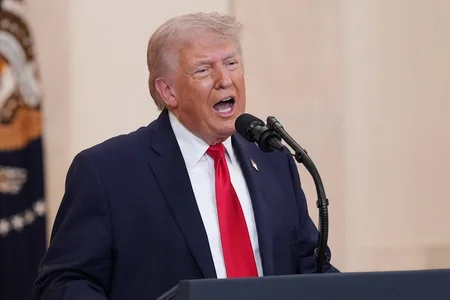
Donald Trump's threats of escalation and lack of a strategy for his war on Iran have "completely terrified" US allies in the Middle East, who fear that he has no real exit plan from this conflict.
Matthew Chance, CNN's chief global affairs correspondent, told The i Paper that sources within the Gulf countries see very few good options left for Trump to end his war.
Insiders fear that further escalation would provoke Iranian retaliation against their vital infrastructure, which could make the Gulf countries unlivable. At the same time, they know that if Trump abruptly ends his war, they could be abandoned in the face of a vengeful and even more belligerent Iran.
Last night, Trump claimed that his “strategic objectives” were on track to be achieved, even as he threatened to bomb Iran “back to the Stone Age,” adding that the conflict could last another 2-3 weeks. While calling on Iran to accept a ceasefire, Trump has sent thousands of troops to the Middle East, raising fears that he is preparing for a ground operation.
Chance, who is currently based in Qatar and has reported on major world conflicts for more than 20 years, says he has spoken to Qatari government officials as well as ordinary people on the street.
A spokesman for Qatar's Foreign Ministry told the reporter that "the government is absolutely opposed to a US troop landing in Iran ." Chance said the possibility of escalation "utterly terrifies" Qatar, a stance he said was shared by many Gulf states.
Further escalation would be existentially dangerous for the economy of a country like Qatar. “If it doesn’t resume oil and gas exports soon, it will find itself in a dire economic position. That’s because it’s losing billions of dollars a day ,” Chance points out.
Qatar wants to return to business as usual, even if it means confronting an unstable Iran that controls the Strait of Hormuz, through which a fifth of the world's oil and gas passes.
However, the CNN correspondent notes that there are different opinions on the war within the Gulf. “The Gulf states do not necessarily speak with one voice, especially on the issue of Iran. There are countries like Saudi Arabia, Bahrain and the United Arab Emirates, which are much stricter in their stance on Iran than countries like Qatar and Oman, which take a softer stance ,” he says.
According to Chance, some Gulf states have expressed to Washington the view that " once you've started doing this to Iran, it's best not to leave them in a position where they can do it again ."
However, Trump remains a very unpredictable character. Given how he has acted in two terms as US president, he could change his mind tomorrow, end this war, and leave the region. Chance thinks everyone is realizing that if this war were to end tomorrow, it would leave behind a high degree of chaos.
"We will be left with a belligerent Iran, which probably still has some kind of nuclear program, ballistic missiles and which now also controls the Strait of Hormuz, one of the most important waterways in the world. This is a much worse strategic position than before the war began and could potentially be a strategic failure for the Trump administration ," the journalist underlines.
However, he argued that in some ways, this is the best-case scenario, because the alternative is for this war to escalate. Meanwhile, Chance raised questions about what the presence of US ground forces would achieve if they were used to take targets like Kharg Island, a seaport responsible for exporting up to 90 percent of Iran's oil products.
This would put American troops at great risk, and there are other ways to stop Iran from selling oil. While the government in Doha is trying hard to find a diplomatic solution, the people of Qatar are angry about the war. Chance says that the people he has spoken to are very critical of this war. They call it “Benjamin Netanyahu’s war” and say that the US president was persuaded by the Israeli prime minister to undertake this military adventure because it served him and no one else.
Trump's decision to go to war against the will of the Gulf is prompting a review of those nations' relations with the United States. Chance says that despite the presence of large American military bases in Qatar, this has not protected the country from Iranian attacks, but has instead made it a target.
The journalist adds that relations have been strained somewhat by the fact that, despite their warnings, President Trump went ahead with his plans and essentially ignored them. Since then, they have been trying to convince Trump to stay away from attacks on energy infrastructure and desalination plants in Iran, fearing that the Islamic Republic could do the same to Qatar.
He claimed that this would cause a “humanitarian crisis” in Qatar and make it unlivable, something that was not fully appreciated by Washington. This crisis poses an existential threat to the Gulf Arab states.
"These countries are closely watching their military relations with the US and wondering if this is the right structure for the future. No one is going to walk away from an alliance with America, but they could diversify their agreements as a kind of insurance," the CNN correspondent points out.
According to Chance, Trump no longer has any good options for winning the war. He can either escalate the situation by deploying thousands of American troops, or he can make concessions, walk away, and declare victory, but leave Iran strategically more powerful than before the war.
“ It’s a terrible choice, because there’s no good outcome that comes from either of these paths ,” Chance says, adding that this is partly because he went into this fight without a clear idea of what he wanted to achieve.
As the war continues, the conflict has thrown global markets into chaos. “We are only at the beginning of this energy supply crisis, and there is already a major shock in Asia. If this crisis is not addressed soon, we will certainly be heading towards a global economic recession,” concludes Matthew Chance./ Adapted from “The i Paper”


Lini një Përgjigje