


 Shkruar nga Pamfleti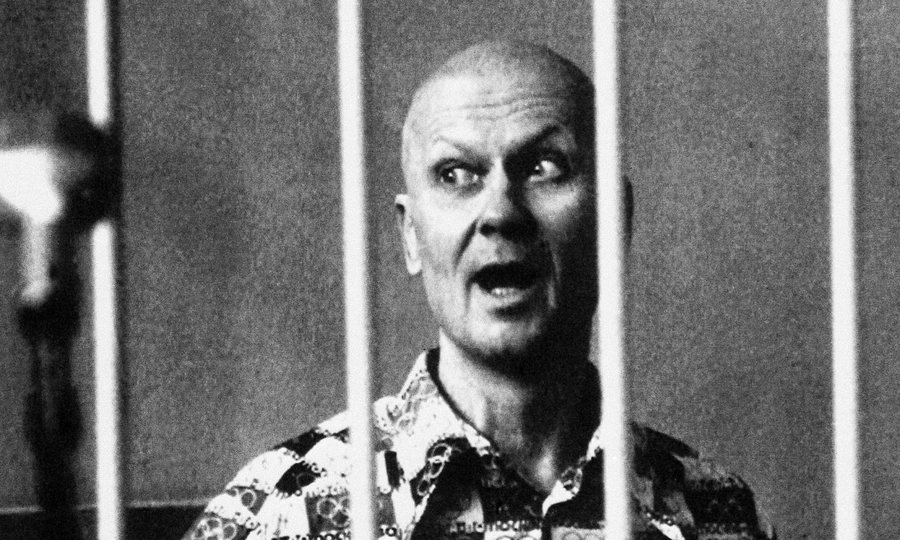
Andrei Chikatilo was described as one of the world's worst serial killers.
A simple man, a teacher by profession, who for years hid a life of extreme violence, luring men, women and children through deception before subjecting them to cruel acts.
His story resonates as a warning in the collective memory of post-Soviet Russia. According to the New York Times, this serial killer murdered more than 56 people between the harshest years of Stalinism and the collapse of the Soviet Union, exposing the cracks in a system that preferred to deny rather than investigate.
Andrei Chikatilo, a former teacher who was convicted in Rostov for the murder of girls, boys and women, on October 15, 1992. He is listed as the world's worst serial killer. Chikatilo dismembered women and children and ate some of their remains.
It was December 1978, and in the town of Shajti, a 9-year-old girl accepted candy, unaware that she was facing her killer. This crime marked the beginning of a nightmare that would last for more than a decade.
According to the New York Times, Andrei Romanovich Chikatilo was born in 1936 in a Ukraine devastated by Joseph Stalin's agrarian policies, which led to mass famine. The episode left deep scars on millions of Soviet families and, according to The Spectator, had a profound impact on Chikatilo's psyche. As a child, he constantly heard stories of his older brother's murder and alleged cannibalism from desperate neighbors.
His childhood was marked by hunger and death. World War II compounded the family tragedy: his father was captured by the Nazis, an embarrassing event for the Soviet regime, which further marginalized the family. The hardships and traumas he experienced shaped a tortured personality, as the New York Times reports.
As a teenager, Chikatilo suffered from social isolation due to shyness, severe myopia, and constant bedwetting until the age of twelve. These factors made him the object of ridicule. His first sexual experience was traumatic and marked by impotence, which was later linked by forensic psychiatrists to repressed impulses of anger and frustration.
He managed to graduate as a teacher, although he was considered a mediocre teacher. He soon accumulated accusations of sexual misconduct towards his students, which led to constant transfers and eventually his dismissal. He ended up working in a factory, where his administrative role and flexible hours allowed him to move freely between train stations, bus terminals and forest areas, arrangements he would use to commit his crimes.
During 1982, he was accused of seven murders; by 1984, the number had increased to 13. The victims were mainly minors, teenagers, single women, and people in vulnerable situations, such as orphanage residents, alcoholics, or sex workers.
He used deception to lure them: he offered them food, money or train tickets. Once he reached isolated areas, he committed crimes with an extreme degree of sadism: stabbings, mutilations and, in some cases, cannibalism.
Some victims were found with their eyes gouged out, as Chikatilo believed that the eyes retained the image of the killer.
Meanwhile, society was in turmoil. State security mechanisms were ineffective and the communist regime tried to erase all evidence: accepting the existence of a serial killer contradicted the official narrative of absolute order.
"The Butcher of Rostov"
The local press finally broke its silence on the news. After censorship was bypassed, the nickname "Butcher of Rostov", with which the media christened the serial killer, began to circulate widely. The authorities, under pressure from public opinion, launched Operation Lesopolosa, led by detective Viktor Burakov.
Up to 25,000 suspects were investigated, but the investigation was fraught with errors. An error in the blood type allowed Chikatilo to evade justice for years, even though the evidence against him was considerable. Impunity was maintained under the cover of secrecy and official repression.
As the rumors grew, Chikatilo continued to move freely. He always carried his bag, filled with knives and ropes. His nondescript appearance allowed him to go unnoticed, even by children, who saw him as a harmless neighbor.
Arrest and confession
He was arrested in 1990, after more than a decade of murders. He initially refused to confess, but psychiatrist Aleksandr Bukhanovsky, who had worked with him in the past, managed to extract his testimony. Chikatilo admitted to committing 56 murders.
Despite the overwhelming amount of evidence, the court considered each case individually. The sentence was handed down in February 1994: the death penalty.
According to the Daily Mail, the execution took place in the basement of the Novocherkassk prison, where he was shot in the back of the head. /Adapted from Pamphlet/







Lini një Përgjigje