


 Shkruar nga Gjergj Zefi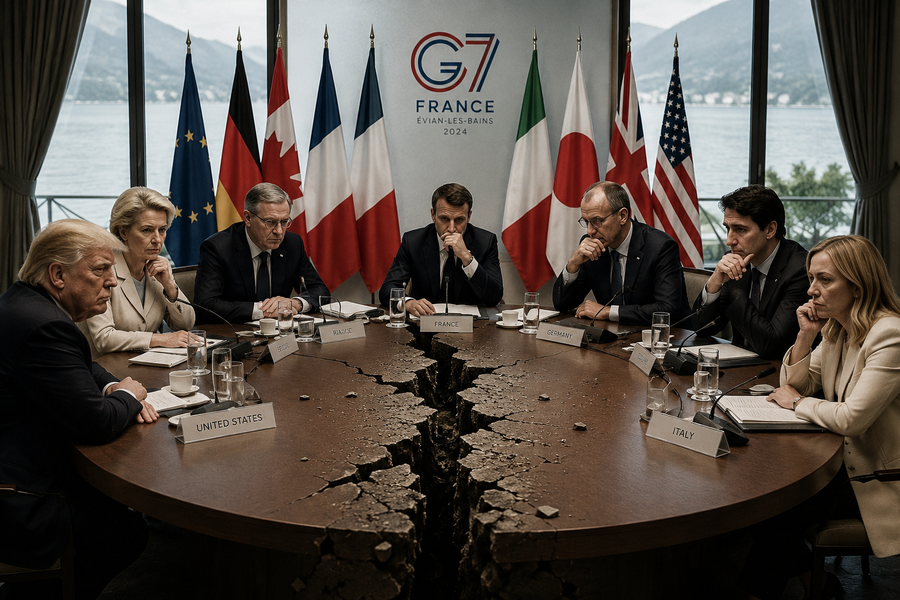
The G7 summit was not just about Donald Trump and European leaders clashing. The crisis of trust that is dividing the West into two camps and questioning the international order built after World War II was clearly on display...
In international politics, there are moments when diplomats talk about wars, economics, weapons, and alliances, but in reality their concern is something much simpler and much more dangerous: trust.
The G7 summit in France is taking place precisely under the shadow of distrust. Not because the West has lost power. Not because it has lost wealth. Not because it lacks weapons or technology. But because for the first time since World War II, the Western world's main allies are no longer confident in each other.
Donald Trump arrived in France not as the undisputed leader of the Western camp, but as a man who has called into question almost every premise on which that camp was built. For decades, the United States guaranteed European security, supported free trade, built international institutions, and imposed the idea that American and European interests were fundamentally aligned. Trump is tearing down this doctrine stone by stone.
For the American president, alliances are no longer communities of values, but contracts of interest. NATO is no longer a strategic family, but a bill that must be paid. Relations with Europe are no longer a historical obligation, but a balance of gains and losses. In his logic, each partner must constantly prove that it deserves American support.
This approach has not only shaken Brussels. It has shaken the very psychological foundations of the West. Emmanuel Macron, Friedrich Merz and Keir Starmer are not afraid that Trump might lose a negotiation or make the wrong decision. They are afraid that America may no longer be the America they knew. They are afraid that the strategic guarantee on which Europe built its security for eighty years may have become an instrument of political pressure.
That is why Ukraine is at the center of the tension. For Europeans, the war against Russia is an existential test. For Trump, it is a conflict that must be ended at all costs, even if this requires compromises that Europe considers unacceptable. The two sides of the Atlantic are no longer arguing about tactics. They are arguing about the very meaning of victory.
The same thing is happening with Iran. Washington negotiates according to the logic of a quick deal. Europe wants longer processes, more guarantees, and more coordination. Americans want results. Europeans want stability. The gap is not technical. It is philosophical.
In the background lies a truth that many European leaders dare not articulate publicly. They are no longer afraid only of Vladimir Putin, Xi Jinping or the Iranian leaders. They have begun to fear the strategic uncertainty that comes from Washington itself. This is why there is increasing talk in European capitals about strategic autonomy, independent defense industries and military capabilities that are not completely dependent on the United States.
This is not an ordinary diplomatic crisis. Diplomatic crises are resolved by declarations, summits, and compromise. This is a crisis of confidence. And history shows that when alliances lose confidence in themselves, military and economic power are not enough to hold them together.
Évian is not just deciding the fate of Ukraine, Iran, or trade tariffs. Something more fundamental is being tested. It is testing whether the West continues to exist as a political community with common interests or whether it is turning into a group of states that share the same history but no longer the same vision for the future.
This is the great paradox of our time. As Russia, China, and other rival powers challenge the international order, the most serious threat to the West's cohesion is not coming from outside. It is arising from mutual suspicion among allies themselves. And when allies begin to doubt each other, history rarely produces peaceful endings./ Pamphlet


Lini një Përgjigje