


 Shkruar nga Pamfleti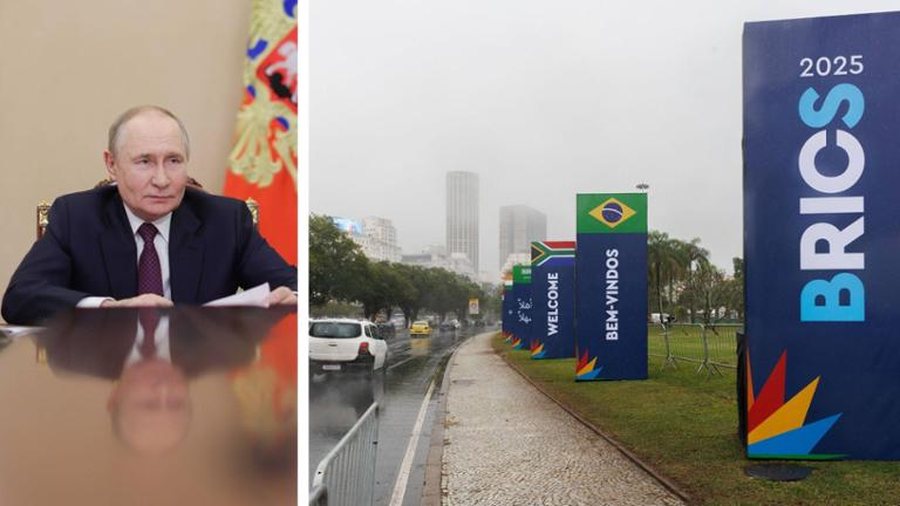
Putin will not be attending because Brazil would have to arrest him. With Xi Jinping's withdrawal, the BRICS summit is almost completely leadershipless...
The BRICS summit in Brazil (August 22-24), considered a prestigious platform for global cooperation between the South, has been overshadowed by the absence of two key players: Russian President Vladimir Putin and Chinese President Xi Jinping. Both will stay away from the conference, a sign of growing tensions within the alliance and a possible erosion of its global importance.
Putin will take part in the conference only via technology. According to Reuters, the Kremlin cites as a reason "certain difficulties related to the requests of the International Criminal Court". The reason is the arrest warrant issued by the International Criminal Court (ICC), which is seeking Putin for alleged war crimes in Ukraine, specifically, the abduction of Ukrainian children.
As a member state of the ICC, Brazil would be obligated to arrest Putin upon entry. This uncertainty prompted the Kremlin to cancel a visit to the South African summit in 2023.
The Brazilian government was unable to guarantee Putin's safety. An open refusal to execute the arrest warrant would have plunged Brazil into a diplomatic rift with the West. Kremlin adviser Yuri Ushakov, commenting, said that "the Brazilian government was unable to take a clear position that would allow our president to attend the scene."
Therefore, Russia will be represented at the summit by Foreign Minister Sergei Lavrov, a diplomatic step backward for Moscow, which traditionally presents BRICS as a counterweight to the Western-dominated world order, notes The Moscow Times.
Xi Jinping also stands aloof, a symbol of China's distance from BRICS.
China's Xi Jinping, a regular participant in BRICS meetings for 12 years, will also not travel to Rio.
Officially, a "scheduling conflict" is cited, but in reality, Xi is only sending Premier Li Qiang, writes The Guardian.
Observers, as analyzed by The Telegraph, interpret this as a strategic stance to avoid the risk of open tensions with the US, especially after US President Donald Trump's clear threats to impose 100 percent tariffs on BRICS countries in the event of an anti-dollarizing currency alternative.
Brazilian President Lula da Silva sought to reposition BRICS as a reform alliance of the Global South. However, the absence of two major powers, Russia and China, casts a shadow over this plan. Brazil wanted to score points on issues such as global governance, green transformation and cooperation on vaccines, without the geopolitical polarization presented by Moscow or Beijing.
BRICS countries: many members, no common goal?
BRICS is an alliance of emerging economies founded in 2006 by Brazil, Russia, India, and China. South Africa joined in 2010, hence "BRIC" became the current name "BRICS". The alliance's goal is to challenge Western-dominated institutions, such as the IMF and the World Bank, and promote a multipolar world order.
Starting in 2024, BRICS experienced a significant expansion: Egypt, Ethiopia, Iran, the United Arab Emirates, and in 2025, Indonesia joined as new full members. BRICS now includes 10 states with approximately 3.9 billion people, almost half of the world's population, and a combined economic output of almost $29 trillion. Despite this, BRICS remains a loose and informal alliance without a defined charter. The interests of its members are often heterogeneous, they are united above all in their rejection of Western dominance.
BRICS meeting in Brazil: a fragmented bloc in crisis
With its expansion to 10 members, including Iran, Egypt and Saudi Arabia, the group’s political diversity has grown enormously. Internal disagreements are clearly visible: Iran wants BRICS support after Israeli-American air strikes, but the alliance has only reached a general declaration, notes the New York Times. The consensus has collapsed due to divergent national interests.
The BRICS countries are also under pressure at home. According to observers, Xi Jinping is again carrying out internal party purges; Admiral Miao Hua was recently dismissed from office, according to The Hill . And in Brazil, Lula is facing a sharp decline in the polls, according to current figures, his support is only 28 percent.
The arrest warrant as a diplomatic burden and Putin's international isolation
Putin's absence from Rio is not just a legal problem, but a symbolic blow to his international legitimacy. The International Criminal Court accuses him of being "instrumental in the abduction of Ukrainian children," a crime that could potentially amount to genocide, the Atlantic Council think tank explains on its website.
While Putin was still being courted in Mongolia last year, Brazil failed to heed the request of the International Court of Justice. Human rights organizations, such as Human Rights Watch, publicly called on the Brazilian judiciary to execute an arrest warrant if Putin entered the country.
Remote participation via video is not just a diplomatic tool, but an expression of international condemnation and a reminder to other autocrats that international prosecution can have political impact.
BRICS, a toothless alliance?
Although BRICS still accounts for about 40 percent of the global economy, the alliance is in danger of turning into a debating club. The attempt to break the hegemony of the US dollar with its own currency has effectively failed, and even Moscow and New Delhi have now openly denied such plans, writes The Telegraph . The alliance's "New Development Bank" also remains a lightweight bank compared to Western institutions such as the IMF or the World Bank.
Given the growing internal rivalries, for example, between India and China or Saudi Arabia and Iran, the vision of a unified geopolitical bloc seems distant. Analyst Oliver Stuenkel writes in the New York Times that “there is no consensus at all on Iran.”
The BRICS summit in Rio in 2025 was supposed to be a landmark moment for the realignment of the Global South. Instead, it may mark the beginning of a downward trend. Putin’s symbolic absence for fear of arrest and Xi’s demonstrative restraint are weakening the alliance at its foundations. What was intended as a new beginning may be a tale of failure. A summit missing key figures can hardly claim to reshape the world order. / Adapt Pamphlet/





Lini një Përgjigje