


 Shkruar nga Pamfleti
Trade, technology, Taiwan and now Tehran...
This is a crucial trip for Donald Trump, a pre-ordained moment to reorient the superpower struggle. If Beijing's meeting with Xi is a barometer of the state of relations, the key metrics are trade, technology and Taiwan, a recognized territory. This time, add another 'T', for Tehran.
The US-Israeli attack on Iran caused the first postponement of this trip, and it still casts a shadow. The US has asked China to intervene with its friends in Tehran to encourage them to reopen the Strait of Hormuz.
It wasn’t a problem before this meeting was carefully scheduled, and the impasse has exposed the limits of American power and influence. Trump is reaching out to Xi to pull him out of the quicksand. Asking an adversary for a favor before they sit down undermines him and changes the power dynamic.
In the eyes of the Chinese, the US president has been weakened by a mess of his own making. Beijing will be keen to help with a solution, but at what cost to Trump in political capital?
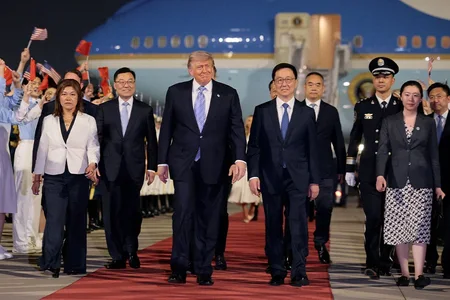
It is the context in which Trump will face Xi Jinping inside the Great Hall of the People in Beijing.
The Taiwan issue
It's not the only issue being discussed, there's also the question of China's shadowy influence over Taiwan. Trump has stuck to the stance of his predecessors in declaring "strategic uncertainty" about Beijing's territorial ambitions.
However, his language has been looser, even vague, on whether the US would come to Taiwan's defense if China attacked. There are suggestions that Xi may encourage Trump to change America's traditional stance of "not supporting" independence to "against" it.
It would be a subtle but significant shift that would reset the starting point for future discussions. US officials insist there has been no change in US policy on the island, but Trump has been erratic in his policy toward China generally. Taiwan will worry that a president who makes policy based on instinct and self-interest might make concessions or appease Chinese ambitions.
Rebalancing relationships
Trump began his second term promising to attack China economically, but time and experience changed that.
He put Beijing at the heart of his tariff policy, but Chinese counter-threats to limit exports of rare earth minerals forced him to back down. The White House is presenting the visit as a rebalancing of relations to restore US economic independence.
There is talk of Joint Trade and Investment Boards and agreements on agriculture, aerospace and energy. It is a structure to contain Beijing, a structure that is not inherently confrontational. In an attempt to win the trade war, Trump is trying to find peace./ Adapted from "Pamphlet" by "SkyNews"




Lini një Përgjigje