


 Shkruar nga Pamfleti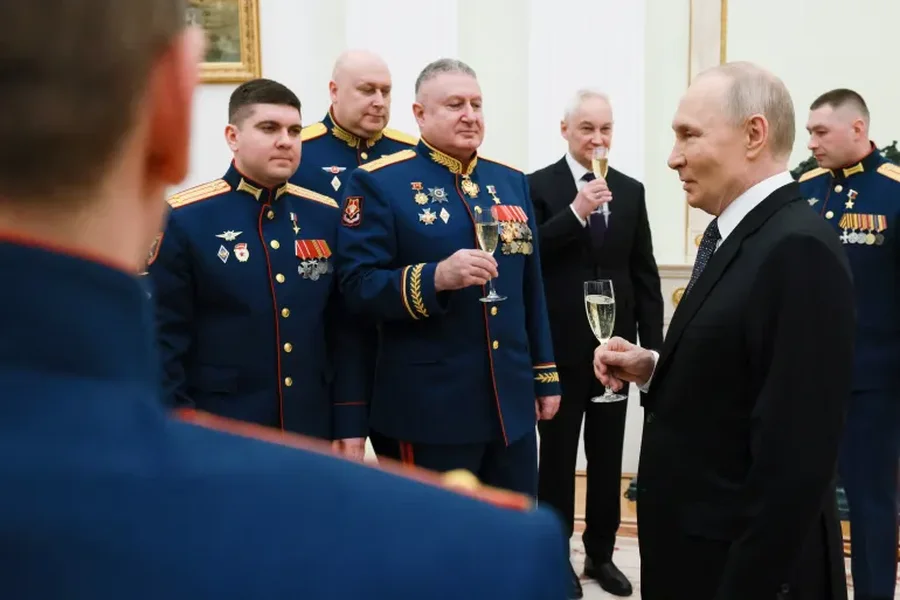
As the all-out war in Ukraine enters its fifth year, Russian political elites remain convinced that their leader, Vladimir Putin, did not make a grave mistake when he launched it in February 2022. On the contrary, they view the conflict with a sense of achievement and believe that the war is ending on Russia's terms, perhaps even soon.
A striking feature of this conflict is the discrepancy between Russia's real expectations and the way they are interpreted by the media and the expert community in the West. The latter tend to describe Russia's motives as an expression of internal imperialism and an attempt to reassert control over half of Europe, as in Soviet times.
According to this alternative interpretation, Russian motives are more ad hoc and pragmatic. Essentially, they focus on establishing a clear red line against NATO expansion towards Russia's borders, a process that, according to Moscow, aimed at its isolation and containment, rather than eventual integration.
Another important factor is that the more hardline and security-oriented elements within Putin’s regime have benefited from the West’s open hostility towards Russia. The symbiosis between these security elites and hardline Western lobbyists linked to the military-industrial complex is described as a mutually beneficial collaboration in power and finance. In the Russian case, the full-scale conflict in Ukraine – which most Russians see as a proxy war with NATO – enabled the security elites to eliminate the liberal pro-Western opposition that threatened their political hegemony.
Putin's decision is also related to developments in 2019-2021, when newly elected Ukrainian President Volodymyr Zelensky sought rapprochement with Russia, which brought about a partial ceasefire along the front line in Donbas, where a low-intensity conflict had been ongoing since 2014.
Zelensky faced intense pressure from Ukraine's security elites and declared that he was facing a coup threat for what was called a "capitulation." Meanwhile, hard-line circles in the West encouraged him by arguing that Russia could be defeated militarily, especially after Azerbaijan's victory over Armenia in late 2020.
In January 2021, Zelensky changed course, moving from a conciliatory approach to a tougher line towards Russia, hitting out at Putin's allies in Ukraine and pushing hard for NATO membership as well as against the Nord Stream 2 gas pipeline project. This change coincided with the inauguration of US President Joe Biden.
In March 2021, Putin began massing troops on the border with Ukraine, but it took another 11 months of tensions before a full-scale invasion began. During this period, Ukraine's Western partners seemed more willing to challenge Russia than to avoid escalation.
When the invasion began, the Russian plan resembled the intervention in Georgia in 2008: a quick operation to create existential pressure on the leadership in Kiev and force Ukraine to accept a more unfavorable version of the 2015 Minsk agreements, which were not fully implemented.
The plan to avoid a protracted war failed, perhaps due to an underestimation of Ukrainian resistance and rapid military assistance from the West. However, Russia managed to create a land corridor between its territory and Crimea, annexed in 2014.
After the failure of the Istanbul talks, which, according to some international sources, were undermined by Anglo-American interference, Russia reorganized its forces, abandoned hard-to-hold areas, and launched a long war of attrition in the Donbas. It also officially annexed four partially occupied regions of Ukraine.
According to this assessment, neither the Russian economy nor the Russian military collapsed. On the contrary, Russia experienced economic growth in the first two years of the war, and the ruble emerged as one of the best-performing currencies in 2025. The Russian military withstood the Ukrainian counteroffensive of 2023 and then resumed a slow advance, aiming to break Kiev's will rather than conquer vast territories. The conflict also turned into a technological war, in which drones took a central role.
In the fifth year of the war, Ukraine appears devastated, with a declining population and weakened demographic and economic prospects, while Russian society continues to live in relatively stable conditions. The Russian death toll, estimated by BBC/Mediazona at between 200,000 and 219,000 dead, is considered high, but affects mainly the poorest classes and peripheral regions.
Sensing an advantage, Putin expects Ukrainian and European leaders to accept the reality on the ground and find excuses for possible failure. According to this analysis, delays in reaching a peace agreement will continue to have high costs for Ukraine in human lives, territory and infrastructure, while prolonging the war could change public perceptions even towards Western supporters of its continuation. / Al Jazeera



Lini një Përgjigje