


 Shkruar nga Pamfleti
He repeated the standard presidential warnings that Iran should never be allowed to have a nuclear bomb...
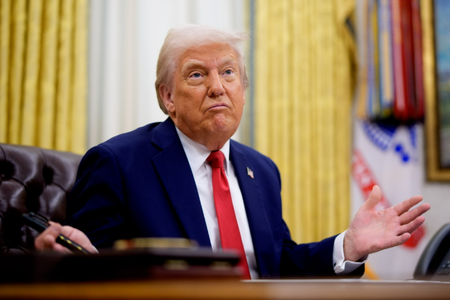
Donald Trump might never have been president if it weren't for a backlash to the Iraq War that destroyed trust in establishment leaders. So it's ironic that he may be emulating some of the rhetorical positions and strategic errors that led President George W. Bush to disaster in the Middle East after 2003.
Trump has reportedly not yet decided whether to attack Iran. But his massive buildup of naval and air power in the region is the largest since the invasion of Iraq that toppled President Saddam Hussein. It could provide leverage to force Iran to back down in crisis talks that resume in Geneva on Thursday. But, absent a major diplomatic breakthrough, ordering such a force to retreat home without firing a shot would damage Trump's prestige.
The Trump administration was founded on the MAGA movement’s allergy to foreign swamps. That may explain why it has presented few coherent arguments for a war it is threatening to wage. But the downside of this approach is that while the U.S. military may be prepared for war, the public is not. Before invading Iraq, Bush spent months arguing for war, albeit a war based on faulty intelligence and false premises. The Trump administration has offered only vague and confusing justifications. Trump offered a little more clarity in his State of the Union address Tuesday night, though that may have come at the cost of backing himself further into a corner.
He repeated the standard presidential warnings that Iran should never be allowed to have a nuclear bomb. In his case, however, this raised doubts about his motives and honesty, as he claimed to have “disappeared” Tehran’s nuclear program last year. Trump also highlighted the hundreds of American deaths in fighting in Iraq caused by Iranian-backed proxies. He lamented the recent brutal crackdown on Iranian protesters that may have killed thousands of civilians.
But the historical echoes were strongest when he addressed Iran's ballistic missiles. " They have already developed missiles that can threaten Europe and our bases overseas, and they are working to build missiles that will soon reach the United States of America ," Trump said.
He may be exaggerating Iran's capabilities. But by citing threats to the homeland, he followed a controversial path taken by the Bush administration and the government of British Prime Minister Tony Blair to justify the Iraq War. Secretary of State Marco Rubio offered a similar warning on Wednesday.
“You’ve seen them increase the range of the missiles they have now, and it’s clear that they’re on the path to one day being able to develop weapons that can reach the continental United States. They already have weapons that can reach most of Europe right now. And the ranges continue to increase exponentially every year, which is amazing to me ,” Rubio said.
This all sounds familiar.
In Cincinnati in 2002, Bush said that American civilians in Saudi Arabia, Israel, Turkey and other countries were at risk from Iraqi missiles. He even claimed that Iraq was exploring ways to use drones that could deliver chemical and biological agents on "missions targeting the United States." That same year, Vice President Dick Cheney warned in Nashville that Iraq was threatening U.S. allies in the Middle East with missiles and was seeking "the full range" of delivery systems that could eventually "subject the United States or any other nation to nuclear blackmail."
Fear of missiles is not the only reason for nostalgia for the Iraq War. One of the Bush administration's worst failures was its gross negligence in planning for the aftermath of a war that led to sectarian division and an insurgency.
Iran may be considered a more powerful state than Iraq. But Trump has not yet agreed with Americans about what might happen if any American military action topples the Iranian clerical regime.
In a new profile on Wednesday, CNN reported that Gen. Dan Caine, the chairman of the Joint Chiefs of Staff, is unable to predict the outcome of regime change in Tehran. And sources told CNN earlier this month that the U.S. intelligence community believes the most likely candidate to fill a leadership void would be the hardline Islamic Revolutionary Guard Corps. So toppling the theocrats in Tehran could lead to an equally radical anti-American replacement that would not measurably improve U.S. or regional security.
The Trump administration has a history of regime change after the ouster of Venezuelan leader Nicolás Maduro earlier this year. But the chances of it finding an Iranian equivalent of Venezuela’s incumbent President Delcy Rodríguez to force her to act in Washington’s interests are slim. American foreign policy has often failed because of miscalculations about how adversaries will behave. Washington’s logic often crumbles in the hot, dusty air of the Middle East. The current administration seems to be plagued by similar misunderstandings, despite Trump’s warning to Saudi Arabia last year that “Iraq War-era meddlers were meddling in complex societies they didn’t even understand.”
This month, US envoy Steve Witkoff said the president couldn't understand why Iran hadn't caved to his pressure. " He's curious why they haven't... I don't want to use the word 'capitulated,' but why they haven't capitulated . Why, under this pressure, with the amount of naval and sea power there, why haven't they come to us and say, 'We state that we don't want weapons, so here's what we're prepared to do, '" Witkoff told Fox News.
Here's one possible reason. Iran has seen the brutal fall of dictators who didn't have weapons of mass destruction, like Libya's Moammar Gadhafi. It's hardly surprising that he would want to keep weapons to ensure the regime's survival.
Arrogance is a danger now, just as it was in 2003.
The Iraq War was expected to be a “shocking and awe-inspiring” affair, and American troops were expected to be welcomed as liberators. More than 20 years later, Trump indicated he expects an easy victory in Iran, after dismissing reports that Caine was emphasizing the complexity of any war. “If a decision is made to go against Iran militarily, he thinks it will be an easy win,” Trump wrote on Truth Social on Monday./ CNN




Lini një Përgjigje