


 Shkruar nga Pamfleti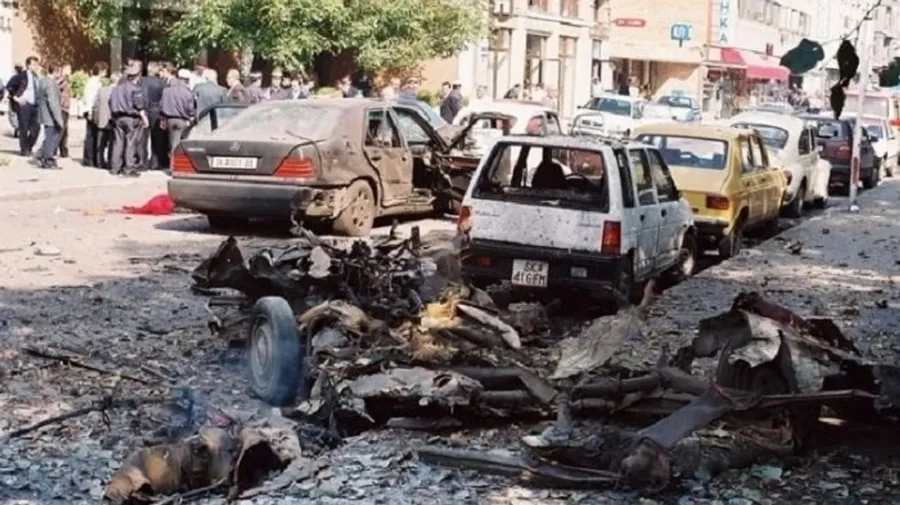
Declassified CIA documents bring to light the assassination of the Macedonian president in 1995 and US intelligence analyses of the possible perpetrators, the risks of ethnic destabilization and the impact on the geopolitical balance of the region...
Declassified CIA documents bring the 1995 assassination of Kiro Gligorov back into the spotlight, shedding light on the assessments that American intelligence made at the time about the possible perpetrators, the fears of ethnic destabilization, and the consequences that the event could have for the geopolitical balance in the Balkans. Thirty years later, the same material has taken on new political significance, as it is being used again in the public debate in North Macedonia.
The assassination of the then President of the Republic of Macedonia, Kiro Gligorov, in October 1995 remains one of the most dramatic and controversial episodes in the post-Yugoslav history of the Balkans. Declassified CIA documents, published in the agency’s online archive, bring back into focus not only the attack, but also how American intelligence services perceived the scale of the risks to the stability of the country and the wider region at the time.
In a document titled “Implications of the Gligorov Assassination Attempt,” dated October 3, 1995, the CIA notes that Kiro Gligorov was taken to a state hospital in Skopje after the attack with severe wounds to the head, face, and right eye area. American assessments indicated that he had just recovered from surgery to remove fragments left by the explosion and that, although his vital signs were stable, his condition remained extremely serious. The recovery period could last from several weeks to several months. The same document noted that the damage was located in the frontal lobe of the brain, leaving open the possibility of a long rehabilitation and an uncertain full recovery.
The most important element of the declassified material lies not only in the medical description of the attack, but mainly in the first analytical assessments of the possible perpetrators. The CIA identified as the most likely scenario the involvement of two members of a small radical nationalist group affiliated with the Macedonian Internal Revolutionary Organization, the Democratic Party for Macedonian National Unity (VMRO-DPMNE). The document also states that VMRO-DPMNE had publicly condemned the attack and had canceled a planned demonstration against the then agreement between Skopje and Greece. At the same time, it was estimated that a breakaway group of about 20 to 30 people could have used tactics similar to terrorism. This formulation is significant, since the text does not attribute direct responsibility to the party as a whole, but presents as the most likely scenario the action of a small radical faction.
However, American intelligence services also considered other possible scenarios, the ibnaeu article states .
The document mentions as less likely suspects extremist groups from the Albanian community in the country, radical pro-Serb circles, Islamic organizations and even individuals within the state apparatus. This assessment was based on the fact that at that time there were several sources of dissatisfaction with Kiro Gligorov. However, the document clearly states that there was no documented evidence of the direct involvement of any of these actors. In the case of the Albanian community in particular, it was assessed that the majority supported pursuing its demands through institutional channels.
The historical context is crucial to understanding the situation. The attack occurred at a time when the country was struggling to maintain a delicate balance between internal cohesion, the pressures of the post-Yugoslav environment, and the difficult implementation of the interim agreement with Greece. The CIA assessed that if Kiro Gligorov were unable to return to office quickly or if he died, the country could enter a period of increased political instability. Such a development would risk slowing down the implementation of the agreement between Greece and Macedonia and could at the same time reignite tensions with the Albanian community.
In the same context, the document emphasized that according to the country's Constitution, the duties of the president would temporarily pass to the speaker of parliament, Stojan Andov. American diplomats described him as the natural successor, but also as a more nationalist politician than Kiro Gligorov, especially in matters related to relations with the Albanian community. This assessment shows that the CIA's concerns were not limited to identifying the perpetrators of the attack on the president, but also extended to how a possible political transition could affect internal ethnic balances and regional diplomatic relations.
The document also pays attention to the international military presence in the country. The CIA warned that the forces of the United Nations Preventive Deployment Mission (UNPREDEP), which included 556 American troops and 553 soldiers from Finland, Norway, Sweden and Denmark, as well as additional UN personnel, could face increased risks. This risk could increase especially if the attack were to cause ethnic unrest or if it were ultimately linked to pro-Serb circles. This assessment shows that American analysis closely linked Kiro Gligorov’s fate to the broader security architecture in the southern Balkans.
However, the document's significance today is not only historical. According to a report by the media outlet Nezavisen, the leader of the Social Democratic Union of Macedonia (SDSM), Venko Filipçe, used the declassified material to launch a political attack on VMRO-DPMNE. He argued that the CIA had revealed who was behind the assassination of Kiro Gligorov. The same report states that Filipçe presented the document as an indication that nationalist circles within VMRO-DPMNE had attempted to provoke early presidential elections in order to block negotiations with Greece on the name issue and to politically benefit from an anti-Greek agenda.
At this point, special journalistic caution is required. Venko Filipce's political argument cannot be equated with the declassified text as definitive evidence. The CIA document identifies the involvement of a radical group affiliated with VMRO-DPMNE as the most likely scenario, but it does not constitute a judicial finding or an irrevocable confirmation of responsibility. It is precisely this difference between an analytical intelligence assessment and a final historical or legal judgment that makes the issue politically sensitive even today.
At this point, the dossier takes on a new political dimension. Thirty years later, the declassified documents do not just illuminate an episode of the past, but return to the public sphere as an instrument of political memory, confrontation, and legitimization. The interpretation of 1995 is now seen through the prism of 2026: who interprets the past, in what way, and for what political purpose today.
Ultimately, the case of Kiro Gligorov is being addressed today on two levels simultaneously. The first is historical and relates to how fragile the stability of the country and the region was in the mid-1990s. The second is deeply contemporary and concerns how declassified intelligence archives can influence today's political discourse in the Balkans.
At both levels, the conclusion remains the same: in the Balkans, the traumas of transition rarely remain in the past. They return, are reinterpreted, and continue to shape the way societies in the region understand power, security, and their democratic path. /Adapted Pamphlet /





Lini një Përgjigje