


 Shkruar nga Pamfleti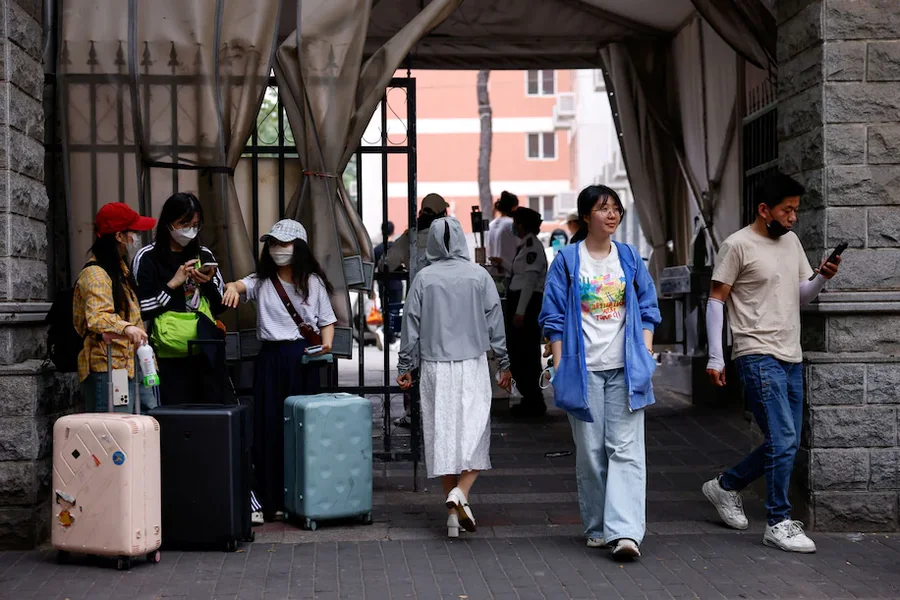
The State Department is resuming student visa interviews and is imposing stricter social media guidelines, including a requirement that all applicants have their accounts made public to be screened for hostility toward the United States, according to a State Department cable sent to embassies and consulates on Wednesday and obtained by The Washington Post.
The move comes after foreign student visa appointments were suspended last month in what U.S. officials described as part of a campaign against universities that they say fueled anti-Semitism and other national security concerns. The Trump administration also singled out Harvard University for additional visa scrutiny last month, describing it as a pilot program for broader measures. The new vetting procedures will apply to all foreign nationals applying for F visas, which are primarily for academic students, as well as M visas for professional students and J visas that are designed for educational and cultural exchanges. It will apply to all student visas, regardless of the institution of study.
Education advocates said they are concerned that the new vetting procedures will send an unwanted message to potential international students in the United States. Some worried that the measures could mean not only social media-based vetting but also a political test for applicants.
"I hope this doesn't discourage international students from coming here to the United States, but also that it doesn't get implemented in a way that leads to a huge increase in rejections ," said Sarah Spreitzer, chief of staff for government relations at the American Council on Education.
The cable, signed by Secretary of State Marco Rubio, said the verification would require reviews of applicants' "online presence" and that the new procedures would go into effect within five days.
As staff members review student profiles, the cable instructed, they should seek to “identify applicants who hold attitudes hostile to our citizens, culture, government, institutions, or fundamental principles; who protect, aid, or support designated foreign terrorists and other threats to U.S. national security; or who engage in unlawful anti-Semitic harassment or violence.”
Stuart Anderson, executive director of the National Foundation for American Policy, a nonpartisan organization, said it remains unclear how broadly or narrowly the rules will be interpreted.
"I don't think any American would want to be judged by their worst tweet ," Anderson said.
While a narrower interpretation of the new guidelines may be less problematic, a broader interpretation could result in the government denying visas to deserving students, Anderson added. However, the policy represents a shift in how the U.S. views visa applications, he said.
" Historically, we haven't criticized people's views before they come here," he said.
The State Department said in a written statement that American citizens expect their government to make their country safer, especially when it comes to the visa system.
"Secretary Rubio is helping to make America and its universities safer while bringing the State Department into the 21st century," the State Department said.
As justification for the expanded vetting, the cable cited two executive orders from President Donald Trump, one focused on preventing hostile foreign actors from entering the country and the other aimed at combating anti-Semitism. The cable also said it was important to protect American institutions of higher education from those who “steal technical information, exploit American research and development, and spread false information for political or other reasons.”
Establishing the new procedure for applicants to all U.S. colleges and universities would place a serious burden on consulates, according to the cable and several State Department officials, who spoke on condition of anonymity for fear of retribution.
Consular staff members “should consider the overall planning volume and resource requirements for proper vetting,” the cable said. They may need to schedule fewer student and exchange visa cases than they previously did, it added.
The cable suggested that State Department officials should require applicants to make all parts of their social media accounts public and accessible and penalize them if they refuse.
If portions of the accounts remain “set as ‘private’ or otherwise restricted, you should treat the case as you would any other case where an applicant fails to provide certain information upon request,” the cable said. It added, in a boldfaced sentence, “You should consider whether such failure reflects evasion or calls into question the applicant’s credibility.”
The new social media verification guidelines will affect not only new applicants, but also those whose cases are currently in process, according to the cable. This includes applicants who have not yet been interviewed and those whose interviews have been waived. It also includes applicants who have already been interviewed and are “otherwise approved” but have not yet been finalized as approved.
In all of these cases, consular officials “should request that applicants make their social media accounts ‘public’, then conduct the verification described in this cable,” the cable said. It directed officials to reject the case or, if necessary, call the applicant back for a follow-up interview if potentially incriminating information is found.
Jill Allen Murray, deputy executive director for public policy at NAFSA: The Association of International Educators, expressed relief that visa interviews will resume, but said the several-week pause hurts international students and the college communities that rely on their presence. She noted that international students and scholars are already among the most popular visitors to the United States.
"At this critical time of year, the administration must act quickly to expedite and effectively screen international students and scholars, allowing them to contribute to American communities and their local economies ," she said./ TheWashingtonPost


Lini një Përgjigje