


 Shkruar nga Pamfleti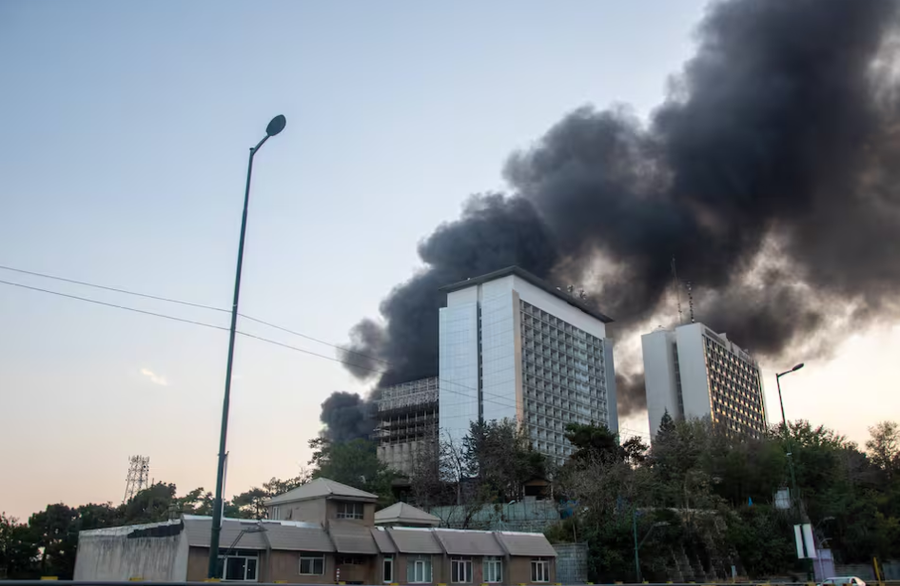
For years, there has been speculation that Iran wants to produce its own nuclear weapons. But which countries actually possess nuclear weapons?
Israel has been attacking targets in Iran for several days, including nuclear facilities, senior military officials, nuclear scientists, defensive positions, and oil and natural gas fields. The stated primary goal is to prevent the Islamic Republic from developing nuclear weapons. Although the International Atomic Energy Agency (IAEA) has no evidence of a systematic effort by Iran to acquire nuclear weapons, covert activities cannot be ruled out.
According to the latest IAEA report, Iran has recently significantly increased its stockpile of near-nuclear-grade uranium. Tehran denies any intention to use the material to build nuclear weapons.
Nine countries in the world are considered nuclear powers
In light of the highly tense global situation, the Stockholm International Peace Research Institute (SIPRI) warns of a new arms race among nuclear powers. As the independent institute's new annual report shows, the world's nuclear weapons arsenals are constantly expanding and modernizing.
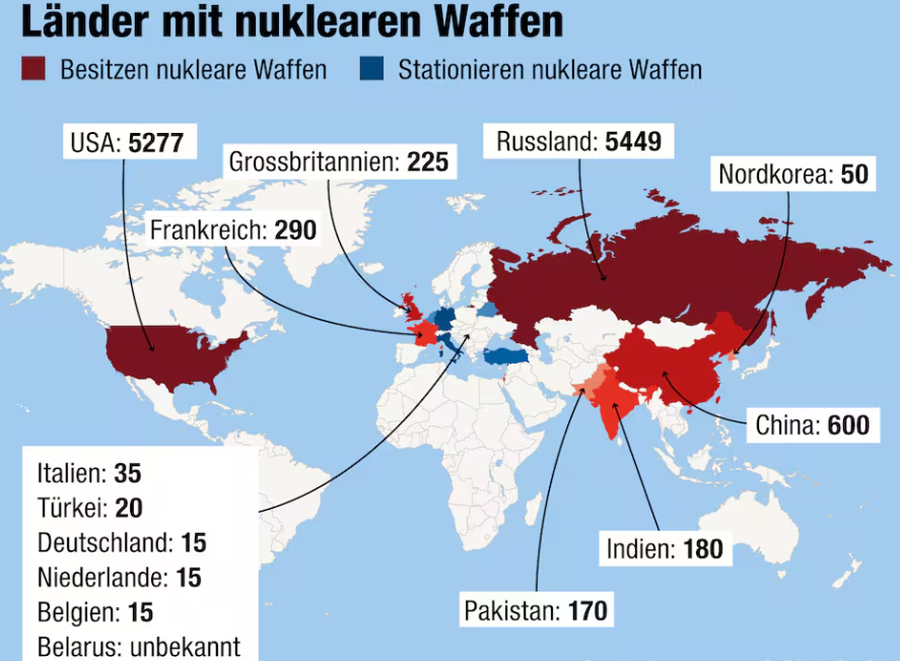
SIPRI estimates that the total global stockpile of nuclear warheads is 12,241. Of these, approximately 9,614 are in military reserves for potential use, about 29 more than last year.
Eight countries are officially considered nuclear powers: the United States, Russia, the United Kingdom, France, China, India, Pakistan and North Korea. Israel is also among them, although it has not yet publicly admitted that it possesses nuclear weapons.
USA and Russia
They are the big players. This is for historical reasons. The two superpowers were engaged in an arms race, especially during the Cold War. Together, they possess almost 90 percent of all nuclear weapons in the world. Russia has the most confirmed nuclear weapons with 5,449 nuclear warheads. The United States comes next with 5,244 nuclear weapons.
In 2022, after the invasion of Ukraine, Russia withdrew from the Treaty on the Disarmament of Conventional Armed Forces in Europe (CFE Treaty). The country of Kremlin leader Vladimir Putin also suspended the last major nuclear disarmament treaty with the United States, New START, at the time. Talks on a successor agreement have been stalled ever since. If no solution is found, the treaty will expire in February 2026.
In 2019, the United States, under then-current President Donald Trump, withdrew from the INF Treaty, which bans ground-based short- and intermediate-range nuclear missiles, and a year later also announced its withdrawal from the Open Skies Treaty on international military observation flights. Russia subsequently announced its withdrawal from the Open Skies Treaty as well.
China
Meanwhile, in the shadow of Washington and Moscow, a third major nuclear power is increasingly emerging, which, according to SIPRI, is in the midst of a comprehensive modernization and expansion of its nuclear weapons program: China. The institute estimates that China’s stockpile is approximately 600 nuclear warheads. That is now more than France (290) and the United Kingdom (225) combined. “China’s nuclear arsenal is growing faster than that of any other country: with about 100 new nuclear warheads per year from 2023,” the SIPRI report says. The trend is continuing to increase.
North Korea
It is not clear how many nuclear warheads North Korea possesses. However, estimates suggest that North Korea possesses enough fissile material to develop 40 to 50 individual weapons. Leader Kim Jong Un is reportedly receiving support from Russia in this effort. "In exchange for troops and weapons, Russia supports North Korea in its missile and nuclear programs," NATO Secretary-General Mark Rutte said in December 2024. According to Rutte, North Korea could destabilize the Korean peninsula and even threaten the United States.
India and Pakistan
India (180 nuclear weapons) and Pakistan (170 nuclear weapons) are the two countries considered to be among those with nuclear weapons. After the last showdown between the two nuclear powers, a ceasefire has been in place since mid-May. There was a risk that a conventional conflict could escalate into a nuclear crisis, explains SIPRI expert Matt Korda. "This should serve as a strong warning to states seeking to increase their reliance on nuclear weapons." The recent hostilities between India and Pakistan show that nuclear weapons do not prevent conflict, he says. "It is essential to remember that nuclear weapons do not guarantee security."
Israel
The total number of nuclear warheads Israel possesses is unconfirmed. Experts estimate that Israel has material for up to 200 nuclear warheads. About 90 nuclear warheads may be operational.
Nuclear weapons are located in these places
The US has stationed nuclear-armed aircraft in Belgium (15), Germany (15), Italy (35) and Turkey (20). On the other hand, Russia is said to have transferred some of its nuclear weapons to Belarus. At least, that is what Belarusian President Alexander Lukashenko claimed. The exact number of nuclear weapons in the country remains unclear. /Adapted from Pamphlet by Blick/


Lini një Përgjigje