


 Shkruar nga Noah Keate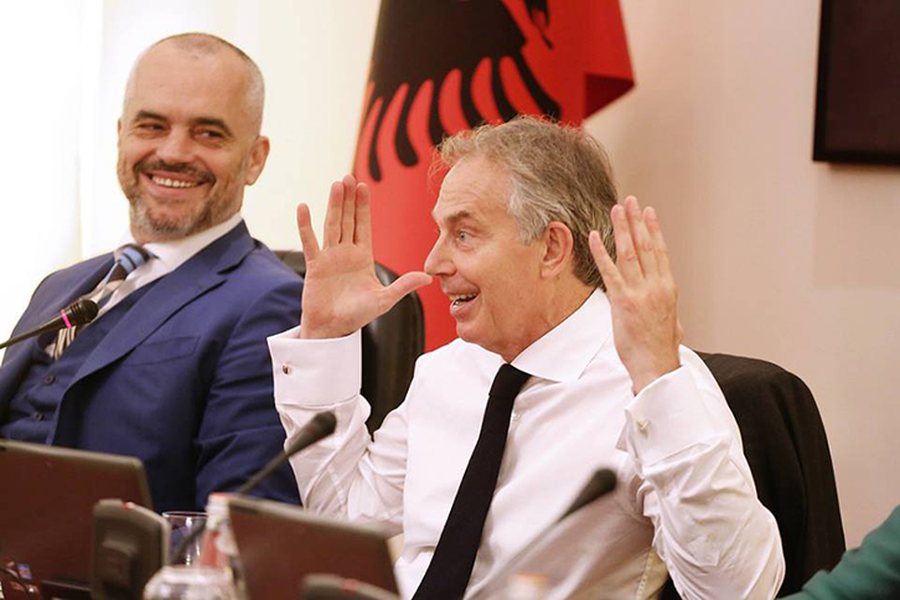
Nobody likes a driver who drives from the back seat. What if the person trying to grab the wheel is a former prime minister?
Britain has seen a succession of leaders over the past decade, leaving it with an unprecedented number of eight former prime ministers still standing and frequently commenting on the person doing their old job.
Just this weekend, Kemi Badenoch, the leader of Britain's hard-hit Conservative Party, attempted to distance herself from the troubled economic legacy of former Conservative Prime Minister Liz Truss, provoking an outcry from Truss herself. It's unfortunate for Badenoch, as barely a day goes by without her raising suspicions of the Labour government towards Truss.
Prime Minister Keir Starmer has his own problems, with his Labour predecessors Tony Blair and Gordon Brown never leaving the headlines, offering mostly unsolicited advice.
"You have incomplete prime ministers. Some of them felt their agenda wasn't finished yet ," says historian Anthony Seldon, who has written books about many departed prime ministers, including "The Impossible Office? The Story of the British Prime Minister."
" They still want to feel like they have a purpose ," said political communications consultant Laura Emily Dunn, who has worked for Conservative cabinet ministers.
Since Starmer won a landslide victory just over a year ago, Blair and Brown’s interventions have come with great speed and intensity. Blair has used his think tank, the Institute for Global Change, to publish a series of policy papers, with a particular focus on artificial intelligence.
Just days before crucial local elections earlier this year, Blair set off alarm bells in Downing Street with a few lines in a report warning that a maximalist approach to net zero carbon emissions was “doomed to fail” and that politicians needed to face “uncomfortable facts”.
A Downing Street spokesman said the government would achieve net zero “in a way that is gentle on people’s lives” rather than telling them how to live or behave. While acknowledging there was a “range of views”, No 10 says it sees net zero as a “huge economic opportunity”.
Gordon Brown, who left office in 2010, has spoken out unapologetically on social justice issues through Twitter posts, books, opinion pieces and even as a guest editor in an issue of the New Statesman magazine, often in ways that are not helpful to the Starmer project.
Labour Party insiders insist there is no resentment over the views of former leaders. A former Labour Party adviser, who remained anonymous, said: “ There is no expectation from the Labour Party leader that former prime ministers will somehow be silenced out of respect.”
"They have been diplomatic, but have said quite clearly what they think ," says Stewart Wood, a Labour Party colleague and former adviser to Brown.
The meddling tendency among former British prime ministers may be a consequence of the strange nature in which they are left to wander after leaving office. While they receive £115,000 a year for life, a permanent security detail but there is no equivalent of an American-style presidential library to promote a former prime minister's legacy.
This can leave former leaders feeling neglected. “ There is a resource that the country can benefit from… in some way. These people served us and served our country. If they were to disappear into lonely retirement, that would be a mistake ,” says Wood.
For some prime ministers, the well-trodden path of writing a memoir and joining the speaking-out-loud circuit is apparently no longer enough.
" There has been a tendency among modern prime ministers not to want to consult their predecessors. They rightly see their successors falling into the same bear traps they themselves fell into ," Seldon argues, saying that leaders often fail to assess the actions of those who came before them.
Even John Major, the reserved former Conservative prime minister who stayed out of the spotlight during the Blair and Brown years, returned to public debate during the Brexit years. He became a frequent and harsh critic of former prime minister Boris Johnson. More recently, he called for tougher parliamentary standards for rule-breakers.
Theresa May could not resist intervening by urging the UK to act to achieve net zero, while David Cameron had a full political comeback as foreign secretary during the last eight months of the Conservative government.
For others, there is a desire to settle old scores. Johnson and Truss saw their terms as prime ministers suddenly collapse, leaving them with a lot of unfinished business. Johnson writes a column for the Daily Mail newspaper and has not shied away from harsh interventions attacking Starmer’s agenda, including a fresh criticism of his Middle East policy in recent days.
Truss, Britain's shortest-serving prime minister, frequently opines on X about Starmer's economic policies, as well as his approach to justice and free speech, as she fights to reshape her tarnished legacy.
Over the weekend, she sharply criticized current Conservative leader Kemi Badenoch, accusing her of failing to speak out about the real failures of 14 years of Conservative government and warning that the same party that made Truss prime minister is now in "serious trouble."
So what makes a truly effective intervention by a former prime minister?
“They have more influence when it is less publicly known,” argues Peter Just, author of Margaret Thatcher: Life after Downing Street. Just says public interventions can be a sign that advice given behind the scenes is not being listened to./ Adapted from “Pamphlet” by “Politico”





Lini një Përgjigje