


 Shkruar nga Francesca Luci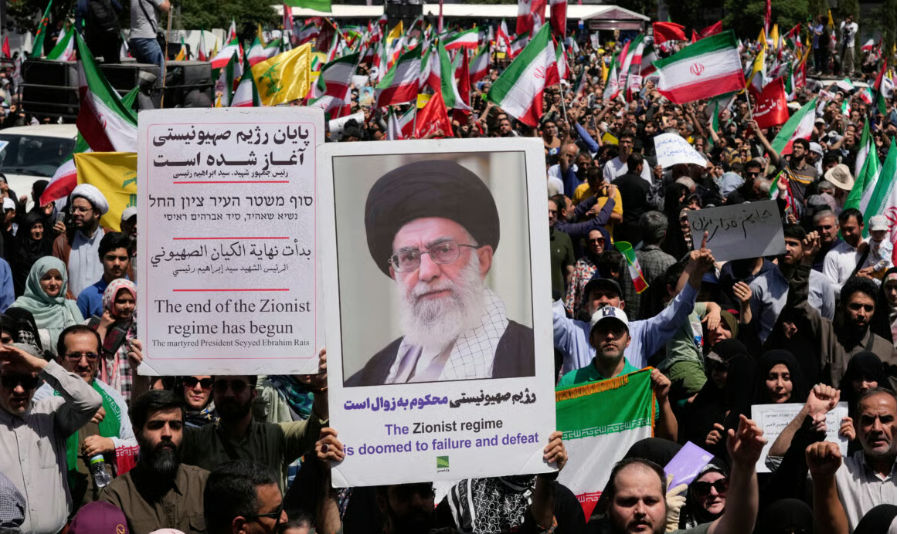
Many thought he was finished, hiding in a bunker who knows where, isolated and out of contact, afraid he would be killed by infiltrators paid by Mossad or hit by a bomb, the supreme leader of the Islamic Republic has emerged from the conflict with the US and Israel, resolutely maintaining his leadership...
Despite the often dark and medieval image he presents, the supreme leader of the Islamic Republic, Ali Khamenei, has demonstrated extraordinary political skills in the recent crisis with the United States and Israel.
A few days after the conflict began, many observers left him free, hiding in a bunker who knows where, isolated and without contact, for fear that he would be killed by infiltrators paid by Mossad or hit by a bomb that penetrates the bunkers.
It was said that he had transferred his powers to a small group of loyalists and that he had already identified three candidates for successors.
The last crown prince of the monarchy, in front of the Western Wall, appeared dreaming of returning to power, while the Mujahedin, historical opponents, were eager to strip the country bare.
In power since 1989, the 86-year-old Ayatollah continues to exercise strong leadership, despite the hostility of all Western chancelleries, especially Washington and Tel Aviv.
The picture becomes even more incredible when you consider that, according to several studies, polls and analyses of the unrest and voter turnout, over half of the population no longer supports the imposition of his authoritarian political line. The so-called "Generation Z" openly expresses its hatred through social media despite bans and controls. But even among those who participated in the 1979 revolution against the monarchy, consensus is now low. National-religious people accuse him of betraying the spirit of social justice of the revolution.
Khamenei has always pursued the goal of transforming Iran into a regional power. An ambition that has made a clash with the US and Israel inevitable. His strategy has been based on the spread of the Islamic revolution and opposition to Western hegemony. Khamenei has always avoided direct conflict, pursuing a balance between provocation and restraint. This approach has its roots in the traumatic Iran-Iraq War (1980-1988), which cost the lives of approximately 280,000 Iranians. This conflict has shaped the country's strategic culture, generating a deep aversion to large-scale wars.
However, this does not mean that Khamenei, if forced, would not have supported the defense of the country to the last drop of blood. On the contrary, belonging to the Shiite branch of Islam, which recognizes martyrdom as the supreme act of loyalty and sacrifice for the cause of justice and truth, makes such a stance almost natural.
However, in an Iran suffering and hostile to a leadership perceived as despotic, a religious appeal could hardly have served as a national glue.
The old leader perceives the strong national sentiment of the population, which places the homeland above all other priorities and would not tolerate external aggression.
For this reason, the call for nationalism and unity becomes central to Khamenei's speeches, and the black flag of martyrdom disappears from the screens, replaced by the national one.
Iranians in the diaspora considered the possibility of a mass uprising real and openly hoped for it. Although many Iranians wanted change and the end of the regime, paradoxically, for many of them, Israel becomes the enemy the moment the first bomb destroys a house and kills civilians.
Khamenei seems to see conflict with the West as a necessary continuation for his survival. However, as the facts show, when the limit that threatens the regime's security is crossed, decisions such as ceasefires are made, the duration of which is not predictable.
Overall, the entire war, while severely affecting nuclear facilities, benefited Khamenei's image: he avoided surrendering on nuclear energy, as Washington wanted; he gained the strategic advantage of presenting himself as a country under attack, capable of resisting the world superpower, inflicting damage inside Israeli territory for the first time, humiliating its defenses, and last but not least, powerfully quelling popular discontent. In his first speech after the ceasefire, Khamenei spoke of the unity of 90 million Iranians, capitalizing on popular devotion as if the entire country were truly united behind its leader.
Those who thought this leadership was over, or that hostility towards the West and Israel was fading, should think again. Khamenei is the only leader who managed to reach a ceasefire with a country he does not recognize, Israel, and with another with whom he does not speak directly, the United States, through the mediation of a country he had just bombed: Qatar! / Adapted from Il Manifesto Pamphlet/



Lini një Përgjigje