


 Shkruar nga Pamfleti
The International Criminal Court, after months of reflection, issues an international arrest warrant against the head of the Tripoli police. Surprisingly, it did so precisely when this person was about to enter Italian territory, after having remained quiet for about 12 days in 3 other European countries.
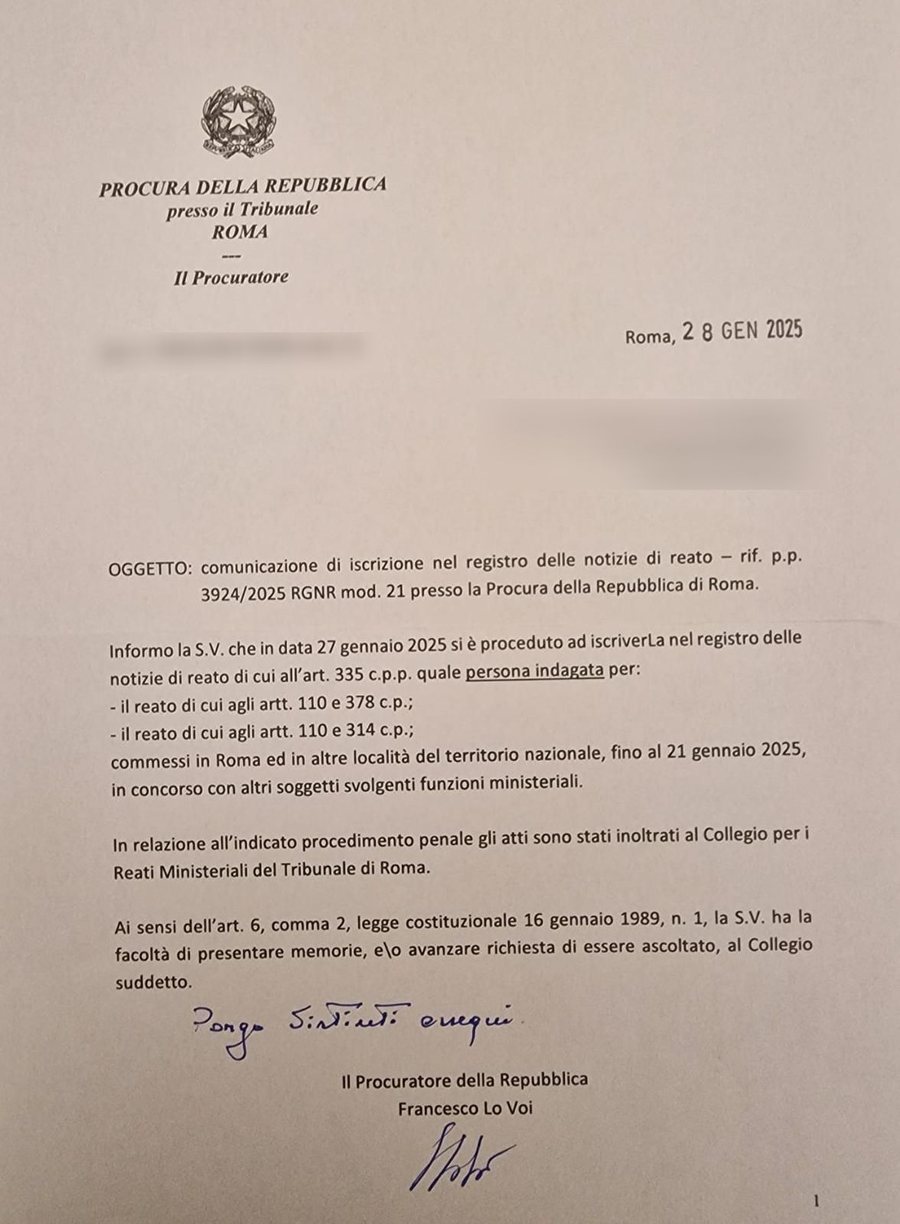
Prime Minister Giorgia Meloni is under investigation by the Rome prosecutor's office for aiding and abetting the repatriation of the commander of the Libyan prison of Mittiga, Osama Njeem Almasri.
She announced this herself on social media.
"This is the news," Meloni said in a message, adding, "The public prosecutor Lo Voi, just like the unsuccessful trial of Matteo Salvini, has just sent me a warrant notice for the crimes of aiding and abetting in connection with the affair of the repatriation of the Libyan citizen Almasri; warrant notice which was also sent to ministers Nordio, Piantedosi and Mantovano."
According to Meloni, the origin of the investigation is the denunciation of the lawyer "Luigi Li Gotti, former left-wing politician, very close to Romano Prodi, known for defending Buscetta, Brusca and other mafiosi."
The facts, according to the Prime Minister's reconstruction, are "quite well known: the International Criminal Court, after months of reflection, issues an international arrest warrant against the head of the Tripoli police. Surprisingly, he did so precisely when this person was about to enter Italian territory, after having remained quiet for about 12 days in 3 other European countries. The request was not sent to the Italian Ministry of Justice and for this reason the Court of Appeal of Rome decided not to proceed with its validity. At this point, with this subject free on Italian territory, instead of letting him go free, we decide to expel him and repatriate him immediately, for security reasons, on a special flight as happens in other similar cases. This is why the Public Prosecutor's Office is investigating me, Mantovano and two ministers".
"I think that what was valid yesterday is valid now: I cannot be blackmailed, I will not let myself be intimidated, it is possible that for this reason I will be disliked by those who do not want Italy to change and become better, but also and above all for this reason I intend to continue my path in defense of Italians, especially when the security of the nation is at stake. With my head held high and without fear," Meloni said.
The announcement of the investigation comes on the eve of a briefing, scheduled for tomorrow in the Senate, by Justice Minister Carlo Nordio and Interior Minister Matteo Piantedosi on the issue of the arrest, release and repatriation of Almasri, wanted by the International Criminal Court in The Hague for war crimes and crimes against humanity.
The constitutional law adopted in 1989 on the alleged criminal liability of members of the government provides that the public prosecutor, when receiving news of a crime related to ministerial functions, sends the documents to the court of ministers within fifteen days and notifies the interested parties.
From the moment the file is received, the ministerial crimes panel - composed of three magistrates - has 90 days to conduct its investigations and then decide what to do with the file.
Days earlier, the National Association of Magistrates had accused Nordio of failing to respond to the requests of the Rome Court of Appeal – thus, in effect, allowing the Libyan to be released.
Almasri was arrested on 19 January in Turin after an Interpol "red notice" was issued on a warrant from The Hague. The prosecutor's office sent an initial tip to Via Arenula, followed by that of the Rome prosecutor's office the following day.
On January 21, after the 48 hours allowed by law for the detention of a wanted person had passed and in the absence of a response from the ministry, Almasri was released, but at the same time he was expelled for the reasons indicated by Piantedosi.
The alternative would have been to impose a security measure on him pending further steps against him, but the path of immediate repatriation was preferred.
The simultaneous release and repatriation of Najeem Osema Almasri sparked an unprecedented conflict between the International Criminal Court and Italy. That is, between those who wanted to arrest and try the Libyan general, the head of the judicial police accused of torture, rape and murder of migrants committed in his country from 2015 onwards, and those who escorted him home on a state flight, considering him a “dangerous subject for national security”.
For almost two weeks, from January 6 to 19, Almasri wandered around Europe unmolested, passing through two police checkpoints unharmed. In theory, the arrest warrant should have been handed over to the police at the border crossing point where the stamps were placed, before reaching the magistrates' desks. And this officially did not happen. But the International Criminal Court based in The Hague claims that it did everything according to the rules: a verbal note to the Italian embassy in the Netherlands and the subsequent transmission of the arrest warrant consisting of hundreds of pages. There is a liaison magistrate at the embassy who may have referred the case to the Foreign Ministry, but it is not known what happened next. For the time being, this is one of the "mysteries" to be clarified.
The basis for Almasri's release, decided by the Rome Court of Appeal with the consent of the General Prosecutor's Office, remains the formal flaw of the lack of "necessary dialogue" with the Minister of Justice. / Pamphlet adapted from Corriere/








Lini një Përgjigje