


 Shkruar nga Pamfleti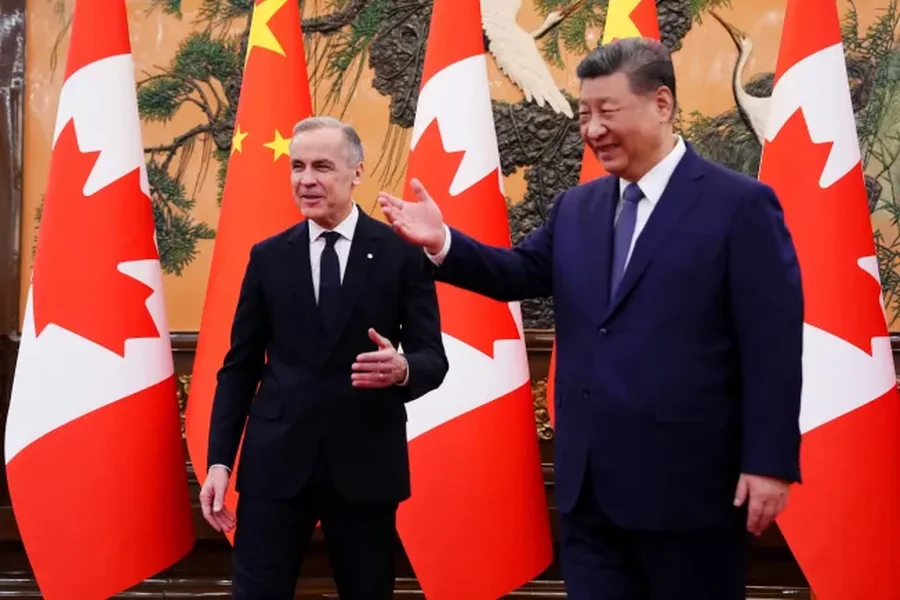
Why Xi keeps winning the summit game
In January, after weeks of threats from U.S. President Donald Trump to annex Canada as the “51st state,” Canadian Prime Minister Mark Carney stood in the Great Hall of the People in Beijing, displaying a cordial attitude toward the leaders of a country he had called Canada’s greatest geopolitical threat less than a year earlier. In a meeting with Chinese Premier Li Qiang, he said that “the progress we have made in partnership positions us well for the new world order.” It was not a good moment for the United States. Yet that scene, of a leader worried about Washington rushing toward Beijing with renewed urgency, has been repeated repeatedly since Trump returned to the White House.
In 2025, the leaders of Australia, France, Georgia, New Zealand, Portugal, Serbia, Slovakia, Spain, and the European Union all traveled to China. In January, the pace of visits accelerated, with the leaders of Finland, Ireland, South Korea, and the United Kingdom arriving one after the other, followed in February by the president of Uruguay and the chancellor of Germany. In April, the Spanish prime minister consolidated this pattern with his fourth visit in four years. They walked the red carpet, shook hands with senior Chinese Communist Party officials, and signed memoranda to strengthen relations. This growing spectacle, which Chinese state media has called a “wave,” reinforced the CCP’s narrative of a rising China and a declining United States.
Now these and other leaders are likely to watch with concern as Beijing prepares to host the US president next week. For Canada and other US allies, the main driver for deepening ties with China is Trump himself. Under pressure from a US behaving like a predatory hegemon, these politicians feel they have no choice but to balance. Meeting with Chinese President Xi Jinping sends a signal to Trump that they have alternatives and will not succumb to “all-or-nothing” alliances or unfair trade deals. In this way, the growing distance between Washington and its partners is a diplomatic gift to Beijing.
But ahead of Trump’s visit, Carney and other leaders have no guarantee that any deals Trump and Xi might reach will not leave them worse off. They can’t trust Trump to take their interests into account, so they must hope that Chinese officials will remember their concerns about industrial overproduction, the weaponization of trade, and foreign interference, and offer them economic relief in exchange for their conciliatory stances. This weakness highlights the problem of the lack of collective action and the need for these leaders to align their policies toward China, defend red lines, and impose costs on Beijing for its pressure.
Although the broken trust between the United States and its allies cannot be quickly restored, Washington can help. It may be too late for a fully unified approach to China, but coordination remains possible. Trump should lead by example, avoid the mistakes of other leaders, and reject temporary agreements that increase dependence on China. Rather than seeking superficial praise, he should use the visit to strengthen deterrence, coordinating with allies in advance, and setting clear boundaries.
Trump and other delegations should use their visits to China to demonstrate a stronger unity of positions and interests. Such an approach would create space for long-term goals: maintaining advanced industrial capabilities, technological advantage, and diversifying supply chains.
The house always wins.
Each official visit to Beijing may have been individually justifiable and in the rational interest of the respective state. But overall, the result has been a political and propaganda success for Beijing. By accepting Xi’s terms and participating in his authoritarian ceremonies, these leaders lend legitimacy to his narrative. Over time, these gestures influence global perceptions of power and legitimacy.
This shift in favor of China hurts U.S. allies. Beijing has pursued policies that strengthen its autonomy and increase the dependence of others. It has used trade and control over resources as tools of pressure. Countries trying to balance against the United States are forced to accommodate China, but this increases the risk of subjugation to it.
Leaders allow China to set the terms of engagement, giving tacit approval to its agenda. The Chinese market exerts a strong pull, and politicians often demand quick trade deals. Delegations include companies seeking support for operations in China.
Meanwhile, China is playing a long-term game. It uses economic interdependence for strategic and political advantage. Each visit is organized to reinforce the narrative of China's rise. Criticism is only allowed in private, while the language of "strategic partnerships" is used publicly.
Chinese officials tailor benefits to visitors' level of persuasion. Agreements often end up in China's favor. Examples include concessions from Canada, European agreements on agricultural products and investment, and steps by the United Kingdom that are accompanied by political concessions.
These agreements rarely bring economic stability. They redirect trade and weaken domestic economies. Exports to China are dominated by basic products, while China supplies advanced industrial goods.
The result is a persistent trade surplus for China, which reached $1.2 trillion last year. China accounts for about 30% of global output and is expected to reach 45% by 2030. Meanwhile, traditional industrial powers are weakening.
The coalition that was not formed
Leaders are aware of this situation. French President Emmanuel Macron acknowledged that China's trade surplus is unsustainable. German Chancellor Friedrich Merz also called for the imbalances to be corrected.
But a coordinated approach is lacking. Each country pursues short-term interests, weakening solidarity. China's five-year plan confirms its goal of dominance in technology and industry.
By placing economic interests above security and human rights, governments increase the risk to their citizens. The example of the United Kingdom illustrates this approach, where human rights concerns are not accompanied by concrete measures.
Commitments before concessions
After many small deals in Beijing, Trump may seek a larger deal. His administration has taken steps to create a positive climate, including easing restrictions on technology exports and postponing some measures against China.
But this approach carries risks. A deal that sacrifices long-term strategic interests would weaken the United States and strengthen China's position.
There is an alternative: using visits to defend interests, establish boundaries, and coordinate with allies. Leaders should clearly articulate concerns about security, the economy, and human rights.
Although skepticism toward the US remains, countries can harmonize some policies, such as investment controls and limits on dependence on China.
The measure of success should not be based on the value of agreements, but on the ability to limit China's influence and maintain political autonomy. This wave of visits shows that the stability achieved through concessions is fragile and weakens the collective strength of democratic countries. /Adapted from ForeignAffairs /






Lini një Përgjigje