


 Shkruar nga Pamfleti
Despite the harsh rhetoric, officials emphasize that Trump does not want a return to large-scale military activity, although he expresses deep dissatisfaction with Tehran's unwavering stance on the nuclear issue.
Donald Trump's stated goal of ending war with Iran has been put to the test in recent days, after Tehran attacked American warships and energy facilities on Monday and blocked American efforts to restore navigation in the Strait of Hormuz.
US officials told the Wall Street Journal that Trump has been moving between two opposing options for several days: on the one hand, severely punishing Iran for continuing its nuclear program and, on the other, avoiding a serious escalation that could involve the US more deeply in the conflicts in the Middle East.
As they point out, he aims to avoid a new bombing campaign, preferring a negotiated solution to both Tehran's nuclear program and the war that has been going on for weeks and has raised fuel prices, affecting the global economy.
Trump now faces the choice between ordering new airstrikes or ignoring Iranian provocations while continuing his diplomatic initiative.
Speaking at the White House on Monday, he indicated that he would maintain the status quo for now. “ I call it a small war,” he declared, adding that it was “a small disruption that works quite well.”
Exchange of fire on Monday in Ngustica
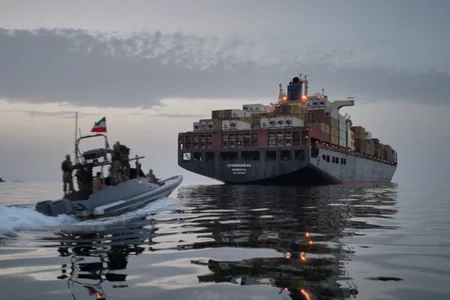
The fragile US-Iran ceasefire was put to a dangerous test on Monday when US forces were forced to repel attacks in the strait. After launching cruise missiles and other projectiles at US and commercial vessels, US Central Command (CENTCOM) said Apache helicopters had sunk Iranian fast boats that were obstructing navigation.
Despite the escalation, Trump avoided declaring that Iran had violated the ceasefire, leaving open the possibility of ignoring Monday's actions. In parallel, he asked South Korea to join the operation in the Strait of Hormuz, after a fire incident on one of its ships.
The Republican president also announced a press conference by Pentagon officials on Tuesday, tasking Defense Secretary Pete Hegseth and the Chairman of the Joint Chiefs of Staff, General Dan Caine, to outline next steps.
In his statements, he argued that he is in a strong position, regardless of whether he chooses military action or continuing negotiations: " In any case, we win. Either we reach a good deal or we win easily militarily."
Political pressures
Meanwhile, pressure is mounting from his political allies for an immediate military response. Senator Lindsey Graham declared that Iran had violated the ceasefire and urged Trump to take a "strong, decisive and short" strike.
Despite the harsh rhetoric, officials emphasize that Trump does not want a return to large-scale military activity, although he expresses deep dissatisfaction with Tehran's unwavering stance on the nuclear issue.
In recent discussions with his aides, he expressed disappointment that the US blockade of the Strait of Hormuz, while damaging the Iranian economy, has not yielded any concessions. Various scenarios have been considered, from striking remaining targets to escorting tankers.
In the end, he chose an interim plan, known as “Project Freedom,” aimed at providing information to merchant ships so they could safely pass through the strait. The operation was launched without the participation of the Allies, a few days after diplomatic contacts.
Within hours, Iran fired missiles at US ships and attacked the United Arab Emirates, according to Admiral Brad Cooper. Trump had warned that any setback would be met “with determination.”
Concerns about new attacks
Some officials estimate that Trump could approve a military response in the coming days, while analysts emphasize his reluctance to launch new attacks.
White House spokeswoman Anna Kelly said all options remain open as efforts continue to reach a deal that would prevent Iran from obtaining nuclear weapons.
Washington's strategy combines diplomacy with increased pressure. After the April 7 ceasefire, talks began on dismantling Iran's nuclear program, while a naval blockade was imposed on April 13.
However, the agreement was not reached, while the US continues with new measures, including a draft resolution at the UN to condemn Tehran.
At the same time, the crisis in the Strait of Hormuz also risks affecting US international relations, ahead of Trump's meeting with Chinese President Xi Jinping on May 14-15. US officials are calling on Beijing to put pressure on Iran, but China appears reluctant to align itself with Washington.
Senator Graham urged Trump to resolve the crisis before his visit to China, stressing that, despite the desire for stable relations, the US "will not tolerate provocations."





Lini një Përgjigje