


 Shkruar nga Pamfleti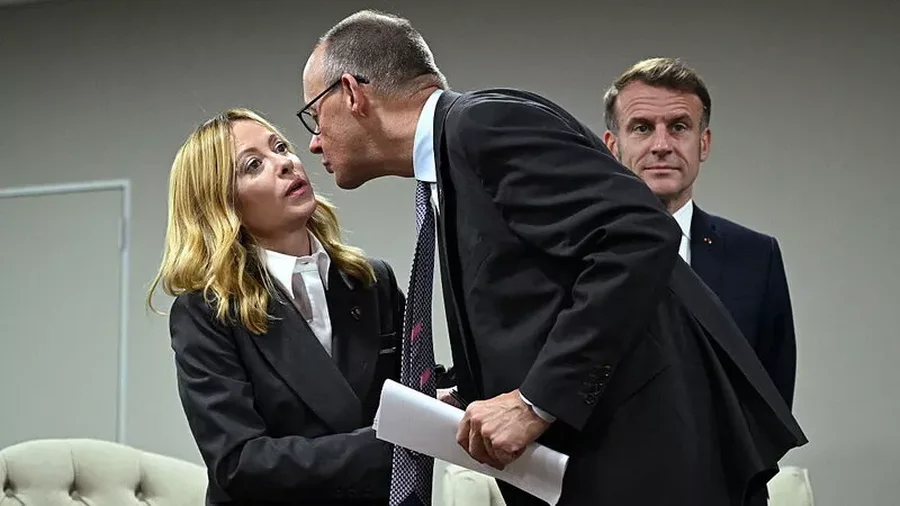
In Berlin they don't want to pull the trigger. A position that is also supported by the Meloni government...
While Friedrich Merz and Giorgia Meloni try to prepare a soft landing in the new clash with Donald Trump over customs tariffs, Emmanuel Macron writes to the US president to ask him to lift US sanctions against former European Commissioner Thierry Breton and the president of the International Criminal Court, Nicolas Guillou. In the attempt to build a common European stance towards Washington, which neither leader denies wanting to achieve, the differences in starting points are confirmed.
In Paris, they are considering countermeasures against the American tycoon, now that he has been weakened by the Supreme Court decision that overturned the tariffs, for which European companies have already paid hundreds of billions; around 100 billion euros for German companies alone, Berlin estimates. But it is precisely in Germany that they are trying not to light the fuse, especially on the eve of the Chancellor's visit to Washington in early March. This time too, the so-called EU "bazooka" is expected to remain in the drawer. Here's why.
Created in 2023, the European Union's Anti-Coercion Instrument (ACI) is the Union's most powerful trade rule to protect itself from unjustified economic pressure from third countries. It allows Brussels to respond to economic measures used as a tool of political blackmail with appropriate countermeasures, such as increasing tariffs on certain products, but also restricting access to the single market or to European public procurement for goods, services or investments from the third country in question. The ACI also provides for the possibility of applying restrictive measures to services and intellectual property rights.
It is called the “bazooka” because, in theory, it is a very broad and powerful countermeasure instrument, capable of hitting strategic sectors and major economies, including the United States, by closing or restricting access to what is the world’s largest single market: 450 million consumers. To implement it, unanimity is not required, but a qualified majority of member states is sufficient. So far, it has never been used. Trump’s trade war has brought him to the center of the European debate, but his most determined supporter remains always and only Macron, even now that the US Supreme Court is reigniting the clash with Washington, after the truce imposed by the EU-US agreement reached in July at Trump’s estate in Turnberry, Scotland.
In Berlin they do not want to pull the trigger. A position that is also supported by the Meloni government. Deputy Prime Minister Antonio Tajani holds a long conversation with Trade Commissioner Maroš Šefčovič "to agree on a common position of Italy with the European Commission and allied countries", says the minister, who tomorrow participates in the G7 meeting on international trade, as well as in the Foreign Affairs Council in Brussels and in a meeting of the task force on tariffs with Italian enterprises.
The Italian-German objective is to avoid another declared war with Trump. Tomorrow in Brussels, the European Parliament's negotiating team will meet to ratify the July agreement with the US. Its president, the German socialist Bernd Lange, will propose suspending legislative work until we have an appropriate legal assessment and clear commitments from the United States. Because, Lange explains, after the Supreme Court's decision, no one understands anything anymore: only open questions and growing uncertainty for the EU and other US trading partners. The terms of the Turnberry agreement and the legal basis on which it was built have changed.
A position shared by the Greens and the Liberals, but the EPP, the party of Merz and Ursula von der Leyen, is holding back. The populists do not want to postpone the vote. The European Commission itself issues an opening statement to Washington: “A deal is a deal. As the main trading partner of the United States, the EU expects the US to respect the commitments set out in the joint declaration, just as the EU respects its own commitments ”.
Parliamentary ratification of the Scottish agreement has been frozen for more than a month, since Trump launched a frontal attack on the EU over Greenland. There is now little willingness to reject the agreement signed eight months ago. Because there is a fear of further countermeasures from the US: the US Supreme Court has only struck down tariffs imposed under the International Emergency Economic Powers Act (IEEPA), but those based on other legal bases, for example on cars and steel, remain in force.
When he announced new tariffs of 10 percent, later increased to 15 percent, in response to the court's decision, Trump used another legislative act, Section 122 of the Trade Act of 1974, which is not affected by the Court's decision. It is true that these tariffs are only valid for 150 days, unless approved by Congress. But the point is that the decision does not completely eliminate the president's ability to impose tariffs: alternative legal avenues remain open. Not to mention the other pressure instruments that Trump has at his disposal, starting with the risk that the US will leave the EU alone in security guarantees after peace in Ukraine and more broadly in the field of defense.
The French suggestion to move to stronger measures seems destined to fall on deaf ears this time too. Meanwhile, the head of the Elysee wrote to Trump to request the lifting of sanctions against Breton and Guillou. The former European Commissioner has been banned from entering the United States since last December: Breton is the "father" of the European directive on digital services, which the American authorities consider an attack on freedom of expression.
Guillou was sanctioned by Washington in August 2025, along with other judges at the International Criminal Court, over the decision on the arrest warrant for Israeli Prime Minister Benjamin Netanyahu. He has also been banned from entering the US and his bank in France has revoked his Visa card. In addition, Guillou no longer has access to a range of US digital services, from Airbnb to Amazon.
Sanctions that, according to Macron, violate "European regulatory autonomy" and "the principle of judicial independence and the mandate of the International Criminal Court". But even in this case, the French president remains the only one who raises his voice with the US, although the list of European citizens recently sanctioned by Washington also includes several Germans. / Adapted "Pamphlet" from " HuffPost"




Lini një Përgjigje