


 Shkruar nga Pamfleti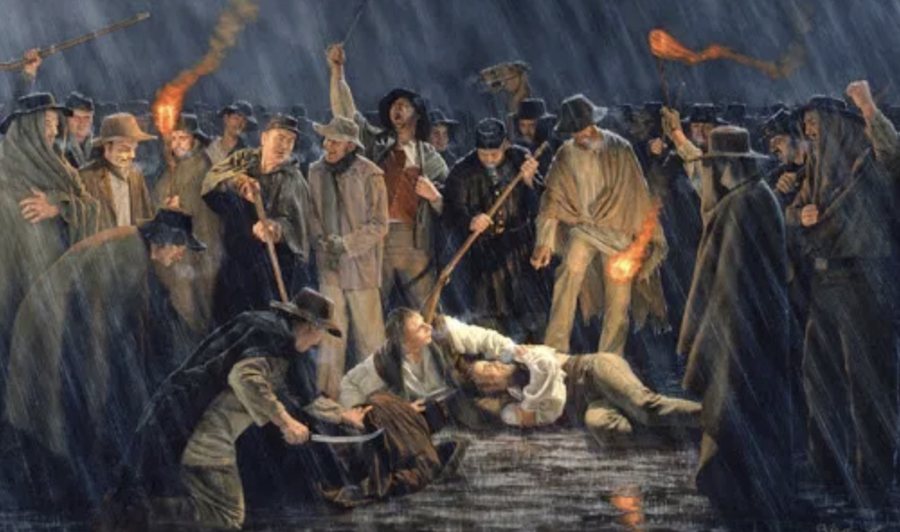
Liberals get "lazy" when they think about crowds. They have cheered "people power" when it threatens regimes they disapprove of, such as in the Middle East, while turning a blind eye to excesses by protesters they think are on the right side of history. .
In August 2020, a public affairs publisher published the book "In Defense of Looting: A Turbulent History of Uncivil Action" by Vicki Osterveil. The occupation of the Capitol by mobs of supporters of President Donald Trump on January 6 was a reminder. of the dangers of playing with fire.
It is naïve to assume that crowds will be confined to the "beautiful" side of the political spectrum; by its nature the type of left-wing crowd generates the type of right-wing crowd. And it is doubly naive to expect that crowds will set limits for themselves; getting out of control is in their nature.
Political philosophers have been saying this consistently for over 2,000 years. Pre-modern political theorists never tired of warning that whenever the "many-headed monster" will take advantage of the opportunity, it will violate the existing order.
Even liberal thinkers worried that democracy could create " mobocracy " (mob rule). They argued that the will of the people had to be restrained by a combination of the laws of the Constitution (individual rights, along with checks and balances) and civic culture. The wisest among them added that breaking such restrictions could turn democracy into mob rule.
The first great work of political philosophy, Plato 's Republic , was, in part, a meditation on the evils of mob rule. Plato regarded democracy as more than mob rule by another name, perhaps non-violent, at least at first, but with the same lack of impulse control.
He compared the citizens of democracies to buyers who see a "coat of many colors" on the market and buy it only to find out that it has been worn only twice. He pointed out that democracies are difficult to prove .
However , Plato argued that democracies inevitably degrade into anarchy, as the poor plunder the rich, and chaos produces collapse. Anarchy leads to the rule of tyrants: an authoritarian leader can appeal to the mob's worst instincts , as he himself is governed by his own worst instincts .
He is somehow the crowd in the form of a single person. For Plato , the only viable alternative to mob rule was the rule of a caste of guardians: philosopher-kings, trained from infancy to control their emotions, and to place wisdom before instinct .
Aristotle, Plato 's great student , distinguished between three legitimate forms of government: kingship, aristocracy, and democracy. He argued that each of them has its dark shadows: tyranny, oligarchy, and mob rule.
He then described the ways in which these virtuous forms of government evolve into their opposites: democracy becomes mob rule, where the rich grab society's wealth. Being a more practical thinker than Plato , Aristotle argued that there were two ways to prevent the degradation of democracy into a mobocracy : mixing it with elements of royalty and aristocracy to curb the will of the people; and the creation of a large middle class, which is interested in the country's stability.
The following centuries brought several innovations in thinking about the crowd. Machiavelli speculated that clever princes might be able to profit from the chaos if they could use the mob against a disintegrating regime. Meanwhile, the elites enjoyed demonizing her.
They coined a host of terrifying names for the people - "many-headed beast", "rude mob", " moving mob ", or a variable crowd, which gave rise to the English term mob "mob". They also invented cynical ways to divert its anarchic energies, especially "bread and circuses " in the days of the Roman Empire.
But the approach changed with the French and American revolutions, which were based on opposite approaches to mob rule. At first many people praised the "power of the people" during the French revolution. However, many of them changed their minds when they discovered that far from liberating man's natural goodness, the revolution had released his inner demons.
Thus, the French Revolution produced a powerful conservative critique of mob rule. In his book "Reflections on the Revolution in France", Edmund Burke says that the crowd has a collective psychology that makes it dangerous in a unique way.
He very accurately predicted that the revolution would end with the massacre of thousands of people (including the king, queen and priests), and the rise to power of a dictator who could restore order and law.
The American Revolution succeeded where the French Revolution and its successors failed, as it was based on fear of "chaos and the disgust and impatience of the crowd." The US Founding Fathers argued that democracy could avoid becoming a mobocracy only if it was protected by a series of constraints that checked the power of the people.
It was divided among the branches of government, in such a way that no one used more than they needed. Citizens were given many constitutional rights. Senators have 6-year mandates to not be dependent on the presidential elections. Supreme Court justices were appointed for life, to ensure that they could not be removed by people in other branches of government.
The Second World War and the defeat of Nazism ushered in an era of democratic self-confidence, while the fall of the Berlin Wall ushered in a democratic euphoria. But some pessimists continued to warn that democracies could degenerate into mob rule if they neglected the health of their political institutions and civic culture.
And in recent years, pessimists have increased. The experience of countries such as Egypt during the Arab Spring confirmed warnings that without strong institutions, democracy would succumb to mob rule. The election of Donald Trump , a reality TV star , raised big questions about the health of America's political regime.
But the era of democratic naivety died on January 6. Now is the time for an era of democratic sophistication . Democracies may be the best defense against mob rule, but they can only be successful if countries make the necessary efforts to nurture democratic institutions: guarding against excessive inequality, ensuring that voters have access to information objectives, in reducing the flow of money in politics, as well as in strengthening checks and balances.
Otherwise, the rule of the people will indeed become the rule of the mob, and the stable democratic order that flourished from the Second World War onwards will look like only a brief historical curiosity. / Bota.al







Lini një Përgjigje