


 Shkruar nga Pamfleti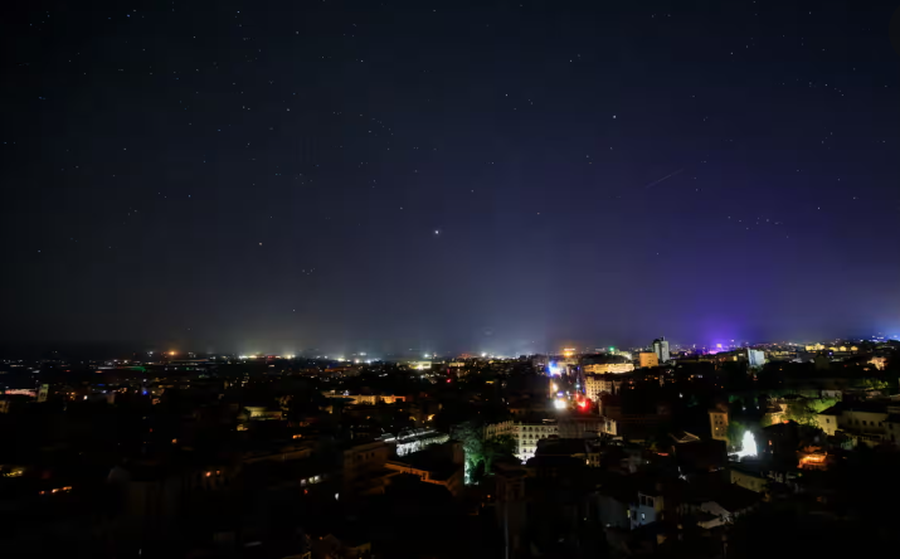
Spanish PM says 'no hypothesis is ruled out' after energy providers concluded cyberattack was not the cause of blackouts
Spain's Prime Minister Pedro Sánchez has vowed to "reveal to the end" the unprecedented power outage that hit the Iberian peninsula on Monday, after energy operators in Spain and Portugal ruled out the possibility of a cyberattack.
The power outage, which plunged cities into darkness and left tens of thousands of commuters stranded on trains, is thought to have led to the deaths of at least five people in Spain. A family of three died of apparent carbon monoxide poisoning after using a generator in the northwest of the country, while a woman died in Valencia after her oxygen machine broke down. Another woman died in Madrid in a fire started by a candle.
Speaking on Tuesday morning after power had been restored to both countries, Sánchez said it was still too early to know exactly what had gone wrong with the power supply. He added that lessons would be learned to prevent any further large-scale outages.
"It is clear that what happened yesterday cannot happen again," he said, as he announced the creation of a commission to investigate the incident, which will also examine the role of private energy companies.
The prime minister said his administration would "see this issue through to the end," carrying out any necessary reforms and adopting any necessary measures to ensure there was no repeat of Monday's events.
Portugal's Prime Minister, Luís Montenegro, said his government would ask the EU Agency for the Cooperation of Energy Regulators to carry out "an independent audit of the electricity systems of the affected countries to fully determine the causes of this situation."
Despite energy providers in Spain and Portugal concluding that a cyberattack was not the cause of the power outage, Sánchez stressed once again that "no hypothesis" was being ruled out, while the country's intelligence services continued their investigations and analysis.
The prime minister also warned people to be vigilant against fake news still circulating and rejected suggestions that the power outage was a result of his administration's decision to phase out nuclear power.
"Those who link this incident to the lack of nuclear energy are frankly lying or demonstrating their ignorance," Sánchez said, adding that nuclear power generation was "no more resilient" than other sources of electricity.
Not long after he spoke, Spain’s highest criminal court, the Audiencia Nacional, said it had opened an investigation to determine whether “an act of computer sabotage” could have been carried out “against critical Spanish infrastructure.” Announcing the investigation, a judge at the court said cyberterrorism was “among the possible explanations” for the power outage.
However, a few hours ago, Spain's electricity operator, Red Eléctrica, said the power outage was not the result of a targeted attack.
The operator's head of services, Eduardo Prieto, said that preliminary investigations mean that "we can rule out a cybersecurity incident", adding that there was nothing to suggest "that there has been any kind of interference in Red Eléctrica's control system".
Prieto said two consecutive events, which occurred at 12:32 p.m. Monday and then a second and a half later, indicated a "generation outage" that had disrupted supply across the peninsula. While the system withstood the first event, it could not cope with the second. Prieto said the problem originated in southwestern Spain, where most of the country's solar power is generated.
The Portuguese government also ruled out a cyberattack.
"In Portugal, we have no information about a cyberattack or a hostile act at this stage," a government spokesperson told CNN Portugal, adding: "It appears there was a problem in the energy transmission network [in Spain]."
By late Tuesday morning, all electricity substations in Spain were back in operation and the country's entire electricity supply had been restored. Across the border in Portugal, electricity operator REN said all substations were fully operational and the national grid had been "perfectly stabilized" by 11:30 p.m. Monday.
In a statement early Tuesday, Spain's national meteorological office, Aemet, appeared to rule out weather as a possible cause. "During the day of April 28, no unusual meteorological or atmospheric phenomena were detected, nor were there any sudden temperature changes in our network of meteorological stations," Aemet said.
REN also said it had not sent a message circulating on social media on Monday attributing the power outage to a rare atmospheric event. The message, in Portuguese, claimed the outage was due to "a fault in the Spanish electricity network linked to a rare atmospheric phenomenon."
"REN confirms that we have not published this statement," a spokesperson told Agence France-Presse.
All of Spain's airports were operational on Tuesday morning, but the transport ministry advised people to check with airlines for possible changes and to find out if they would be able to get to the airport by public transport.
State rail operator Renfe said the country's rail network, which was hit hard by the power outage, was gradually returning to normal, but local train services were suspended in regions including Murcia, Extremadura and Andalusia.
About 35,000 people were rescued from more than 100 trains after the power outage on Monday.
In 2003, a problem with a hydroelectric line between Italy and Switzerland caused a power outage for about 12 hours, and in 2006 an overloaded power grid in Germany caused power outages in parts of the country and in France, Italy, Spain, Austria, Belgium and the Netherlands. / Adapted from The Guardian Pamphlet /






Lini një Përgjigje