


 Shkruar nga Pamfleti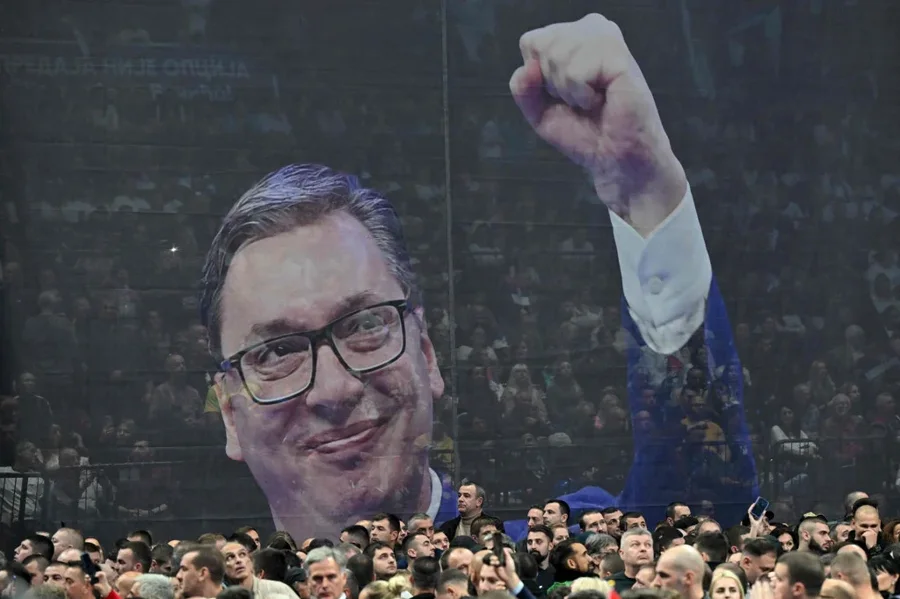
The entire campaign in Serbia for the parliamentary and local elections came down to Vučić's superpower, summed up in the slogan "We will not give Kosovo!".
Those who, when it comes to the "holy Serbian land", believed his progressives, believing that he resisted all EU pressures regarding the constitutional integrity of Kosovo, the southern Serbian province, as Belgrade calls it, were wrong. official.
Quite the opposite, while in the pre-election campaign there was a lot of noise about today's Obiliq, the branches of Komercijalna in Kosovo fell into a whisper.
Workers were given their notices along with the agreed severance pay and customers were told to go to the nearest office in Vranje, Serbia, which is more than a hundred kilometers away from Gracanica, for example, to collect their payments in dinars.
What is it about?
Apparently, in a silent agreement with the representatives of the international community, Prishtina declared the euro the only official currency in the territory of the Republic of Kosovo and thus expelled the Serbian dinar, in which a good part of the Serbs from the north of Kosovo receive their salaries and pensions from Belgrade.
Although the European Commission asked the Prime Minister of Kosovo, Albin Kurti, for a statement on this action, Miroslav Lajçak, the EU's special representative for the dialogue between Belgrade and Pristina and other regional issues, despite the opposition of Aleksandër Vucic, is extremely silent.
In this way, the existence of a parallel educational, health and cultural system in Kosovo, which is managed by Belgrade, in the areas where the Serbian majority population lives, is prevented. The professional staff who perform these jobs often come from Serbia, so the big question is how many of them will stay in their jobs after they realize that they will no longer be able to receive salaries in dinars in Kosovo.
Only through the Office for Kosovo, the mother country sends more than one hundred million euros to the Serbs in Kosovo every year. Without that money, as well as the fact that in the north of Kosovo, municipal services have been reduced to a symbolic level thanks to the Government of Belgrade, the remaining Serbs, who despite everything do not want to leave their homeland, would have moved out.
During all these years in the north of Kosovo, mostly in Mitrovica of Kosovo, and to a lesser extent in the Serbian enclaves throughout the country, a kind of dual government has ruled. Public service employees and pensioners of Serbian nationality receive salaries and pensions from Serbia in the national currency of that country, even though they live in Kosovo, whose existence has been condemned by a large part of the international community.
From now on, everyone who is still financially tied to their country will have to go to Serbia to get money for salaries or pensions. That is, what Komercijalna bank has already done in Kosovo, it is ready to do under the control of Belgrade, which Prishtina is forcing to respect the legal integrity of Kosovo and the payment system defined by the Constitution and laws of that country.
At the same time, two processes are underway by which Serbia de facto recognizes Kosovo.
The first is that vehicles with registration marks for the official Belgrade of the unknown state of Kosovo can move freely through Serbia and the second is that in recent days Serbs have been flooded with requests for the issuance of passports of the Republic of Kosovo because, thanks to the grace of To the political West, it offers all citizens of Kosovo visa-free access to the countries of the Schengen border area.
As they say from Prishtina, Kosovo is no longer in a cage and its citizens can travel freely to the European Union, which was welcomed with equal enthusiasm by Albanians and Serbs, so they often wait together in long lines to get their passports. Kosovo.
After the Serbs south of Ibri were practically integrated into all the institutions of the Republic of Kosovo, because a good part of them have all the official documents and receive their salaries and pensions in euros, now the same process has started in the north of Kosovo, away from the witnesses, has no desire to accept President Aleksandar Vučić, to whom the EU, despite not turning its back on Putin and Russia, will not withhold funds from pre-accession funds or introduce visas jobs for Serbs working in EU countries.
The Central Bank of Kosovo has officially announced that from February 1 in Kosovo, the euro will be the only currency that can be used for cash transactions and in the payment system.
Since the beginning of the year, the application of the visa-free regime for citizens of Kosovo for travel within Schengen has come into force, which enables citizens of Kosovo to travel within these countries without visas for up to 90 days in every 180 days. period.
The Government of Kosovo adopted a decision approving the end of mandatory stickers on vehicle plates registered in Serbia, and from the beginning of the year, cars with Kosovo plates can enter Serbia, even though Belgrade does not formally recognize the existence of Republic of Kosovo. She does not officially accept it, but obviously, step by step, she accepts the real state of affairs./ Adapted from Slobodna Dalmacija, Pamphlet


Lini një Përgjigje