


 Shkruar nga Pamfleti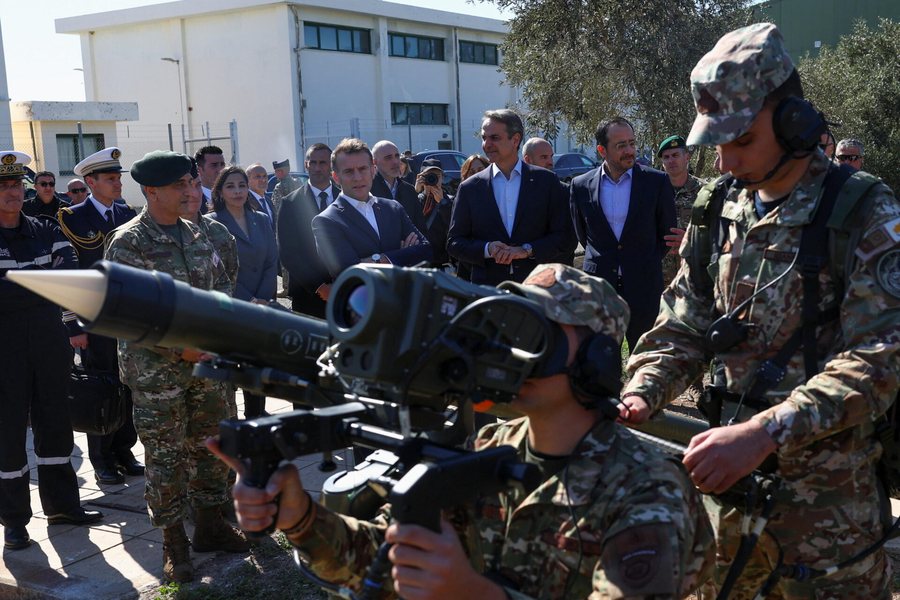
The French president's visit and the increased military presence in the eastern Mediterranean highlight regional tensions and Cyprus' role in the European security architecture...
French President Emmanuel Macron’s visit to Cyprus in early March 2026 was accompanied by strong political statements. “When Cyprus is attacked, Europe is attacked,” he declared during a joint appearance with Cypriot President Nikos Christodoulides and Greek Prime Minister Kyriakos Mitsotakis at the Paphos air base. The statement placed the island at the center of a new narrative on European defense, following the attack by an Iranian-made drone on the British base RAF Akrotiri, the first installation on European soil to be hit in the context of the Middle East conflict.
France has accompanied the rhetoric with concrete actions. Paris has deployed air defense systems, the nuclear aircraft carrier Charles de Gaulle, the frigate Languedoc and a significant air component to the eastern Mediterranean. It has also announced the intention to create a European naval mission along the Red Sea and the Strait of Hormuz. Other European countries have also been involved in this framework: Spain has announced the dispatch of the frigate Cristóbal Colón, while Italy has announced the dispatch of the frigate Martinengo, in coordination with French forces.
Relations between France, Greece and Cyprus have historical roots. During the dictatorship of the colonels in Greece, many dissidents, including Constantinos Karamanlis, found refuge in Paris. These ties have transformed into lasting political, economic and military cooperation. In 2021, Athens and Paris signed a bilateral defense agreement that includes the supply of FDI frigates, Rafale aircraft and Exocet missiles. These contracts are part of a modernization program for the Greek armed forces worth around 25 billion euros.
On December 15, 2025, France and the Republic of Cyprus signed a strategic partnership spanning the fields of defense, economy, and security. The agreement provides for joint exercises and increased French operational support in the region, strengthening Paris' presence in the eastern Mediterranean.
For its part, Greece has sent four F-16 jets to the Paphos base and the frigates Kimon and Psara to strengthen defenses around Cyprus. The move is linked to the long-standing strategic relationship between Athens and Nicosia.
However, the situation remains complex. Cyprus is a divided island: the Republic of Cyprus controls the south, while the north is controlled by the Turkish Republic of Northern Cyprus, recognized only by Turkey. According to Turkish sources, Ankara is considering deploying six F-16 jets to the north of the island, a move that could increase tensions with Greece and its Western allies.
The gap between rhetoric and reality on the ground is obvious. While there is talk of a united Europe, the growing military presence in Cyprus has clear geopolitical implications and is also linked to the rivalry with Turkey.
Within Cyprus itself, reactions are mixed. The AKEL party and other left-wing groups have organized protests against the expansion of the foreign military presence and the government's pro-Western orientation. They criticize the lack of transparency, especially the fact that information about the attacks was made public through British sources and not by Cypriot authorities.
Some analysts have also raised questions about the nature of the threat, suggesting that the drone incident may have been used to justify an increased European military presence, although there is no evidence of deliberate manipulation.
Cypriot analyst Xristos Yakovou emphasizes that the current crisis creates an opportunity to review Cyprus' role in European defense, but warns that the island should not be treated as a simple strategic element without taking into account local and historical sensitivities.
Italy has chosen a more cautious approach. It has sent the frigate Federico Martinengo to the region, but has avoided positions that could be interpreted as a direct confrontation with Turkey. Rome balances economic and strategic relations with Ankara and cooperation with European partners, while also considering the possibility of selling frigates to Greece.
Meanwhile, Russia remains in the background, but retains potential influence through economic ties and the Russian-speaking community on the island.
The Cyprus crisis has taken on a broader dimension than an isolated security incident. It has become a meeting point of European and regional strategic interests. France aims to strengthen its role in European defense, Greece consolidates its position in the region, while Cyprus tries to turn a fragile situation into a more central role in EU security. In an increasingly tense eastern Mediterranean, the island remains a key space in geopolitical developments. /Adapted from “Inside Over”



Franca historikisht la putta!