


 Shkruar nga Pamfleti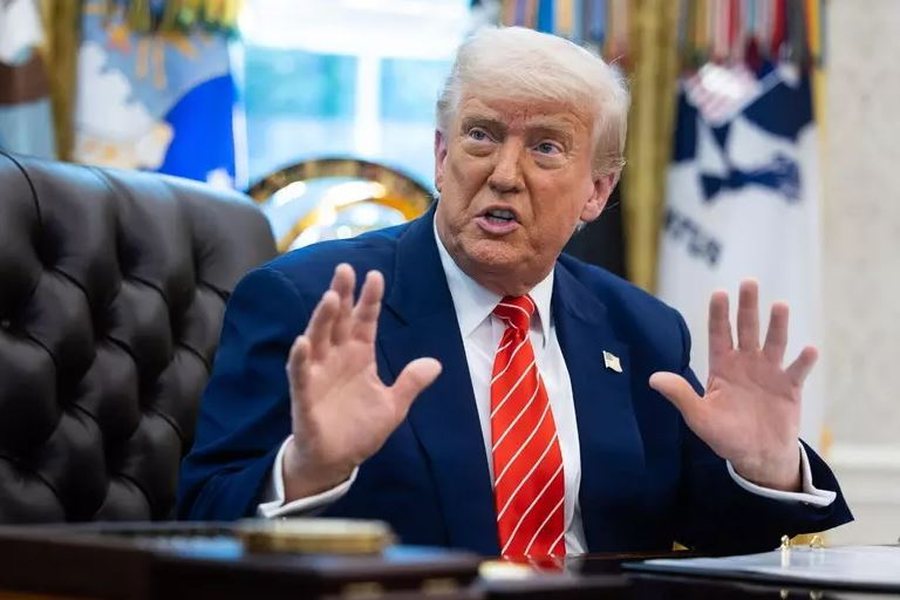
Trump told Iran's leaders: If you don't completely give up uranium enrichment, if you don't surrender unconditionally, "something is going to happen."
The ultimatum could not have been clearer. Trump told Iran's leaders: if you don't completely give up uranium enrichment, if you don't surrender unconditionally, "something is going to happen." It's not a negotiation, it's not a compromise. It's a demand for unconditional surrender.
Just a few days earlier, after Israel's attack on Iran, Trump had chosen a middle path: he gave vague support through American intelligence for the Israeli attacks, which he described as "unilateral" and of course promised defensive support for the ally, but at the same time emphasized that the war would serve as leverage to force Tehran to accept a deal.
But the moment has now come when, if this threat tactic fails, Trump must decide whether this is Israel's war or the United States'. For this reason, the world waited with bated breath yesterday for the outcome of his meeting in the "Situation Room" to understand whether he is ready to help the Israelis destroy the Iranian nuclear plant at Fordow.
The meeting was preceded by a change in Trump's rhetoric in recent hours: not only the disturbing message on social media "evacuate Tehran" shortly before he left the G7 summit prematurely, but above all the use of the pronoun "we" when mentioning regime change, when he wrote "we have complete control over Tehran's airspace" and "we know exactly where the so-called Supreme Leader is hiding. It's an easy target, but it's safe there; we won't get rid of him (or kill him!) at least for now."
Vice President JD Vance's intervention on social media is also significant: he tried to explain a possible US military intervention to the MAGA (Make America Great Again) electorate, saying that "of course people have a right to be concerned about new involvement abroad after 25 years of idiotic foreign policy", but "the president has done everything he can to keep the military focused on protecting our soldiers and citizens". Now, however, "he can decide whether further action is necessary to end uranium enrichment".
The MAGA front, the Trumpian “choir” led by commentator Tucker Carlson, is trying to stop what they see as an inevitable slide into one of those “eternal wars” that their leader has always condemned. Trump, on the other hand, has been berating Carlson on social media and retweeting a message from his ambassador to Israel, Pastor Mike Huckabee, who wrote to him that God had saved him during the Butler assassination attempt to make him “the most important president in history since Truman in 1945”: the one who dropped the atomic bomb on Japan. Netanyahu has convinced Trump that the Iranians are already close to a nuclear weapon.
The two leaders have disagreements, mutual suspicions abound, but they have one thing in common: the conviction that Iran should never have nuclear weapons and that it poses an existential threat to Israel. Before launching its attacks on Iran, Israel had given the United States alarming intelligence that Tehran was conducting new research useful for creating a nuclear weapon – although some American officials, while convinced that Iran had made great progress in its atomic program, were skeptical that it had actually made the decision to build a bomb.
Yesterday, the White House distributed to reporters a list of 15 instances where Trump had stated since the beginning of his term that Iran should never have a bomb; while State Department spokeswoman Tammy Bruce stated that since 2011, these statements had totaled 40.
The Americans had long known that Netanyahu was preparing to attack. On June 8, at Camp David, CIA Director John Ratcliffe told the president that Israel would strike with or without US support. On June 9, Trump spoke on the phone with Netanyahu and realized that he would not be able to stop him. The Israeli prime minister revealed that he had forces inside Iranian territory: this impressed Trump, as he was also impressed by the success of the Israeli operation, a success that he wants to present as his own.
“I believe we will help him ,” he reportedly told his advisers that day. Moreover, Trump was losing patience with the negotiations with Iran: they were not going in the direction he wanted./ Corriere della Sera



Lini një Përgjigje