


 Shkruar nga Luciano Bozzo
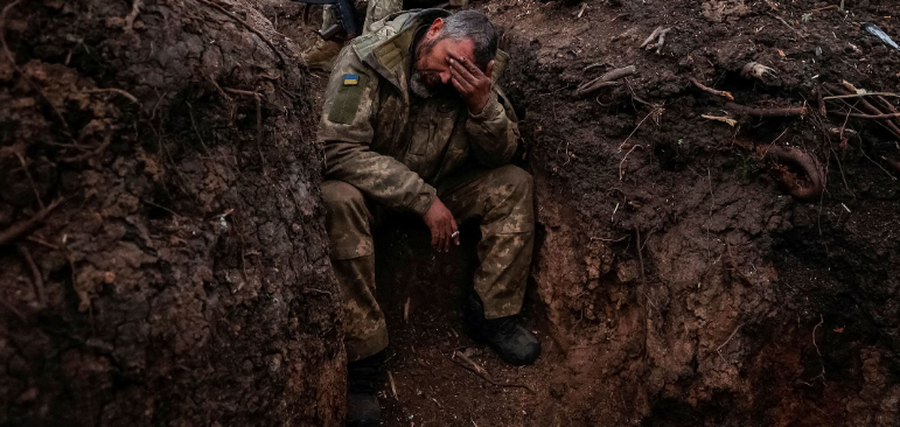
The fight will continue. The result will be determined by the consumption of material and human resources. Regardless of the outcome, the consequences will have a major impact on the future international order (or chaos)...
During the last month, many public statements have been made by national leaders and European institutions, starting with the most sensational one by French President Emmanuel Macron about the possible deployment of NATO troops to the Ukrainian front.
They have "discovered" what was already obvious. What has been happening for more than 2 years is not only or mainly a classic war of aggression by one power against a neighboring country.
Rather, it is a new clash between great powers that began, like similar ones over the past century, with the aggression of one of them against a smaller regional adversary. An aggression accompanied by underestimation of the reactions of other powers but also of the possible consequences.
Such was the case of the First World War, with the attack of the Austro-Hungarian Empire on Serbia, and the Second World War with the attack of Nazi Germany on Poland. Similar is the case of the Crimean War, which began in 1853 with the Russian Empire's attack on the Ottoman Empire, leading the latter to its final crisis.
The following year, France, Great Britain and the Kingdom of Sardinia intervened alongside the Turks, with the political support of Austria. Thus the war turned into a confrontation between the great powers, which like all conflicts of this type, ended the existing international order, the so-called Concert.
On the other hand, the latter was the result of the earlier, long and violent phase of the conflict between the powers: the Revolutionary and Napoleonic Wars. Today, as yesterday, the great powers are aligned with one or the other of the warring parties.
On one side are the United States and NATO allies, first of all Great Britain. On the other side is Iran, North Korea and China. In one respect, the latter is behaving like Austria in 1854. The obvious change today can be seen in the lack of direct participation of the powers in the conflict.
This change is explained by the obvious risk of escalation of the conflict towards a global and nuclear war, which has been repeatedly mentioned by the Russian leadership. But we add to this the lack of preparation of the West, first psychological and then material, in the face of the very hypothesis of the return of war.
Unlike what happened during the Cold War, today the nuclear threat does not contribute to the stabilization of relations between the powers, and does not lead to the definition of a "new nuclear order", that is, a new system of global security. Instead, this threat prevents a deep strike on the contenders' logistical support resources or the establishment of a "no-fly zone" over Ukrainian skies.
Wars between great powers have a common feature often ignored by a military literature that has made its own an evocative narrative in which the outcome of the conflict depends on the attack, if not the decisive battle. In reality, these kinds of wars - see the examples mentioned - are or at least turn into wars of attrition.
The powers that can in the long run commit greater financial, economic and demographic resources to the war end up on top. That is why I emphasized from the beginning of the war in Ukraine that the conflict would be long and that the expectation of a decisive attack was largely illusory.
Of course, in addition to the outcome determined by the effects of long wars (the consumption of resources and people), the power involved in such a war can collapse for internal reasons. Such was the case of Czarist Russia and the Austro-Hungarian Empire in the First World War. But the fall of the first was also caused by the great losses suffered in the first 3 years of the conflict, while that of the second was caused by the explosion of centrifugal nationalist forces.
The year of the Bolshevik Revolution was also that of the Caporetto defeat and widespread desertions among the French troops. Therefore, it is possible and with some strong reason to hypothesize that there is a certain level of costs, and above all human losses, which cannot be predetermined, and beyond which the continuation of the war becomes extremely difficult for each belligerent. .
However, it cannot be ruled out that a similar level is imminent in Russia, as in Ukraine. The ability to return the production system of the Russian Federation to a war economy, the limited "bypass" effect of sanctions and new buyers - first on the list is India - of Russian fossil fuels allow Moscow to continue the war. The same can be said for the recruitment of young soldiers in the peripheral regions and for mercenary groups of various kinds, which soften the effect of the losses in the big cities, where the most westernized segments of Russian society live.
Neither the consolidation of Putin's leadership, the result of the elimination or removal of his opponents, the recent tactical successes on the front, the result of the presidential elections and the terrorist attack in Moscow, do not allow us to believe that there will be an internal coup soon.
The fight will continue. The result will be determined by the consumption of material and human resources. Regardless of the outcome, the consequences will have a major impact on future international order (or chaos). Ukraine's resistance is decisive and possible, but it obviously depends on external support.
All the countries of the European Union should take this into account and at least consider it realistically as the "worst case scenario". This does not mean, as is often repeated, to create the conditions for an "inevitable war". On the contrary, it is about the reconstruction of a reliable conventional preventive capacity, which, through a nuclear guarantee, makes war avoidable./ Adapted Pamphlet from "'Formiche.net"


Lini një Përgjigje