


 Shkruar nga Pamfleti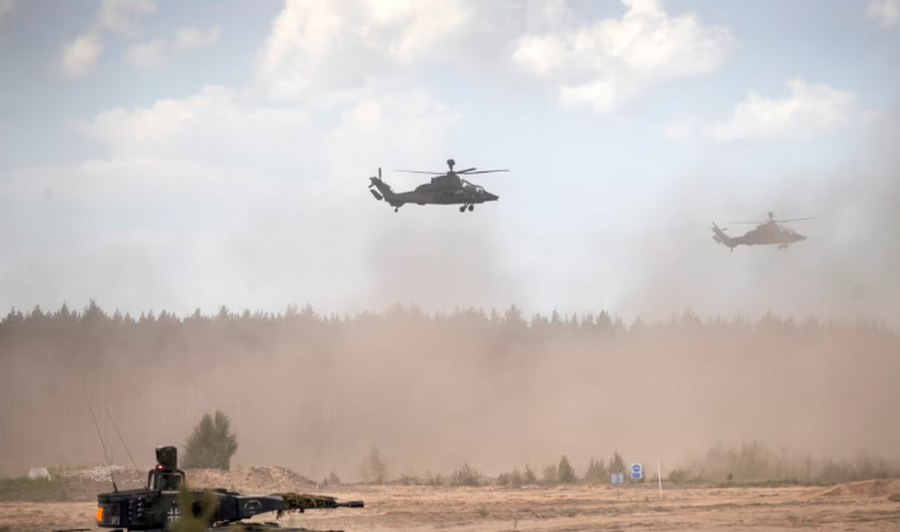
European countries could face a trillion-dollar rearmament bill in light of the growing threat from Russia and a new defense review by the United States that could lead to a dramatic withdrawal of American forces from the continent, a report published on September 3 said.
The 106-page report by the London-based International Institute for Strategic Studies (IISS) highlights shortcomings in all areas: in production, intelligence, and military equipment such as long-range missiles or air and missile defense systems.
"One of the main reasons for this greater urgency is the military threat from Russia and uncertainty over US commitment to the defense of European allies," the report said.
"While strategic assessments differ among European countries on how soon Russian forces could pose a direct threat to NATO in Europe, their timescales typically range from two to five years."
Meanwhile, the Pentagon's Global Force Review is expected to be published this month and present a shift of military resources from Europe to Asia/Pacific.
"Some NATO officials believe that a reduction of up to 30 percent of US troops could occur," the report, titled "Progress and Shortcomings in European Defense: An Assessment," said.
Increasing budgets for armies
European leaders have been making plans this year to respond to these challenges. In March, at a European Union summit, leaders pledged to spend billions on defense, with European Commission President Ursula von der Leyen calling it a “defining moment for Europe.”
EU-backed loans of up to €150 billion have been made available to member states to strengthen their militaries, and Eurozone debt rules have been relaxed regarding military spending.
US President Donald Trump has repeatedly criticized European NATO allies for not spending enough on defense and relying too heavily on US military power. But he has recently praised them for pledging to spend more, especially after a NATO summit in June, when member states agreed to increase defense budgets to 5 percent of gross domestic product.
But the IISS report highlights that this is not just a matter of money. A key problem, according to the report, will be building military capacity.
“Europe’s defence industries continue to face challenges in scaling up production as quickly as required, with many European militaries failing to meet their recruitment targets,” the report said. The
IISS report highlights that Integrated Air and Missile Defence (IAMD) is an area where Europe is particularly vulnerable.
Current and former US military commanders have told Radio Free Europe that Europe's air defenses are not prepared to deal with the scale of the threat from Russia.
"You see what happened in the big cities of Ukraine. The same thing could happen in some of the big cities of Europe," Philip Breedlove, former NATO supreme commander in Europe, told Radio Free Europe in April.
Long-range missiles
Another weakness highlighted in the IISS report is long-range missiles.
European countries have very effective cruise missiles – air-launched – such as the Anglo-French Storm Shadow/Scalp missiles or the German Taurus system.
Meanwhile, Ukraine – which is not a NATO member – recently unveiled its new Flamingo cruise missiles.
But, "only a few European allies currently have land-based systems for precision and long-range attacks, while in the maritime aspect, only France and the United Kingdom have sea-to-land cruise missiles with a range of 1,000 kilometers," the report says.
“The European Long Range Attack Approach [ELSA] project is potentially the most significant European effort to extend its conventional land attack capability to, and possibly beyond, 2,000 kilometers,” the report said.
The project was launched by France, Germany, Poland, and Italy. It was later joined by Britain, Sweden, and the Netherlands.
Other weaknesses cited in the report include a lack of surveillance and intelligence aircraft, “sovereign large-scale data processing capabilities,” and a slow and uncoordinated procurement process.
The spending demands come at a time when European governments are also facing huge pressures for non-military spending in sensitive areas such as health, education and social affairs.
Meeting these challenges, the report said, "will require many European NATO allies to take significant financial risks and make very difficult political decisions."/ REL





Lini një Përgjigje