


 Shkruar nga Pamfleti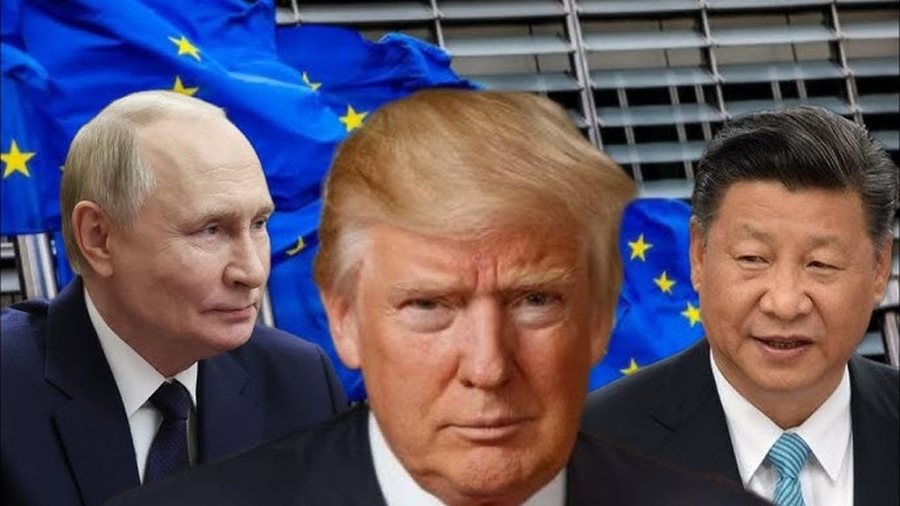
President Trump's recent statements regarding his intention to acquire Greenland "by any means" have provoked a series of reactions and indignation from many governments and international observers, writes ispionline.it.
However, this statement is part of a growing trend of interest in the Arctic region, involving not only the United States but also other international players, including China, Russia, and the European Union, albeit with different goals and approaches.
The reasons for this interest lie in the growing global demand for strategic minerals, rare metals and hydrocarbons, of which Greenland and, in general, the Arctic is abundant.
In 2023, the Geological Survey of Denmark and Greenland (GEUS) identified approximately 6 million tons of graphite, 36 million tons of rare earth metals, 235,000 tons of lithium, 75,000 tons of copper and other critical metals in Greenland's subsoil.
Furthermore, due to melting ice and the opening of new sea routes, the Arctic is also taking on increasingly important strategic importance, both from an international trade and political-military perspective.
With the end of so-called “Arctic exceptionalism” (the polar region’s tendency to remain outside of interstate disputes) and the devastating effects of climate change, Greenland finds itself caught up in an “Arctic race” that goes far beyond Trump’s expansionist ambitions and involves, among others, China, Russia, and the European Union.
China in Greenland: Between mineral resources and political involvement
One of the reasons cited by Trump for Washington's desire to gain control of Greenland is China's increasingly massive presence in the Arctic, which poses a threat to US security.
This is reflected in the Chinese government's stated intention to increase its presence in the Arctic through investment and political involvement.
For years, China has defined itself as a country “near the Arctic,” and in 2018, the Chinese government published a strategic document titled “China’s Arctic Policy,” which highlighted its interests in sensitive areas such as natural resource exploitation, the fight against climate change, and security in the Arctic.
Most recently, China has been an observer member of the Arctic Council since 2013. Amid growing Chinese interest in the Arctic, Greenland (China is its main trading partner), with its strategic location between Europe and North America and its wealth in minerals and rare metals, has been targeted by Chinese investment for several years.
"Gateway to the Arctic": Greenland's strategic importance to Russia
In addition to China, Trump also cited Russia's military presence around Greenland as a further reason to ensure US control over the island.
While from China's perspective, Greenland represents an opportunity to expand its control over global production of minerals and rare metals, for Russia, it has a much more strategic importance in maintaining its security in the Arctic.
Brussels Strategy: Economic Security, Partnership and Political Challenges
In all of this, it is important to remember that Greenland is an integral part of the Kingdom of Denmark and, although it has not been a member of the European Union since 1985, it is considered one of the EU's "overseas territories".
Recently, the interest of the European Commission and EU member states in Greenland has increased significantly, mainly due to the need to gain access to minerals and rare earth metals essential to continue Europe's energy transition without dependence on external actors such as China or Russia.
The European Union's interest in Greenland is based primarily on economic security issues.
As specified by the European Commission itself: “Twenty-five of the thirty-four rare earth metals needed for the energy transition of the European economy are present in the subsoil of Greenland.”
Therefore, in November 2023, a memorandum of understanding was signed between the Commission and the Government of Greenland for a strategic partnership aimed at creating a sustainable supply chain for the exploitation of rare metals on the Arctic island, thus placing the country in geoeconomic competition with the United States itself.
Furthermore, in March last year, Commission President Ursula von der Leyen travelled to Nuuk to open a new EU representation in the capital of Greenland, demonstrating the European Union's growing commitment to issues relating to the Arctic island.



Lini një Përgjigje