


 Shkruar nga Pamfleti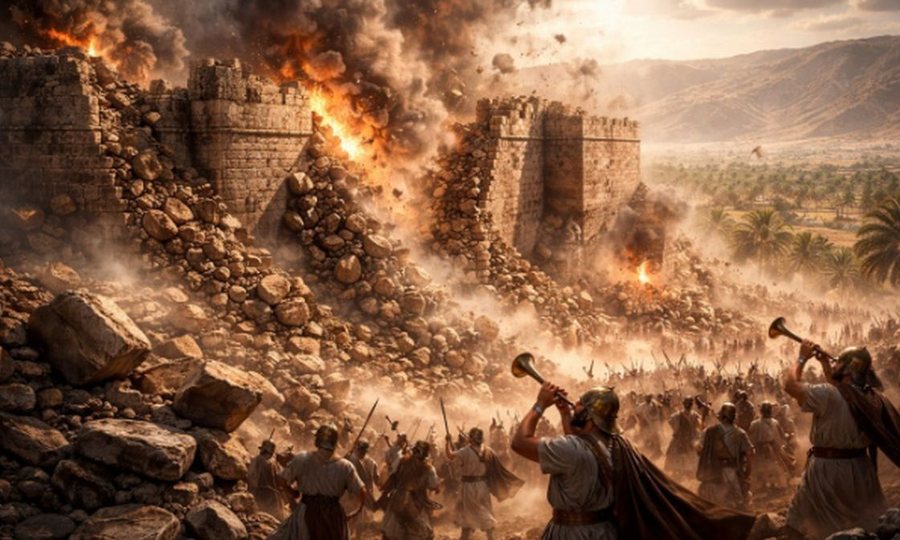
Jericho is often described as the oldest continuously inhabited city in the world. Its fall, described in the Old Testament as a spectacular divine miracle, is one of the best-known accounts in the biblical tradition.
However, modern archaeology paints a much more complex, less spectacular, but extremely interesting picture of what really happened in this oasis on the outskirts of the Jordan Valley.
Jericho is located in one of the oldest inhabited places on the planet. For more than ten thousand years, people have been returning to the area, building houses, fortifications and, later, city walls.
These walls became the central symbol of the well-known biblical story in the Book of Joshua, where they supposedly collapsed on their own after a ritual performed by Israelite priests.
This image is deeply etched in Western collective memory, but the true history of Jericho is much more complex than the biblical text suggests.
What do the excavations show?
Archaeological research at Tell es-Sultan has continued for more than a century. Each generation of archaeologists has added new evidence, but also new controversies. Early 20th-century scholars sought evidence that would directly confirm the biblical account.
However, modern archaeology attempts to reconstruct the city's long and discontinuous history through stratigraphy, radiocarbon dating, and analysis of finds. As a National Geographic review points out, Jericho was destroyed and rebuilt many times, not because of a single catastrophic event.
The crucial issue is timing. The biblical account places the fall of Jericho around the 13th century BC, the period when, according to tradition, the Israelites arrived in Canaan. However, archaeological layers indicate that at that time the city was probably sparsely populated or even abandoned.
The clearest layer of destruction, associated with fire and the collapse of walls, appears to date to around 1550 BC, several centuries earlier than the biblical chronology.
Myth, memory and history
These findings do not mean that biblical history is "fabricated" in the modern sense. Rather, they show how true historical events can be gradually transformed through oral tradition.
The memory of a real disaster may have been preserved for generations and later incorporated into a theological framework intended to convey meaning and moral lessons. Similar processes are observed in other ancient cultures, where history and myth coexist.
Archaeologists also point out that the fall of Jericho may have been due to natural causes. The area is highly seismic, and strong earthquakes are no exception.
Some studies suggest that a major earthquake may have caused the collapse of the walls and the fires that followed. Such an explanation is less impressive than divine intervention, but it is more consistent with the natural traces that have been identified, as summarized in the Encyclopædia Britannica analysis.
Even the biblical text itself, according to some historians and theologians, can be read non-literally. The description of the march around the city, the trumpets, and the collapse of the walls can function as a literary symbol of the victory of faith over obstacles rather than as a detailed account of a military operation. In this perspective, Jericho becomes more of a metaphor than a specific battle.
Why Jericho continues to worry us
Modern archaeology does not necessarily contradict the belief, but rather expands our understanding of the past. It shows that Jericho was not a single city at a single point in time, but a long-term phenomenon of settlement, decline, and rebirth.
Each layer of soil tells a different story about climate, population movements, technology, and social conflict.
The "Fall of Jericho" cannot be limited to just one day or a single event.
What makes Jericho special is not just its age, but also its ability to raise questions about how we understand history. It is a place where archaeology, religion, politics, and identity collide. Therefore, each new discovery has not only scientific but also social significance.
Perhaps, ultimately, the important question is not whether the walls fell exactly as the Bible describes them.
More important is understanding how people in the past told their stories and how they changed over time.
Jericho reminds us that history is not static, but a mosaic of events, interpretations, and evolving human memory.







Lini një Përgjigje