


 Shkruar nga Mario Lavia
Why this openly displayed declaration of loyalty to Trump...
It's hard to believe that the prime minister doesn't understand how little Italians like the hard-nosed politics of the White House chief. So why this overt declaration of loyalty to Trump just over a month before a referendum in which she herself is struggling?
The recent election of the Prime Minister could become an impetus for the "No" vote. It is clear that on March 22 and 23 every issue counts. Therefore, it is not easy to understand why Giorgia Meloni has suddenly changed course towards Donald Trump, precisely at a moment when he is facing obvious difficulties according to all the polls.
However, Meloni did not hesitate to distance himself from Friedrich Merz, who in Munich had marked a clear division between Maga politics and European interests and values, choosing the latter. The rejection of Merz came just a few days after the mention of the "Italian-German engine", which now seems devalued.
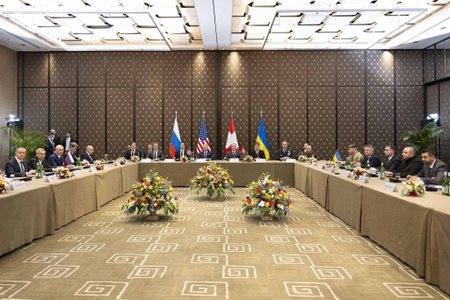
Then came another unexpected step: Italy's accession "as an observer" to the Board for Peace group. For once, the opposition appeared united in opposition, as is expected to happen in Parliament, where Antonio Tajani will have to justify a choice that finds no support even in the Presidency of the Republic.
So why did the theorist of the "bridge" between Europe and the United States hit the very pillars of that bridge? And why did he act so quickly, precisely the one who seemed to have chosen a more measured, less noisy, and less divisive tactic?
What is behind this new and hasty homage to the Ice leader? It cannot be just a question of ideological loyalty to the American ally. Augusto Minzolini has argued that the prime minister does not want to be surpassed to the right by the new rival Roberto Vannacci. But it would be inappropriate if she were to put national dignity at stake in order not to lose a few votes. Moreover, the general does not challenge her in the relationship with Washington, but on the ground of sovereignty and, to some extent, rapprochement with Putin. The closer Meloni gets to the Maga line, the more he can present himself as a pure nationalist.
First, Meloni seems not to consider that this new layer of Trumpism could cost him more than a few votes in the referendum, where it is already clear that many issues are intertwined. In Italy, the vote is never neutral or merely technical; it becomes a general political judgment. Every voting process takes on a plebiscite character. Italy is not Switzerland.
Every ballot box measures the level of consensus, every ballot carries a political message. So there may be something more that is not entirely apparent. This may be related to Donald Trump's unusual intervention in European politics: direct, as in his public support for Viktor Orbán during Hungary's electoral difficulties; and indirect, through allegations of American funding of European right-wing party foundations.
Politico recently cited Nazione Futura and the Machiavelli Foundation as entities that may have received financial support from the Americans. Representatives of these foundations denied the allegations. However, on February 6, the Financial Times reported on a European mission by the State Department's deputy representative for public diplomacy, Sarah Rogers, with stops in Rome and Milan, with the aim of supporting European structures close to the Maga world.
It could be that Giorgia Meloni fears losing the support of the Trumpian circle at a delicate moment for her. There could also be deeper factors, connections that are not apparent. Mar-a-Lago may have requested a new declaration of loyalty, which she has given. But such an action could have a cost in the referendum vote. It could be the price of securing the support from Washington that she considers necessary./ Adapted from "Pamphlet" by "Linkiesta"


Lini një Përgjigje