


 Shkruar nga Pamfleti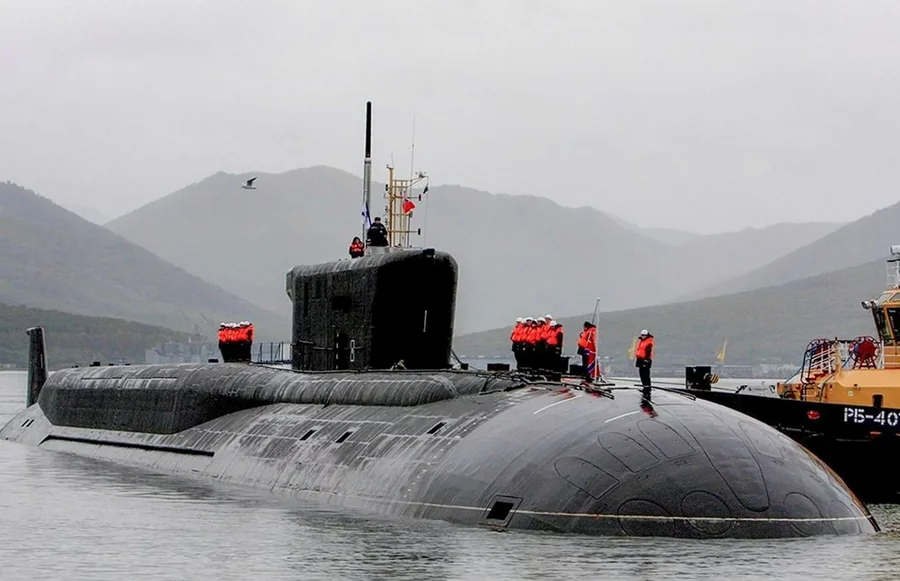
According to information published by the Moscow Times, Russian President Vladimir Putin stated during a high-level meeting in Severodvinsk that expanding the fleet of nuclear-capable submarines is essential to ensure the country's sovereignty and maintain regional and global stability...
Russian President Vladimir Putin emphasizes that over the past 6 years, the Russian Navy has put into service 5 Borei-A-class strategic missile submarines and 4 Yasen-M-class nuclear-powered multifunctional attack submarines.
Looking ahead, the Kremlin confirmed the planned delivery of four additional Borei-class submarines, two of which are already under construction at the Sevmash shipyard in Severodvinsk, Russia’s largest shipbuilding enterprise. These strategic assets will form the core of Russia’s sea-based nuclear defense in the coming decades and will play a central role in maintaining the operational reliability of its strategic forces.
Technically, the new Borei-A class (Project 955A) represents the most advanced generation of Russian ballistic missile submarines (SSBNs) ever developed. Each submarine is approximately 170 meters in length, with a beam of 13 meters and an underwater displacement of about 24,000 tons. They are powered by an OK-650V pressurized water nuclear reactor with an auxiliary steam turbine and a single shaft, enabling smooth propulsion and stable operation underwater for extended patrol missions.
The Borei-A is designed with hydrodynamic improvements over its predecessor, including a pump-jet propulsion system, redesigned bow, and a lower acoustic signature achieved through improved hull plating, vibration isolation for the machinery, and improved propeller design. These advances make it one of the most stealthy SSBNs in Russia's arsenal and significantly improve its survivability in contested environments.
In terms of armament, each Borei-A submarine is equipped with 16 silo-based vertical launch systems for the RSM-56 Bulava (SS-N-32) submarine-launched ballistic missile (SLBM). The Bulava is a three-stage solid-fuel missile with an estimated range of between 8,000 and 9,000 kilometers and the ability to carry six to ten MIRV warheads, each with independent targeting capabilities.
In addition to its strategic armament, the Borei-A can carry torpedoes and anti-ship missiles launched from six 533 mm torpedo tubes forward, increasing its self-defense capability against enemy submarines or surface ships during patrols. The class is also equipped with an integrated combat management system, advanced sonar arrays including wing-mounted and towed passive sensors, and satellite navigation linked to the GLONASS constellation for precise underwater positioning.
The new Borei-A submarines significantly enhance the Russian Navy’s ability to maintain a secure second-strike position, which is central to Moscow’s nuclear doctrine. These submarines are capable of launching their missile payloads while submerged, reducing their vulnerability to preemptive strikes. Their exceptionally low noise profile and ability to operate at great depths allow them to conduct covert patrols in the Arctic Ocean, North Atlantic or Pacific, where detection by enemy ASW platforms remains limited. The Arctic ice cover, in particular, serves as a natural shield, enabling Russia to create secure bastions for SSBN operations, particularly in the Barents Sea and the Sea of Okhotsk. This strategy has been a cornerstone of Soviet and now Russian strategic planning, and the Borei-A class ensures that it remains viable even in an era of increased Western maritime surveillance.
Furthermore, the integration of the Borei-A class into the Northern and Pacific Fleets will ease the burden on the aging Delta-IV class submarines and provide 24-hour preventive patrols, with a reduced risk of compromise. Their automation and reduced crew requirements, around 107 people, a relatively small number for an SSBN of this size, increase operational efficiency and reduce the logistical burden during extended deployments. With nuclear propulsion providing a virtually unlimited range, these submarines can remain at sea for up to 90 days, maintaining high levels of readiness without returning to port.
The strategic imperative behind this naval modernization becomes clearer when considered in the broader context of Russia’s evolving perception of the maritime threat. Moscow increasingly sees NATO naval deployments in the Arctic, Baltic Sea, and North Atlantic as encroaching on what it considers strategic buffer zones. U.S. and allied forces have intensified submarine and maritime patrol activities near Russia’s northern and eastern maritime perimeter, while advances in Western anti-submarine warfare capabilities, including P-8A Poseidon aircraft, unmanned underwater vehicles, and SOSUS-style acoustic arrays, have further strained Russian submarine operations. In response, the Borei-A program is designed not only to evade these surveillance networks but to serve as a counterweight to the U.S. Ohio-class SSBNs and future Columbia-class platforms.
Beyond deterrence, Russia also sees these submarines as tools of geopolitical influence. The Arctic region, rich in untapped natural resources and open to new sea routes due to climate change, has become a focal point of great power competition. By maintaining a reliable and modern SSBN fleet capable of operating undetected in these waters, Russia ensures that it remains a dominant player in the militarization of the Arctic. Furthermore, in the Pacific theater, the deployment of Borei-A ships at the Rybachy base on the Kamchatka Peninsula reinforces Russia’s strategic presence near U.S. naval assets in the Asia-Pacific and strengthens its ability to project power along the Northern Sea Route.
The Borei-A class submarines represent more than a technical upgrade to Russia’s strategic forces. They are a crucial move to maintain naval nuclear parity, bolster assured second-strike capabilities, and assert Moscow’s status as a global naval power. As competition among great powers intensifies, these submarines will serve not only as instruments of deterrence but also as symbols of Russia’s determination to shape the balance of power across the world’s oceans. /Adapted from Armyrecognition/



Lini një Përgjigje