


 Shkruar nga Pamfleti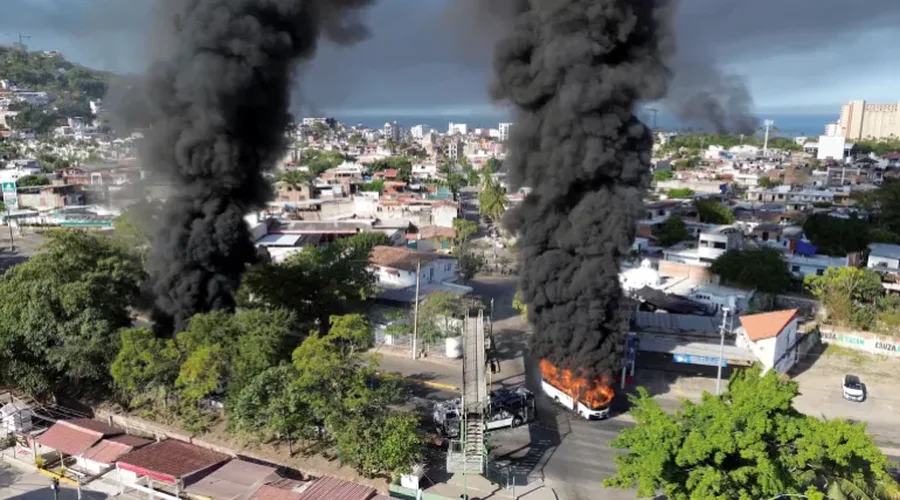
The killing of Nemesio Ruben Oseguera Cervantes, known as "El Mencho" and leader of the Jalisco New Generation (CJNG) cartel, has sparked a wave of violence in several Mexican states, including Jalisco. He was reportedly killed on Sunday during a Mexican army operation.
Immediately after the news broke, suspected cartel members launched coordinated retaliatory attacks in more than 20 countries. They set fire to stores and gas stations, blocked highways with trucks, and erected burning barricades, known in Mexico as “narcobloqueos,” paralyzing cities and cutting off major highways.
Miguel Alfonso Meza, director of the Mexican human rights organization Defensorx, told Al Jazeera that the attacks caused widespread panic among the population. According to him, the violence was intended to demonstrate the strength and reach of the cartel after the loss of its leader.
In Jalisco alone, more than 25 members of the National Guard were killed, making it one of the bloodiest days for federal authorities. Meza described the situation as a terrorist attack, arguing that the use of violence was intended to spread fear in society.
What is the Jalisco New Generation Cartel?
The CJNG is considered one of the most powerful criminal organizations in Mexico. Founded around 2009–2010 from the remnants of the Milenio cartel, the group quickly became a dominant player in the country's drug trafficking.
The cartel developed a reputation for brutal violence, often compared to that of the former Los Zetas cartel. The latter was formed by former elite soldiers who defected and brought military tactics to organized crime, notable for its brutality and expansion into kidnappings, extortion, and fuel theft.
Activities and international outreach
The U.S. State Department describes the CJNG as one of the most powerful drug trafficking organizations in Mexico, with vast distribution networks for cocaine, heroin and methamphetamine. In recent years, the cartel has played a significant role in trafficking fentanyl to the United States, a synthetic opioid linked to thousands of deaths.
In addition to drugs, the group profits from extortion, migrant smuggling, and the theft of oil and minerals. It operates throughout much of Mexican territory and has established international trafficking routes that extend into Latin America, the United States, and parts of Asia.
The cartel has also been linked to direct attacks against security forces and public officials. In 2015, gunmen shot down a military helicopter with a grenade launcher during an operation to capture its leader. In June 2020, the group staged an assassination attempt on Mexico's then-Secretary of Public Security, Omar Garcia Harfuch, in Mexico City. He survived, while two bodyguards and a civilian were killed.
What awaits Mexico after the killing of 'El Mencho'?
The death of Nemesio "El Mencho" Oseguera is one of the most significant blows to a Mexican criminal organization.
While experts note that the CJNG may now be in a "weaker position," many others warn that "cutting off the cartel's head" without dismantling its resources is a mistake.
Critics argue that instead of long-term "financial strangulation", the government has reverted to a strategy that previously failed during the presidency of Felipe Calderon (2006-2012).
Under Calderon, a fierce military offensive targeted cartel leaders in an effort to destroy organized crime. But while some top drug lords were captured or killed, the crackdown led to violent fragmentation. Hundreds of thousands were killed or disappeared in the years that followed, yet the criminal groups ultimately adapted and continued to expand.
When the current ruling party, Morena, came to power in 2018 under former President Andres Manuel Lopez Obrador, it promised a different approach. Obrador’s slogan, “abrazos, no balazos” (“hugs, not bullets”), signaled a shift away from high-profile attacks toward social programs and addressing the root causes of violence.
Will the Jalisco cartel survive?
Yes, in all likelihood, experts say.
According to Meza, the Mexican government, by killing a leader while the organization "is still at its peak," has triggered a cycle of revenge and internal power struggles.
This is because the cartel still “has the capacity to set half the country on fire” and, separately, local rivals can now “test how far they can go to see if the CJNG gives up ground,” Dalby explained.
Ultimately, experts suggest that removing a key figure does not dismantle the business. / Adapted from "Al Jazeera"





Lini një Përgjigje