


 Shkruar nga Charles Moore
The West's defense spending may be increasing, but there are still reasons for the Kremlin to be calm...
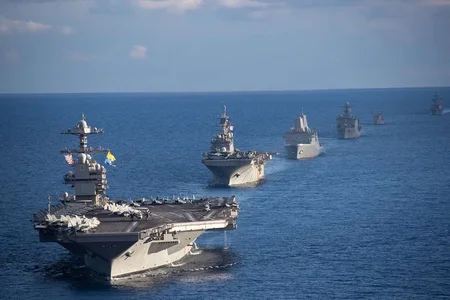
NATO leaders left their summit in The Hague on Wednesday relieved. All but Spain pledged to spend significantly more money on defense.
31 of these leaders thought they had managed to appease the 32nd, or rather, number one, Donald Trump. NATO Secretary General Mark Rutte had written him a letter before the summit about his great achievements. He also referred to him as "Dad."
And “dad” seemed pleased. As he was leaving, he announced that NATO “is not a hoax”; so that was good.
But if you read the statement that NATO leaders released, you can see how significantly it differs from past ones.
Three things stand out.
The first concerns Ukraine. In NATO’s declaration in 2022, the year of Putin’s full-scale invasion, leaders warned that “war has returned to the European continent.” They condemned Russia’s “aggression” and “flagrant violation of international law.” Their text spoke, in surprisingly undiplomatic terms, of Russia’s “lies,” “cruelty,” and the “humanitarian catastrophe” it has caused. NATO offered “full solidarity” with “close partner” Ukraine and supported its “territorial integrity.”
The 2022 declaration judged Russia as "the most significant and direct threat to peace in the Euro-Atlantic area."
Three years later, that war is still raging. Yet this week’s statement says only this about Ukraine: “Allies reaffirm their enduring sovereign commitments to provide support to Ukraine, whose security contributes to our own, and, to this end, will include direct contributions to the defense of Ukraine and its defense industry when calculating Allies’ defense spending.”
The word "sovereign" was included to appease pro-Russian NATO members who would not want Vladimir Putin to think they were helping Ukraine. The stuff about paying for Ukraine's defense industry is part of the extra spending hoax. Collective support for Ukraine is now clearly meaningless.
The only thing the statement says is that NATO spending is increasing because of the “long-term threat that Russia poses to Euro-Atlantic security and the continuing threat of terrorism.” “Long-term”? The day before the summit, 350 drones and 16 missiles attacked Ukraine, killing ten people in Kiev. Such incidents are almost daily.
Another omission is the word "nuclear." In Cold War declarations, the range, level, and balance of nuclear weapons between NATO and the Soviet Union were often discussed. Their importance was emphasized. In 1983, when the Soviet threat was high and Reagan and Thatcher were countering with space shuttles and the deployment of Pershings to Europe, the NATO declaration emphasized: "a sufficient level of conventional and nuclear forces remains necessary for the credibility of deterrence."
The last word missing from the statement is "United States." It's almost as if an important Vatican document has failed to mention His Holiness the Pope. There's a big orange elephant in the room, trumpeting uncontrollably, but no one wants to talk about it.
This is a dramatic change. This passage from the 1982 NATO declaration may represent the entire doctrine of the alliance and its key American dimension: “The security and sovereignty of the European members of the Alliance remain guaranteed by their defense, by the presence of North American forces on European soil, and by the strategic nuclear commitment of the United States to Europe. The United States and Canada also depend for their security on the contribution of European partners to the defense of the Alliance.”
The reason the doctrine is not repeated today is, apparently, that it would not be believed. This "credibility of deterrence" has weakened. NATO communications often speak of member states' commitments as "ironclad."
The question that naturally arises is: “what is NATO for?”
It must be for something, since 31 of its 32 countries are pledging to spend a lot more money on it: but for what? Who is the enemy? How big is the threat? What is the attitude? There is now a radical divide between the perceived immediacy of the Russian threat by roughly half of NATO allies, including the Baltics, the Nordics, Poland and Britain.
President Trump's bombing of Iran's nuclear facilities, while in no way a NATO action, shows that he is on the side of the West against the maniacs. But it cannot be that "Dad" considers Israel to be some kind of "Prodigal Son" whom he will please, while for NATO he is more like an absent father who does not like having to see his children.
We face the contradiction that the man who tells us to contribute much more and acts like he's the boss may be the one least likely to stick around.
He is also the friendliest to our greatest enemy. Mr. Trump has been absolutely consistent in rejecting NATO's basic approach, which is that Putin is completely wrong for trying to change Europe's borders by force.
Perhaps Mr. Trump will eventually see more reason, or simply calm down and power will be gone from him anyway in no more than three years, or even, perhaps, after the midterm elections next year.
In these difficult circumstances, we should feel sympathy for Sir Keir Starmer's efforts to take Britain's defence and security more seriously. So it was a bit of good news this week that we will buy 12 dual-capability F-35A bombers from the United States, thus improving our nuclear capability.
However, when you consider that they will be American and under American custody and command, and that we are not buying more bombers than before, but simply different ones (going from B models to A models), you, and Vladimir Putin, may not be satisfied.
On Victory Day in 1945, Churchill said: “Our enemy humbles us.”
Eighty years later, we risk the opposite. /Adapted from The Telegraph Pamphlet/




Lini një Përgjigje