


 Shkruar nga Pamfleti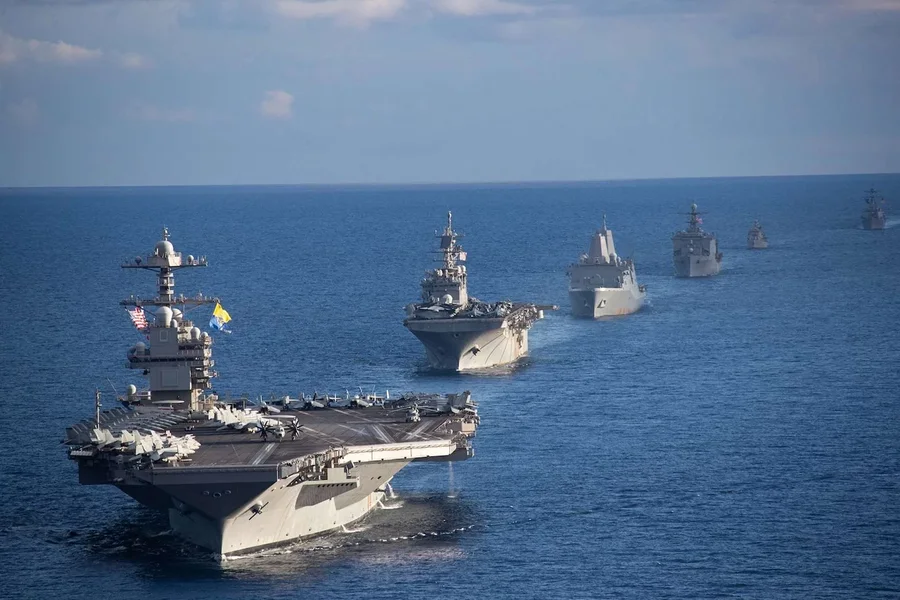
As the Gerald R. Ford Carrier Strike Group enters EUCOM space, its presence sends a clear message: The United States maintains an unmatched capacity to deploy integrated, multi-domain naval power wherever needed...
The United States has deployed the world's most lethal carrier strike group, the Gerald R. Ford fleet, to Europe. The 12 ships have departed Naval Station Norfolk to deploy to the U.S. European Command (EUCOM) area of responsibility. The move marks the latest mission for the most capable, adaptable and lethal naval force ever assembled.
As reported by the US Navy, this deployment underscores the strategic center of the Mediterranean Sea in the midst of a changing global security environment. The mission is not just about presence, but about projecting power, deterring and protecting US and allied interests throughout Europe and its maritime periphery.
As the Gerald R. Ford Carrier Strike Group enters EUCOM space, its presence sends a clear message: The United States maintains an unmatched capacity to deploy integrated, multi-domain naval power wherever needed.
The Twelfth Carrier Strike Group (CSG-12), centered around the USS Gerald R. Ford (CVN 78), the world's largest and most technologically advanced carrier, represents the pinnacle of U.S. naval power.
With nearly 4,500 Marines, the strike group integrates multiple warfighting domains into a cohesive operational force, including air, surface, and electronic warfare components. The deployment reflects America's ability to sustain a forward presence and respond rapidly to emerging threats.
Rear Admiral Paul Lanzilotta emphasized the mission's readiness for "sustained, multi-domain operations at sea, wherever and whenever tasked."
The strike group includes not only the Ford-class aircraft carrier, known for its electromagnetic aircraft launch system, advanced jamming equipment, and increased attack generation rate, but also the Carrier Air Wing Eight (CVW-8), Destroyer Squadron 2 (DESRON 2), and several Arleigh Burke-class guided-missile destroyers, including Winston S. Churchill, Mitscher, Mahan, Bainbridge, and Forrest Sherman.
Air Wing Eight operates a mix of advanced naval aircraft, including F/A-18 E/F Super Hornets for multirole strike missions, EA-18G Growlers for electronic warfare and radar jamming, E-2D Advanced Hawkeyes for airborne early warning and command and control, and MH-60R/S Seahawks for anti-submarine, anti-surface, and logistics operations.
Together, these units enable the strike group to execute integrated air and missile defense, maritime control, and strike missions, providing strategic opportunities for both deterrence and escalation dominance.
CSG-12's operational history includes recent deployments in support of NATO deterrence measures and freedom of navigation operations.
Its presence in the Eastern Mediterranean in 2023 provided critical reinforcement during escalations in the Levant, serving as a rapid response element for potential crises near Syria and Lebanon. Compared to other US carrier strike groups, Ford's unit stands out due to its improved electrical capacity, advanced sensor integration, and reduced crew size through automation, improving both survivability and lethality.
Strategically, the current deployment comes at a sensitive time. With two other US carrier groups already positioned in the Middle East, particularly around the Red Sea and the Arabian Gulf, the deployment of the Gerald R. Ford to EUCOM raises questions about broader planning within the US military command structure.
EUCOM's map of responsibility covers the Mediterranean, where tensions with Russia remain high and where NATO's southern flank remains vulnerable to hybrid threats and irregular maritime activity.
At the same time, the presence of a third carrier strike group in the immediate vicinity could signal preparations for coordinated preemptive operations or potential escalation scenarios involving adversaries such as Iran, should tensions in the Strait of Hormuz or the Iraq-Syria axis intensify.
The Gerald R. Ford Strike Group also plays a critical role in disrupting gray-zone activities, including maritime harassment, information warfare, and unmanned aerial threats.
Its advanced radar systems and electronic warfare capabilities enable it to detect and neutralize a wider range of threats than previous Nimitz-class carriers. Furthermore, the deployment supports NATO's expanded presence in, and is an added assurance at a time when Russia continues to exert pressure throughout Eastern Europe, the Black Sea, and beyond.
This deployment reinforces Washington's strategy of layered deterrence, positioning credible force multipliers across all combatant commands to give American leaders and allies strategic flexibility.
The Ford Strike Group, in particular, extends U.S. naval reach deep into contested areas, reassuring allies and complicating adversary planning cycles.
In an unstable global landscape, the Ford Strike Group is not just a symbol of strength, but is a fully operational and mobile center of American naval power, capable of shaping events across continents, protecting global commons, and maintaining a balance of power favorable to the United States and its allies. /Adapted from Pamphlet by armyrecognition/




Lini një Përgjigje