


 Shkruar nga Merrill Matthews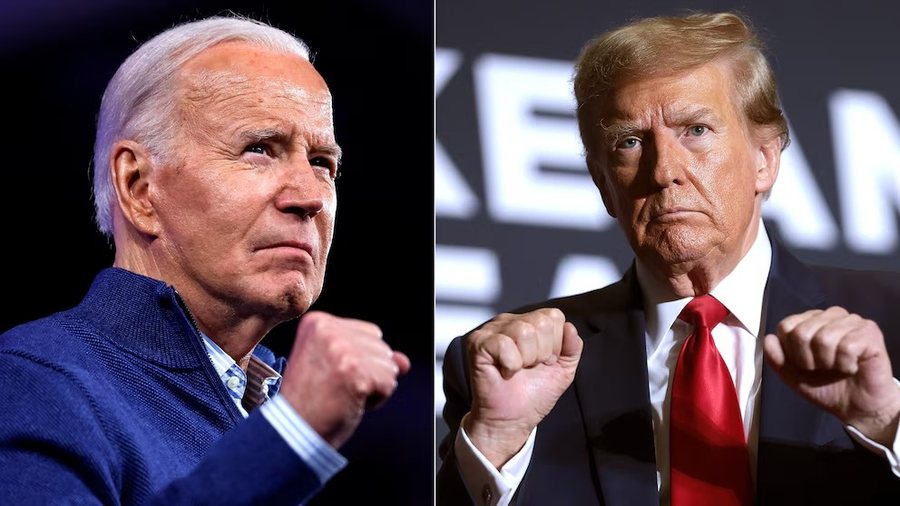
A third party candidate can change the result...
This may be the most unusual presidential election in US history, and in some ways it already is. But there is a possibility that these elections will take the country down paths not previously taken and with potentially disastrous consequences. Here are the 5 scenarios:
1. There may be a tie in the Electoral College
Among political analysts there is a consensus that this year's winner will be decided by 7 swing states, which have a total of 93 electoral votes: Georgia (16 votes), North Carolina (16), Pennsylvania (19), Michigan (15), Wisconsin (10), Nevada (6) and Arizona (11 votes).
To win a candidate needs 270 out of 538 electoral votes in total. Therefore, if 2 candidates receive 269 votes each, there would be a tie. Can this happen? Yes, but since the passage of the 12th Amendment to the US Constitution in 1804, which improved the procedure for electing the president and vice president, only the 1824 election has had no winner in the Electoral College.
Given the state's current voting patterns, analysts assume that President Joe Biden will enter the election with 226 electoral votes, while Donald Trump has 219. And the 93 swing state votes will decide the winner. If Biden wins North Carolina, Georgia and Arizona, while Trump wins Michigan, Pennsylvania, Wisconsin and Nevada, both would have 269 electoral votes.
Or if Biden won Wisconsin, Nevada, Georgia and Arizona and Trump won Pennsylvania, North Carolina and Michigan, there would also be a 269-vote tie. A third party candidate can change the result. And the most talked about presidential candidate is independent Robert F. Kennedy, Jr. Additionally, 2016 Green Party nominee Jill Stein is targeting the race again. Then there is independent Cornel West and likely a Libertarian Party candidate.
2. Candidates of other parties may be included in the ballot of any state
Currently, Kennedy is only on the ballots of the states of Hawaii, Michigan, Utah. But his staff says he is close to running in 6 more states. Three of them - Michigan, North Carolina and Nevada - are swing states. Kennedy and Stein could pull in more votes than the margin of victory for Biden or Trump in one or more of those states.
This has happened before. The 2000 presidential election was decided in Florida. George W. Bush defeated Vice President Al Gore by 537 votes. However, Green Party candidate Ralph Nader received 97,488 votes in Florida. Had Nader not been in the race, most of his supporters would have voted for Gore or stayed home, giving Gore the win.
The latest Real Clear Politics poll shows Kennedy getting 7-9 percent of the vote in the 4 swing states of Georgia, Michigan, Pennsylvania and Wisconsin. But polls differ on whether Kennedy hurts Biden or Trump more. The point is that Kennedy, and possibly Stein, could be the winner in one or more states.
3. "Non-fanatical voters" can change the result
After the November 5 election, Americans will vote again on December 17. In 48 states, they vote for the candidate who won their respective state. The other two states can share the vote. But there were also "faithful voters" who voted for someone other than the winner of their state.
This has happened 35 times in US history according to SCOTUS.blog, and 10 of them (two Republicans and eight Democrats) in the 2016 election. They did not change the results of the election, but under the right conditions they could have done so. 33 states require their electors to vote for the state winner, while 17 allow them to change their vote but may impose a penalty.
Of the swing states, Georgia and Pennsylvania have no laws banning non-faithful voters, while Michigan counts altered votes without a problem. So it is possible that in the event of a tie of 269 votes, one or more non-fanatic electors could cast a different vote from their state that would be counted, thus deciding who wins the election.
4. The winner can be decided by Congress
If no presidential candidate receives 270 electoral votes or more, the election goes to Congress, with each state having one vote. Currently, Republicans here control more states than Democrats, so Trump is likely to win. But it won't be the current Congress, but the one that will be elected in January 2025. Congress could shift to Democratic control next year, although there will likely be more Republican-led states.
5. The Senate can decide who will be the new vice president
Under the 12th Amendment, the Senate votes for the vice president, with each of the 100 senators having one vote. Currently, the Senate is controlled by Democrats, but that could change next year. However, if the 2025 Senate were to be split evenly, 50-50, Vice President-in-Office Kamala Harris, as Senate president until his inauguration, would cast the deciding vote.
Would she cast the winning vote for herself, given a Republican president and a Democratic vice president? Of course, all scenarios are highly unlikely to happen, but all are in theory possible. And given how strange the campaign has been to date, nothing can be ruled out. /Adapted 'Pamphlet' from "The Hill"
Note: Merrill Matthews, researcher at the Institute for Policy Innovation in Dallas, Texas.







Lini një Përgjigje