


 Shkruar nga Dan Sabbagh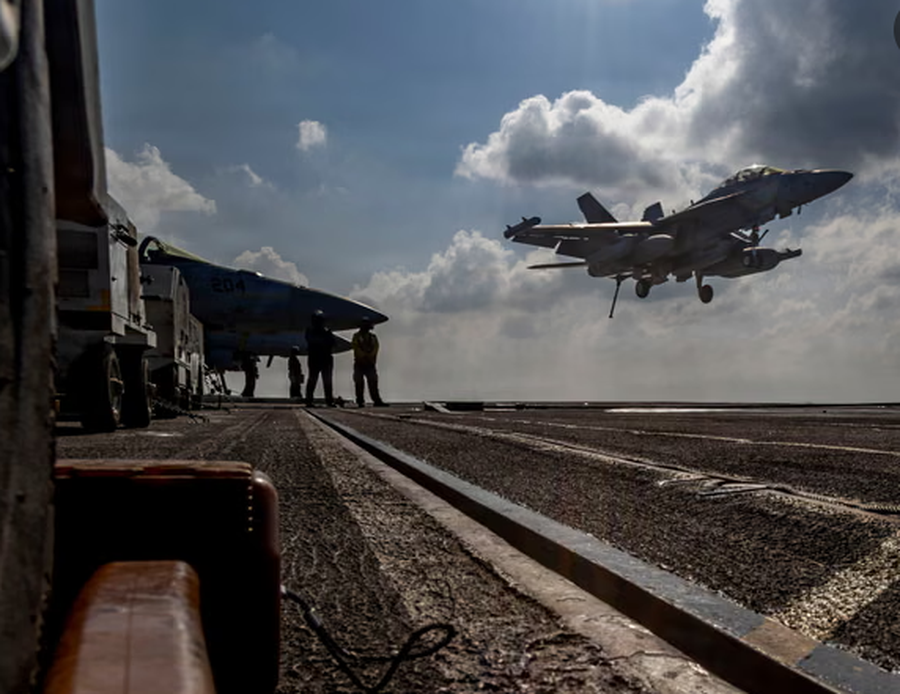
According to former US national security official Michael Carpenter, the most plausible military scenario could be targeting Iran's supreme leader, Ayatollah Ali Khamenei.
Donald Trump has already deployed large military forces to the region, but their use against Iran remains fraught with risks and uncertainties.
Two weeks ago, when Trump publicly threatened the Iranian regime by telling protesters that “help is coming,” the US did not yet have sufficient military capabilities in the Middle East to back up this rhetoric. That situation has changed significantly, although it still remains unclear what strategic objective a direct attack on Iran would have.
The US aircraft carrier USS Abraham Lincoln has arrived in the Indian Ocean, accompanied by three destroyers equipped with Tomahawk missiles. Its air wing includes modern F-35C, F/A-18 and EA-18G Growler aircraft, specialized in neutralizing enemy air defenses.
According to open-source observations, the US is also sending air defense systems to the Persian Gulf, including Patriot and THAAD batteries, to protect American bases from potential Iranian missile and drone attacks.
Meanwhile, around 35 F-15 fighter jets have been redeployed from Britain to Jordan, strengthening the air defenses of Israel and neighboring countries in the event of an escalation of the conflict.
According to former US national security official Michael Carpenter, the most plausible military scenario would be targeting Iran's supreme leader, Ayatollah Ali Khamenei, through a capture or elimination operation. But he warns that striking Iranian military targets would not significantly weaken the regime.
“An operation against Khamenei would be extremely difficult and of uncertain outcome,” Carpenter emphasizes, underlining that success would require deep intelligence from within Iran, something that remains doubtful.
Although Israel managed to eliminate several senior Iranian figures during last year's clash, security measures around Khamenei have been significantly tightened and have kept him out of any direct target.
Militarily, Iran currently has limited air defenses against US attacks, but the risk of retaliation is high. Tehran has thousands of ballistic missiles stored in underground bases, capable of hitting US and allied targets in the region.
Iranian President Masoud Pezeshkian has warned that any attack on Khamenei would be considered a declaration of war.
The main targets of an Iranian counterattack could be the US aircraft carrier and military bases in the Persian Gulf, including al-Udeid Air Base in Qatar, the headquarters of US Central Command. Although these bases are protected by modern anti-missile systems, recent experience shows that not all Iranian missiles can be neutralized.
Another scenario would be the blockade of the Strait of Hormuz, a vital route for global oil trade, which would have severe economic consequences worldwide.
In the end, although Iran has limited military options against the US, even Washington has no clear path to a quick or consequence-free victory. / Adapted from "Pamphlet" by "The Guardian"






Lini një Përgjigje