


 Shkruar nga Pamfleti
When a leader starts talking publicly about resigning, even as a "possibility," it's usually a sign that the situation is not as calm as he would like to present it...
Aleksandar Vučić's statement from Beijing that his mandate "is ending soon" and that he "may resign" sounds like a casual statement, but in fact it shows that the mass protests in Serbia are pushing the government to react more nervously than usual.
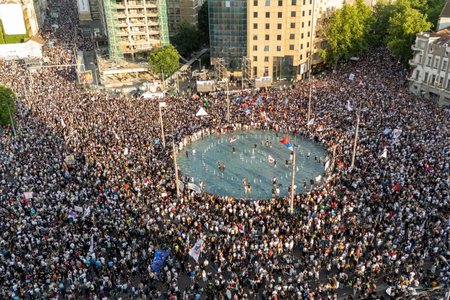
Even when Vučić tries to minimize the rallies by calling them "empty" and "without content," the fact that he pays attention to them, talks about numbers, and refers to "service evaluations" shows that he understands one thing: the protest is no longer just noise in the street, but a political problem.
When a president who has maintained firm control over institutions, pro-government media, and the state apparatus begins to talk about resigning, there are two possible explanations.
First: the protests are making governance costly and are hitting it where it needs it most, the image of stability and control.
Second: this could also be a tactic. Vučić often uses political drama to test the waters: will people get scared, will protesters split up, will they start thinking “if this guy leaves, what next?” So, the idea of resignation could be used as psychological pressure on society and opponents.
When the government calls protests "empty," it aims to take away their meaning, to say that "they have no idea, no plan, they're just shouting." But in reality, mass protests often don't take to the streets with a government program in their pocket. People come out because they're tired of corruption, state capture, political pressure, propaganda, and the feeling that "nothing changes."
This is why minimizing sometimes backfires; citizens hear it and think that the government is not taking them seriously.
When Vučić says that “three ministries gave estimates” for the crowd in Slavija, he is shifting the discussion from “why they are protesting” to “how many there were.” This is an old trick, numbers are used to demoralize protesters and convince people who are staying home that “there is no limit.”
But here's a problem for the government: in mass protests, it's not just the math that decides. It's the visuals, the rhythm, and the persistence that decide. If the rallies are repeated and grow, then even when the numbers are discussed, the political effect becomes real.
No one can say for sure from just one statement. But one thing is clear, Vučić is indirectly acknowledging that the protests are affecting him. Even when he calls them "not a concern," he is dealing with them, blaming them for incidents and framing them as a threat to order.
This means that the protests have entered the phase where the government must choose, either increase the pressure and treat them as a police problem, or make controlled concessions to mitigate them, or attempt to channel them into a political game that it manages itself; e.g. changes, reformation, elections.
So when a leader starts talking publicly about resigning, even as a "possibility", it's usually a sign that the situation is not as calm as he would like to present it. / Adapted from "Pamphlet" by "The Geopost"


Terhjekt kembet zvarre edhe per keta shtazett tona pa shpirt