


 Shkruar nga Gregor Schwung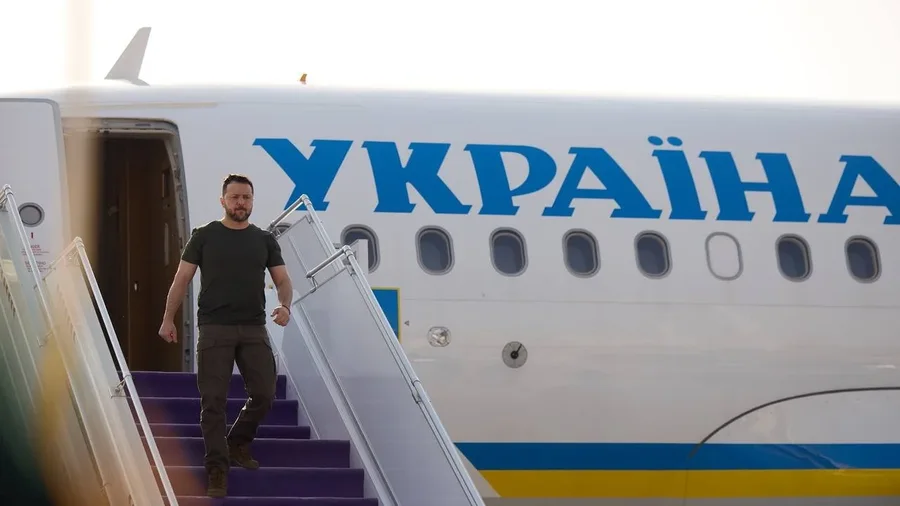
Arrogance, avoidance of institutions, complete closure to the media, concentration of power and misuse of martial law are the features that are characterizing Zelensky's leadership...
Ukrainian President Volodymyr Zelensky has declared that this year will be a turning point. He declared last week that the fate of his country will be decided precisely in the third year of the war against Russia. These words were addressed above all to the international community and the need for further support of Ukraine.
In both the US and Europe, there is a heated debate today over how much military support should be provided. As Republicans in the US Congress are blocking funding for Ukraine and German Chancellor Olaf Scholz is reluctant to deploy Taurus missiles, Kiev's forces are increasingly retreating on the defensive.
Last week, Russia captured 3 villages in 3 days, and its army is steadily advancing after capturing the town of Avdiivka. Although the difficulties of the Ukrainian army stem mainly from the lack of material support from the West, Kiev finds itself in a critical situation for another reason that is its own: Zelensky's leadership.
The Ukrainian president's approach to government is encouraging bad decisions with serious consequences. Moreover, Zelensky seems increasingly reluctant to make any changes to his method. In just a few weeks, his mandate will end and with it the legitimacy of Zelensky as president.
Presidential elections were due to be held this month, and recent polls have suggested they would bring about regime change. Only 64 percent of Ukrainians trust their president, down from 77 percent in December last year. At the start of the Russian invasion in February 2022, support for him was 90 percent.
Meanwhile, General Valerii Zaluzhny, the former commander-in-chief of the Ukrainian army, whom Zelensky recently dismissed and is now his direct rival, saw further increases between December 2023 and February 2024, from 92 to 94 percent.
However, there will be no choice. Martial law is still in effect in Ukraine. Even if the government wanted to change the law so that people could go to the polls, it would be impossible to organize the process in Russian-occupied regions, and it would be too much of a problem for soldiers to exercise their right to vote. and the millions of Ukrainians who have fled the country.
Zelensky was recently asked - and not for the first time - about a possible alternative: the creation of a government of national unity. A reporter's question at the press conference was difficult and complicated, which the visibly irritated president took as an opportunity to interrupt. "Can you name someone who would later become prime minister?" Zelensky asked.
But Oleksiy Goncharenko cannot understand this arrogance. I meet the 43-year-old MP in a cafe near the parliament building in Kyiv. "Zelensky thinks he has the best team around him. But it's not like that" - Goncharenko tells me. As a member of the opposition party led by former president Petro Poroshenko, Goncharenko argues that Zelensky has surrounded himself with a small team of trusted people who try to do all the government's work themselves.
"He believes in his loyal colleagues and not the institutions," says Goncharenko, arguing that this was his approach long before the war. Advisers and colleagues who oppose or criticize the president have long since been fired.
Today, Zelensky is surrounded by a close circle of advisers, coordinated by his chief of staff Andrii Yermak. Everything goes through him. Yermak is unofficially number 2 in Kiev. Cabinet ministers must report to him and his 10 representatives, which has essentially stripped all powers from the prime minister, who is formally the head of government.
This means that all decision-making is reduced to the narrow circle of people centered around Zelensky in the presidential building. Thus, Ukraine is facing a number of obstacles that are not directly related to the military. Because power is concentrated around the president, critics accuse the government of not dealing with economic problems, sluggish trade policy and issues surrounding wheat exports.
The inefficient approach to the government can be seen in other and very concrete ways. Since last summer, the post of Ukraine's ambassador to Britain - one of Kiev's key allies - has remained vacant, with the appointment process stalled in the Office of the President.
"Even the most brilliant people cannot govern a country alone," says Goncharenko. He claims that this approach to government makes the state inefficient, and argues that a government of national unity would not only solve the legitimacy problem, but also lead to better decision-making. But Zelensky is refusing to take this step.
Three weeks since the dismissal of Zaluzhny, the commander-in-chief of the armed forces very popular with the citizens, the president has not given any reason for this decision. Some point to the fact that by the end of last year, Zaluzhny had contradicted the president's optimistic view of the war.
The general spoke of a stalemate, while Zelensky said it was still possible to regain all the territories occupied by Russia. Zaluzhny's comments were criticized by people close to Zelensky, and the general was even accused of doing "the work of the Russians".
The consequences of this collision are being felt by the soldiers on the front line. Based on his analysis, Zaluzhny wanted a new wave of mobilization to boost the dwindling numbers of the Ukrainian army. But Zelensky has so far rejected the idea, fearing it would be politically unpopular.
Zaluzhny's successor, General Oleksandr Syrskyi, is said to be more in line with the president's approach. Although Goncharenko notes that the same problem exists in Zelensky's leadership. "If the group that is making decisions is made up of like-minded people, there is no open decision-making process in which even unpopular options can be discussed," he emphasizes.
Government control of the media, also imposed by martial law, is having a negative impact on the country. When the Russians launched the invasion, Zelensky ordered all television channels to broadcast the same, state-controlled program. Online media are not subject to these restrictions, but often self-censor.
The consequence is that the population in general believes the government's optimistic view of the situation at the front. Sasha Andibur is feeling the effect of all this censorship. The 29-year-old activist lives in Dnipro and provides supplies for the army. Soldiers use their smartphones to send messages requesting first aid kits, drones, tactical vests or food. Andibur then organizes online fundraising campaigns. "The media does not report how bad the situation is at the moment for the soldiers at the front," she complains.
As a result, many people continue their daily lives, unaware of the real situation. "At first, the Ukrainians were afraid, and they gave everything they had to help the army. Now it takes much more time to collect enough money for new supplies" - says Andibur.
She says the consequences for soldiers are dramatic. Not only materially, but also psychologically. Soldiers cannot leave the front line without the relief and circulation of new troops that the new mobilization would bring. "So they are forced to continue fighting, which is very unfair" - says the activist./ Pamphlet adapted from "Worldcrunch"


Lini një Përgjigje