


 Shkruar nga GIORDANO STABILE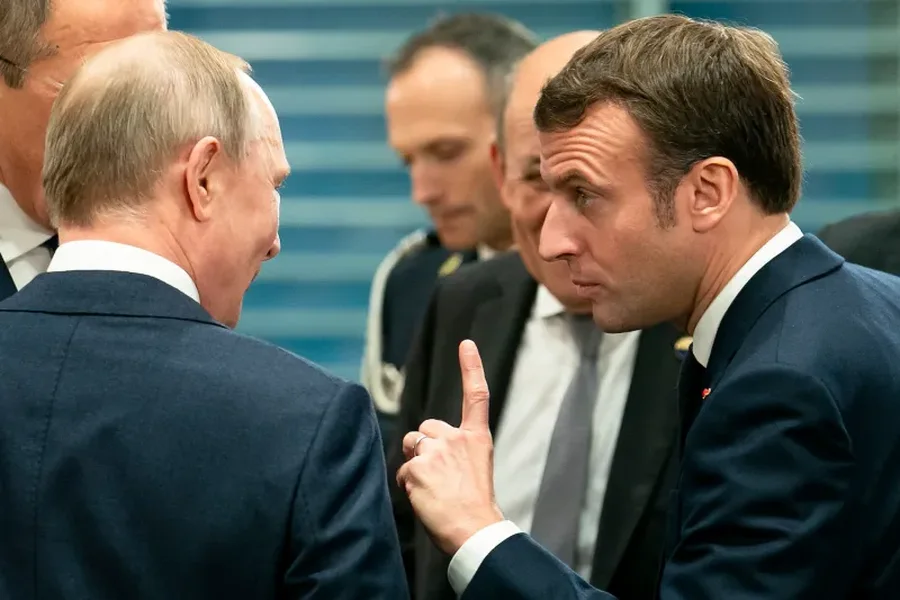
If the idea that the loss of Ukraine is inevitable enters public opinion, Russia has won. Macron's gamble has sparked a furious domestic debate that has singled out his main rivals
As at the beginning of 2022, the West and Russia are preparing for a new phase of the conflict, with new elements, unseen even in the most tense moments of the Cold War.
Two years ago, the taboo to be broken was the use of military force to change the borders of a sovereign state in Europe. It had not happened since 1945, except for consensual secessions, as in Czechoslovakia or the very bloody ones, in the former Yugoslavia.
Vladimir Putin broke the taboo and tried to cannonball part of an otherwise independent nation. It was a dam break. Other taboos are beginning to break down.
Emmanuel Macron put one on the table. And this is the direct clash between the troops of NATO and those of Russia. It had been circulating for some time, France's allies immediately excluded it. But here it is.
The French leader, as he often does, operates on two fronts, external and internal. As for the confrontation with Russia, it has brought about a powerful strategic ambiguity.
Sending a European contingent is a possibility that the Kremlin could previously rule out a priori, and now has to evaluate. He knows it's unlikely, but he can't ignore it. And what's more, the warning comes from another nuclear power.
The Elysee does not know if it is enough to slow Putin on his march to Kiev, although it is very slow. But something had to be done. And this is where the interior front comes into play.
If the idea that the loss of Ukraine is inevitable enters public opinion, Russia has won. Macron's gamble has sparked a furious domestic debate that has singled out his main rivals, Marine Le Pen on the right and Jean-Luc Mélenchon on the left. They fell into the trap, the latter more than the former, and their pacifist inspirations were dismissed by Prime Minister Gabriel Attal as "intelligence with the enemy", in short.
Now it is easier to impose the evidence that everything must be done to save Ukraine. Macron's gamble on approaching war power status reduces the scope for internal debate on the issue as European elections on June 9 approach. The debate about the effectiveness of sanctions, not to mention diplomacy, is now outdated. The Russian opposition itself rejected it. Even before Alexey Navalny's death, his associates had made it clear that economic measures were not enough. Julia Navalnaya made it clear to the European Parliament.
His direct challenge to Putin works alongside the new French stance, the activism of EU Commission President Ursula von der Leyen and the bilateral agreements that increasingly commit European states, starting with Italy, to defend Kiev, accepting growing risks.
Putin now has to put all these new elements on his scales. The birth of a Russian opposition flag, free to move and supported by the entire European establishment. The biggest determination, even at the military level, of the Western leadership.
Weakening the arguments of the pacifist faction within rival states. He sees that the chances of a change of orientation after the European vote are decreasing. He even has a little faith in Donald Trump, he said, in his usual sly tone.
It is true that the tycoon does not want to give money to Ukraine. But more to trouble Joe Biden than strategic vision. Even an isolationist, or "sovereignist", America ultimately cannot accept Russia's victory.
It is one thing to withdraw from Afghanistan, another thing from Europe. Its global hegemony is at stake. The Kremlin leader is left with his favorite strategic ambiguity. That is, the possible use of nuclear energy. The taboo of taboos.
The specter resurfaced with the leak of secret documents on Russian military doctrine, published by the Financial Times, which foresee the use of tactical atomic weapons if Russian territories were at risk. But from the Bogeyman of Armageddon (mythical creature) we have moved on to weapons of several kilotons, capable of annihilating an armored brigade, not the whole world.
It is a strategic ambiguity that is walking on a very thin ridge. Fortunately, it should still be seen in its psychological component. Intimidate, confuse the enemy, limit his freedom of action because a game of chess also includes a draw./ Adapted from La Stampa


Lini një Përgjigje