


 Shkruar nga Pamfleti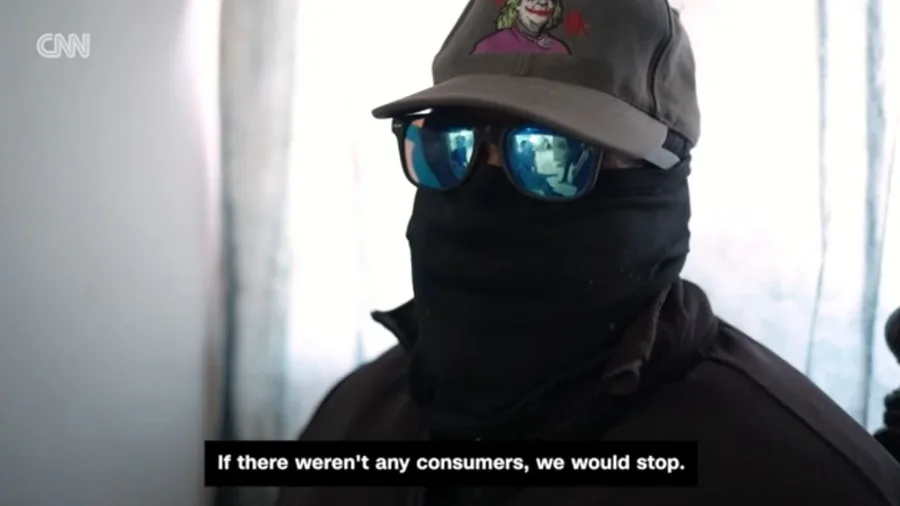
A man with dark glasses, a hoodie with the logo of the movie "Joker", a scarf covering his face and gloves hiding tattoos, in front of him a Kalashnikov, two radios and a gloomy room with a painting of Christ on the wall.
Thus begins the CNN journalist's meeting with a member of the Sinaloa Cartel, one of the most powerful criminal networks in the world, which has now been declared a "terrorist organization" by the US.
"Yes, it's sad. But life goes on. Families need to eat," he said.
"To meet this man in Culiacán, the heart of this cartel, it took weeks to verify his identity and convince him that we are not part of any law enforcement agency," writes CNN.
The circle was clear: no cops, no DEA, no CIA. The meeting place was an ordinary house in a neighborhood controlled by the cartels.
He admits to being a producer of fentanyl – the most deadly synthetic opioid in the US, where just two milligrams are enough to kill a person. The base chemicals come from China and are processed in small, clandestine laboratories in Mexico.
"Business is not going as well as it used to. But we have learned to adapt," he said.
They now produce in smaller quantities, in mobile laboratories that move frequently to avoid military raids. A radio network maintains contact with armed observers who signal any police or military movements.
A new approach to the war on cartels
Faced with pressure from the US, which has threatened military intervention and increased tariffs, Mexico's new president, Claudia Sheinbaum, has changed course. Thousands of National Guard soldiers have been sent to the northern border to stop drug trafficking, while hundreds more have been deployed in Sinaloa.
Officials say that in the first six months of her presidency, more than 17,000 people have been arrested for serious crimes and more than 140 tons of drugs have been seized - including 1.5 tons of fentanyl and more than 2 million pills. Meanwhile, in the past year alone, US authorities have seized more than 24,000 pounds of fentanyl.
However, the Mexican government officially denies that fentanyl is produced in the country, claiming that most laboratories are destined for the production of methamphetamine.
Ground War: A Battle in the Shadows of the Mountains
On a Mexican army helicopter air mission over Sinaloa, soldiers look for signs of clandestine laboratories: footprints, electrical wires, water sources – anything that could indicate the presence of a drug production base.
Synthetic labs are often equipped with only pots, protective masks, plastic containers, and nylon sheets to protect them from aerial detection. In one case, the military discovered a methamphetamine lab that had been abandoned just the day before. The military still found food, water, and clothing—clear evidence that cartel workers had been there for several days.
At one post, a banner was placed with the note "For agreement: phone number", apparently directed at soldiers - evidence of attempts to corrupt the security forces.
"There is real commitment from the state. But the problem is serious, and the market for synthetic drugs is not stopping," says Brigadier General Porfirio Fuentes Vélez.
However, in off-the-record conversations, officials admit: corruption remains widespread, and there are many who have secretly collaborated with the cartels, including the former head of public security, later convicted in the US for taking bribes from the Sinaloa Cartel itself.
War within the war: The cartel implodes from within
In Culiacán, the bloodshed has intensified after two key cartel leaders were arrested in Texas: Ismael Zambada García (El Mayo) and Joaquín Guzmán López, El Chapo's son. El Mayo's arrest is believed to have followed a betrayal by Guzmán López, leading to internal divisions and a bloody power struggle.
The consequences are dramatic: over 1,200 people killed in a year, more than double the number the year before. Many of them are innocent civilians. Schools are empty, children learn how to hide during gunfire, and the city falls silent at night.
The pain of families: "I'm afraid to be a woman in Mexico"
One of the victims was Vivian Karely Aispuro, 26. Her body was found after 17 days missing. At the funeral, her mother bursts into a scream that echoes throughout the cemetery. Her sister Alma recounts: “She had nothing to do with the cartels. But the war has destroyed everything. Before there were codes – women and children were not touched. Now, there are no rules.”
Young people continue to be recruited by cartels with promises of quick riches. “If the demand for drugs in the US does not change, this war will never end,” says Miguel Calderón of the State Council for Public Safety.
At the end of the day, in the face of this powerful industry, it is the ordinary people who bear the brunt. “Being a woman in Mexico today is like walking blindfolded through a minefield. I am afraid. And more than anything, I am afraid that no one will help us,” says Alma, as she watches her sister lie buried.





Lini një Përgjigje