


 Shkruar nga Peter Doran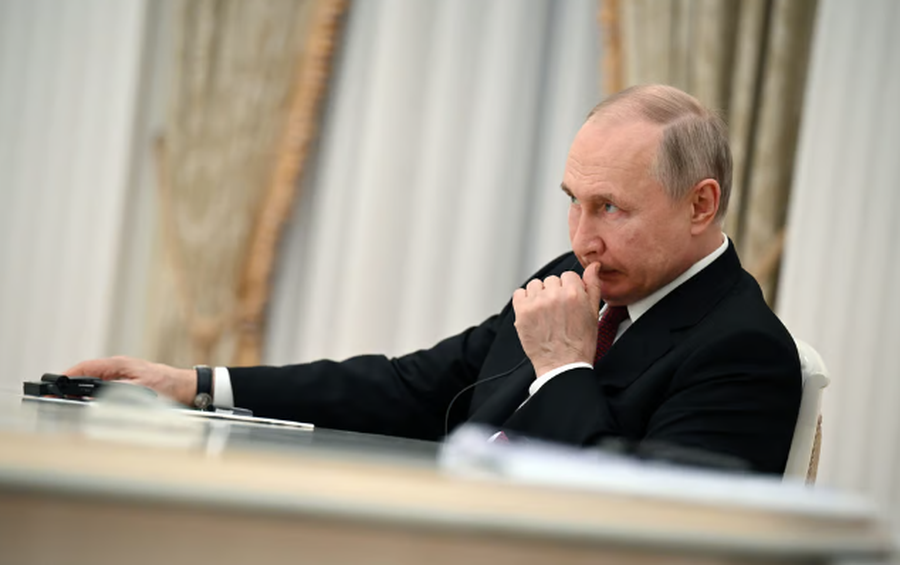
"Without money from Moscow, we will not be able to resist even for 1 month!". This is a weakness that Europe and the US must exploit.
It seems that the financial "wizards" in the Kremlin are running out of "rabbits" to pull out of the "hat". The Russian government revealed this fact when it published its revised budget for 2025, showing the spiraling costs of Russian President Vladimir Putin's war against Ukraine.
It is now up to Europe and the US to seize this opportunity, further increasing the economic costs for Russia by closing the loopholes of the current sanctions. By doing so, they could hasten the end of the war, perhaps in Ukraine's favor.
Or at least encourage Putin to sit down and negotiate for a serious solution to the conflict that has been going on for 2 and a half years. A closer look at Putin's budget plans for next year shows the Kremlin intends to spend $145 billion on defense out of nearly $436 billion in total government spending.
That totals over 6.3 percent of Russia's GDP - remember that NATO's standard is 2 percent - and marks Moscow's highest level of military spending since the Cold War. And the bad news for Putin: his technocrats have hidden the full cost of the invasion of Ukraine.
Distributed in the annual budget are additional payments related to the war, including wages that Moscow pays to workers in illegally occupied Ukrainian regions; health care for wounded soldiers; waste removal; infrastructure repair and undisclosed "classified" expenses.
When these expenses are added up, it turns out that the real burden on Russia's economy approaches the level of 10 percent of GDP. The truth is that the Russian government is not collecting enough money to cover the costs associated with the war. The Kremlin must run a deficit, and it was already around $34 billion last year alone.
And this gives the West a new room for maneuver. While budget deficits are manageable for most governments, Russia is not a normal country. Due to Western sanctions, Moscow cannot balance its budget items through international borrowing.
In addition, it has to pay very high interest rates - up to 16 percent for a 10-year bond - to domestic lenders. It is a very large cost. What's worse, Putin's technocrats have already emptied the National Wealth Fund (NWF) earmarked for use in "bad days".
Under normal conditions, the Russian NWF has two purposes - to preserve excess tax revenue in good times, and to protect the country from low oil prices when things go bad. But recently, the Kremlin has depleted this fund to pay for the war it is waging in Ukraine.
In 2021, its liquidity reached 117 billion dollars, while today it is only 55 billion dollars. And if the NEF is emptied at all, then Moscow will be forced to choose between a menu of bad options to keep its war machine running.
Such options include higher taxes on Russia's elite and middle class, borrowing on tougher terms, further pressure on the ruble to further devalue it, and possibly reductions in social subsidies that help keep the economy afloat. oxen of its population.
Now, the Russian Ministry of Finance is pursuing these options to some extent, as long as they do not cause any major public reaction. If it turns to stronger borrowing, higher taxes, crushing of the ruble and benefit cuts, this approach would pose serious risks to the stability of the regime.
Let's take a look at the subsidies that Moscow currently pays to keep its troubled regions calm. The payments are vital for countries like Chechnya, where warlord Ramzan Kadyrov runs the territory as a client state inside Russia.
Kadyrov has made his warning clear: "Without money from Moscow, we will not be able to resist for even 1 month!". This is a weakness that Europe and the US must exploit.
And the fastest way to do this is to lower the "oil price ceiling" by the G7 on Russian crude oil exports. Originally proposed by the EU, and promoted as a tool that would limit Moscow's revenues, the "price ceiling" offers Russia a wide path to avoid sanctions.
As long as it sells oil below the $65 per barrel mark, the Kremlin can earn as much revenue as it wants without any serious damage. For example, just last month, when the Brent market price briefly fell below $70 per barrel, Russia was forced to make a small cut in the price of its crude oil.
And because of these legal sales (and illegal ones through the embargo), money has flowed into Moscow's coffers. Each month, Moscow collects about $9 billion in tax revenue from these sales, including about $1 billion from the EU.
And every billion dollars the Kremlin collects from energy sales represents $1 billion it keeps in the NEF to balance its budget, shore up regime support, and pay for its war against Ukraine.
Therefore, the time has come to tighten the "financial screws" against Russia, lowering the "ceiling price" of Russian oil to only 30 dollars per barrel, i.e. close to real production costs, and for both Europe and the US to be even more tough in enforcing sanctions against illegal oil buyers such as China, India and Turkey.
This should be a top priority when European leaders sit down for talks with the next US administration. Targeting Putin's financial weakness in this way will help Ukraine win the war. /Adapted "Pamphlet", from "Politico.eu"
Note: Peter Doran, Fellow at the Foundation for Defense of Democracies.





Lini një Përgjigje