


 Shkruar nga Pamfleti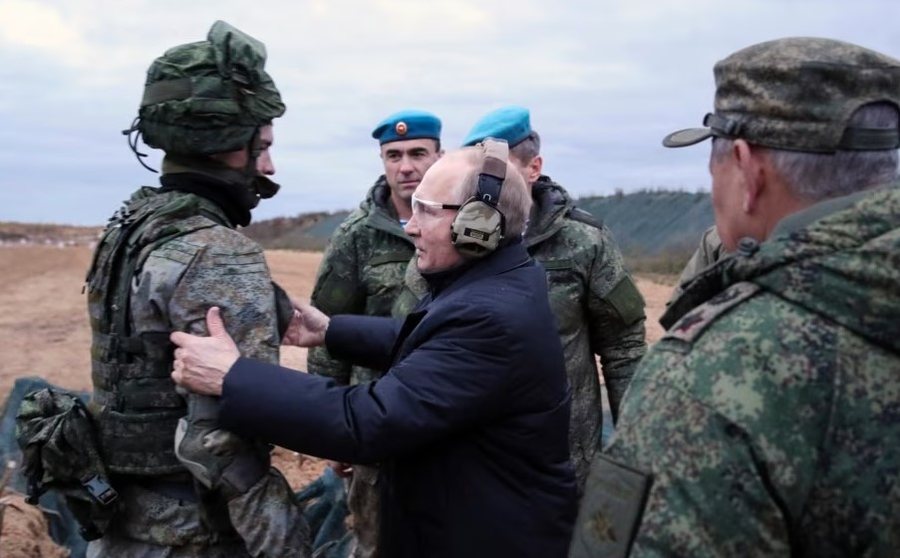
Although the Russian military is believed to be the fifth largest military force in the world, it has not been as successful in Ukraine as President Vladimir Putin initially hoped when he ordered the start of the aggression in Ukraine 18 months ago. VOA correspondent Ani Chkhikvadze spoke with American experts to understand Russia's true military power.
When Russia launched its aggression against Ukraine in February 2022, Russian President Vladimir Putin promised to capture its capital, Kiev, within three days. Eighteen months later, that still hasn't happened, despite the Kremlin spending more than $60 billion on the war, said Gary Schmitt of the Washington-based Enterprise Institute.
"Everybody looked at the amount of money the Kremlin was spending on the Russian military and said, 'This army is definitely going to be very strong!'" Mr. Schmitt says.
Atlantic Council strategy and security expert Ian Brzezinski believes that the aggression against Ukraine was designed as a short-term campaign that has now turned into an attack with limited offensive capabilities.
"Now they have to protect themselves. Unfortunately, they were given too much time to settle and create fortifications and minefields. It's not a world-class fighting force, but it's still an important force," says Mr. Brzezinski.
Today, the Russian army has about one million soldiers. Mr. Schmitt says that because of the losses in Ukraine and despite its mobilization, large parts of the army are not ready for combat.
“They used to be a formidable force when it came to armored operations. But now it turns out that without combined operations capabilities, without the logistics necessary to conduct operations and without the use of air power, this great force simply does not exist," says Mr. Schmitt.
Mr Brzezinski says the August 2008 conflict in Georgia exposed weaknesses in discipline, command and structure within the Russian military.
"The presentation of the Russian army in Georgia was weak! "Putin vowed to turn things around and started a 10-15 year military modernization plan," says Mr. Brzezinski.
Moscow began transforming its forces into a modernized, more compact army, creating Western-style battalion tactical groups. But analyst Schmitt says this caused another problem as quantity of units was prioritized over quality. On the other hand, the military leaders exaggerated the capabilities of the army to please the political leaders. The reforms, he says, have not been that effective.
"Most of the money that was being given, instead of improving the army, was pouring into the pockets of generals and contractors", Mr. Schmitt estimates.
Today, Russia faces the problem of not having enough soldiers in Ukraine. But increasing troop numbers alone will not help Moscow, says Philip Breedlove, a retired US Air Force general who was NATO's top commander from 2013 to 2016.
"If you think that Russia has finished its efforts in Ukraine, you are wrong. They still have other strengths. But it would take a major political decision for Putin to continue to raise additional forces and do some of the things he might be forced to do," says former NATO commander Breedlove.
Experts VOA spoke to say they are waiting to see how Wagner's fighters react to the death of their rebel chief, Yevgeny Prigozhin, in a plane crash believed to have been orchestrated by President Putin. /VOA


Lini një Përgjigje