


 Shkruar nga Pamfleti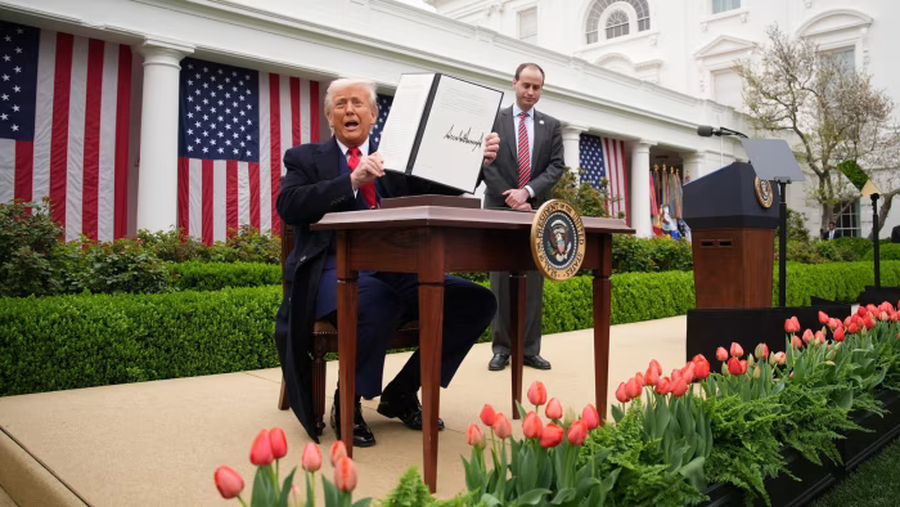
This was not a "liberation day" for America. If Trump has his way, the American economy will be isolated from the very system that has powered its centuries of growth. The whole world will suffer, but it does not have to follow America's path.
If it goes ahead, Donald Trump’s decision on April 2, 2025, to enact sweeping “reciprocal” tariffs on U.S. trading partners will go down as one of the greatest acts of self-harm in American economic history. They will inflict incalculable damage on families, businesses, and financial markets around the world, upending a global economic order that America benefited from and helped create.
The president spoke brazenly from the White House Rose Garden on Wednesday, offering a protectionist agenda beyond most analysts’ worst-case scenarios. Within a week, the U.S. will be sealed off by a minimum tariff of 10 percent on all imports, reinforced by large individual tariffs on countries with significant U.S. trade deficits. These build on tariffs already announced by the administration, including on China, Mexico, Canada and the auto industry. The combined effect will raise America’s effective tariff rate to its highest level in more than a century.
Trump’s justification hinges on a naive belief that treats trade imbalances as if they were a business’s profit and loss account rather than the culmination of highly specialized supply chains. He also views factory labor as the bedrock of economic development, ignoring how decades of free trade have enabled America to rise up the industrial value chain and become a global leader in services and innovation.
His “reciprocal” tariffs are a backsliding calculation. They take the U.S. goods trade deficit of trading partners as a share of imports from that country, and then divide it up. This is not a calibrated attempt to equalize the tariff and non-tariff barriers that American exporters face. However, it is a reckless rejection of all the trade agreements the U.S. has signed, as well as a deeply flawed plan to attract foreign manufacturing investment.
For the US economy, the most immediate effects of Trump’s actions will be higher inflation and a slowdown in economic activity. Capital Economics estimates that Trump’s tariff hikes could push annual US inflation above 4 percent by the end of the year, causing further pain for households that have already suffered a 20 percent increase in prices since the pandemic. Interest rates could now stay higher for longer.
American businesses should be shaken. They face the costly and complex task of finding domestic suppliers. The prospect of sectoral tariffs and retaliatory measures, coupled with the administration’s tough approach to policymaking, will stymie investment plans and any chance of sparking a manufacturing renaissance. Financial markets are also volatile. The S&P 500 and the U.S. dollar fell in early trading Thursday. Confidence in U.S. economic exceptionalism continues to erode.
For those most dependent on U.S. goods, the economic fallout from Trump’s tariffs will be substantial. Decades of progress in poverty reduction in Southeast Asia, in particular, are now at risk. Slow growth in major economies, including the EU, Japan and China, will worsen.
The temptation to retaliate will be strong. But this moment calls for cooler heads. Trump has promised to fight fire with fire. Policymakers should weigh their next moves carefully. Instead, America’s already closed trading partners should focus on accelerating free trade initiatives among themselves. After all, the US accounts for only 13 percent of global merchandise imports, and except for those in the White House, the economic imperative of comparative advantage remains widely understood.
This was not a "liberation day" for America. If Trump gets his way, the American economy will be isolated from the very system that has powered its centuries-old growth. The whole world will suffer, but it need not follow America's path. / Adapted from "Pamphlet" by "Financial Times"





Lini një Përgjigje