


 Shkruar nga Pamfleti
The US president says European countries are 'absolutely terrible' for refusing to support operations in the Strait of Hormuz. The US has about 68,000 US troops permanently stationed in Europe.
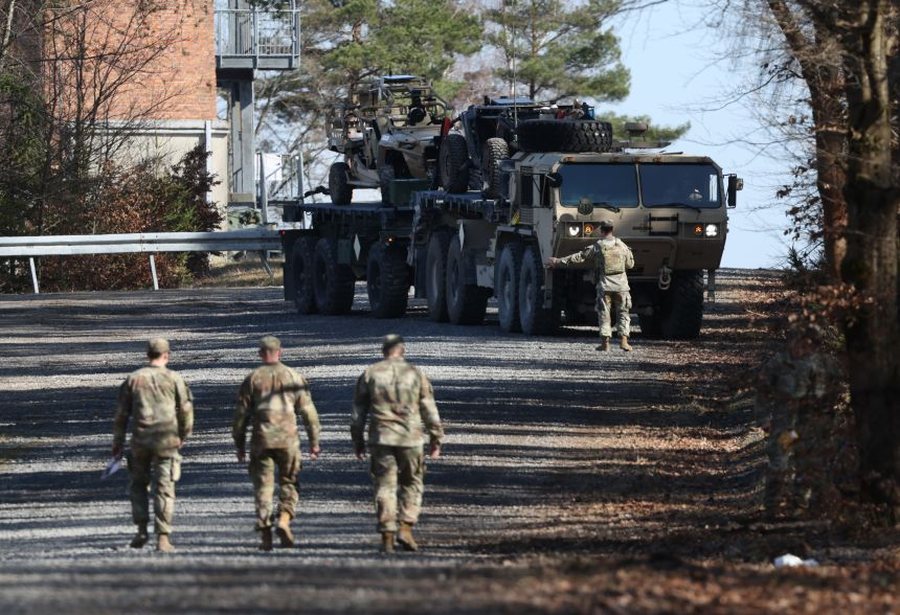
The US is withdrawing 5,000 troops from Germany, the Pentagon announced, while Donald Trump also threatened Italy and Spain for refusing to help reopen the Strait of Hormuz.
US President Donald Trump had earlier threatened to remove American troops from the country after Chancellor Friedrich Merz said the US was being "humiliated" by Iran in talks to end the two-month war.
Merz suggested in a speech on Monday that the US had not thought enough about an exit strategy from the war.
Trump hit back by saying that Merz is "doing a terrible job" with his country and should spend "less time interfering" in US efforts to confront the "Iranian nuclear threat."
"The president is rightly reacting to these counterproductive comments," a senior Pentagon official told Reuters, adding that the German's recent statements had been "inappropriate and unhelpful."
A combat brigade currently stationed in Germany will be withdrawn from the country, while a long-range weapons battalion that the Biden administration had planned to deploy to Germany later this year will no longer be sent, the official said.
The withdrawal is expected to be completed over the next six to twelve months, said the Pentagon's chief spokesman, Sean Parnell.
The Pentagon said the US will withdraw approximately 5,000 troops from Germany over the next year.
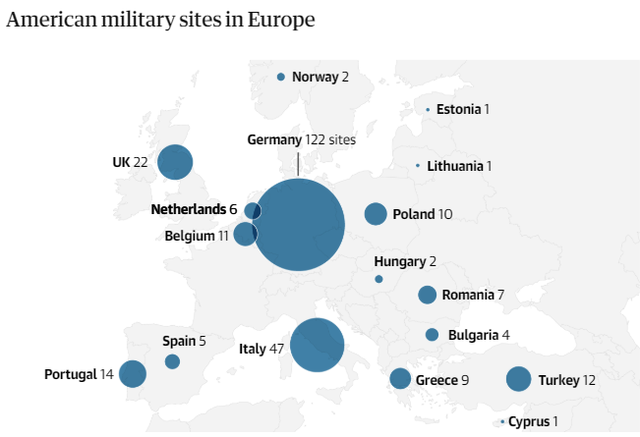
The US has about 35,000 active military personnel stationed in Germany, according to data from the US Defense Manpower Data Center, more than half of the total in Europe.
US military sites in Europe
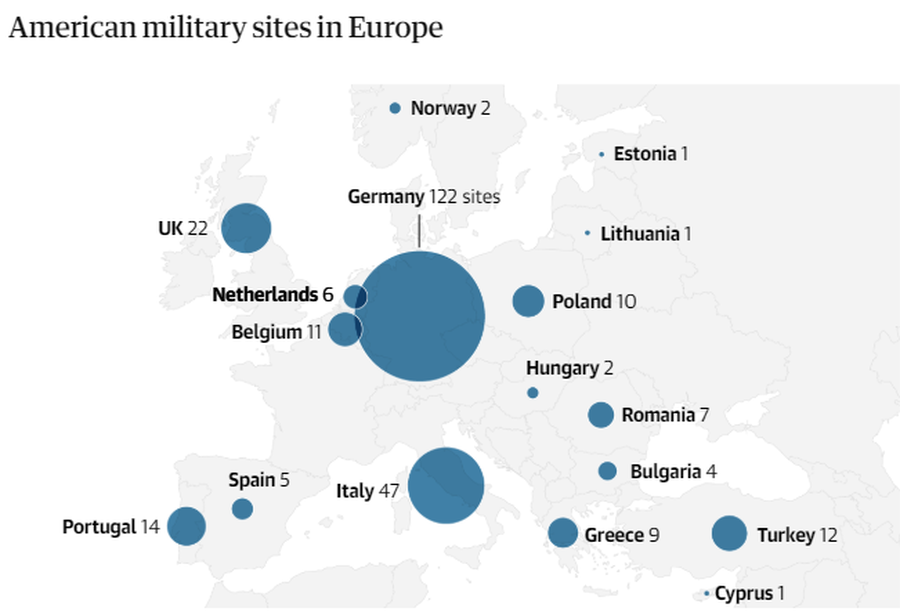
The potential withdrawal of US troops from Europe is taking place in a climate of growing rift between the United States and its NATO allies over the war in Iran.
Spanish Prime Minister Pedro Sánchez has opposed the US and Israeli military intervention in Iran from the beginning. He stressed that Madrid's position remains clear: cooperation with allies, but always within the framework of international law.
Meanwhile, Italy maintained a balanced approach until late March, when it refused to allow US planes carrying weapons to use an air base in Sicily. US President Donald Trump reacted sharply, saying Italy had “not helped” and Spain had been “absolutely terrible”, leaving open the possibility of withdrawing troops from those countries.
Italian Defense Minister Guido Crosetto dismissed these accusations, emphasizing Italy's contribution, especially in maritime security. He denied allegations of the passage of European-bound ships through the Strait of Hormuz and underlined Rome's readiness to participate in defense missions.
About 13,000 US troops are stationed at seven naval bases in Italy, while in Spain there are about 3,800 military personnel at two main bases, Rota and Morón. These installations are considered essential for US operations in the Mediterranean, Europe and Africa.
Spain has yet to officially respond to Trump's statements, but has rejected the use of its bases for attacks on Iran and has emerged as one of the strongest European critics of the war. Last month, Trump also threatened a trade embargo on Madrid.
According to official US data, at the end of last year, about 68,000 US troops were permanently stationed in Europe. However, it remains unclear whether the US president would have enough support for a major withdrawal. Defense analysts and some US politicians argue that the military presence in Europe is essential for global operations and that reducing it would significantly weaken Washington's strategic capabilities.
Similar criticism has been voiced by Republicans in Congress. Representative Don Bacon warned that attacks on NATO allies harm American interests and stressed the importance of bases in Germany for strategic access to three continents.
In this context, the US House of Representatives passed a law that limits the president's ability to reduce the number of troops in Europe, setting a minimum threshold of 76,000 soldiers.
Relations between Rome and Washington have been further strained after Italian Prime Minister Giorgia Meloni criticized Trump's statements against the Pope, who had condemned the war in Iran. Trump, in turn, accused Meloni of lacking courage in not supporting military intervention.
More broadly, the US president has also suggested the possibility of withdrawing from NATO, arguing that European allies are not supporting operations in Iran and security in the Strait of Hormuz. However, such a step is considered impossible in practice due to legal restrictions in the US, which require the approval of Congress or a qualified majority in the Senate./ Pamphlet


Trump është humbësi më i madh këtu: (1) KURRË NJË ÇMIM PAQEJE, (2) KURRË ZEMRA E MELANIE-S, (3) KURRË MË MIRË MOS I BESONI AMERIKANËT, (4) "MAGA" U SHKAT, (5) KINA FITUESJA E PARË (6) KIM JONG-IL FITUESJA E DYTË (AI DO T'U SHESË ARMA BËRTHAMORE EGJIPTIT, TURQISË DHE IRANIT DHE SHUMË VENDEVE TË TJERA), PËRMBLEDHJE E LUFTËS ME IRANIN: (A) KËRCËNIMI I VËRTETË EKZISTENCIAL PËR IZRAELIN SA KA FILLUAR (B) GARA GLOBALE E ARMËVE DHE ARMAVE BËRTHAMORE KA FILLUAR, (C) AMERIKA E HUMB BESIMIN NË VEND DHE NË BOTË PËRGJITHMONË. Faleminderit Netanyahu!
A e kupton ky trimi me flete e pras ne by... qe po e beri Rusi Europen te flase Rusisht, Amerikanet nuk do te jene mbroth.