


 Shkruar nga Pamfleti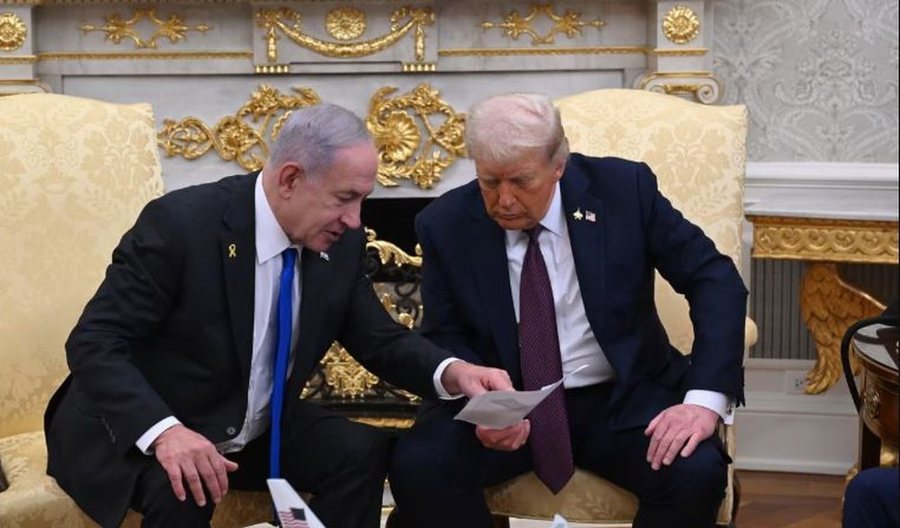
During his visit to the United States, Benjamin Netanyahu managed to change Trump's plan for Gaza, making it even more favorable to Israel and more difficult for Hamas to accept.
Especially on two key issues: the disarmament of militants and the withdrawal of the Israel Defense Forces (IDF) from the Strip. This is understood by comparing the text of the 21-point draft revealed by the Times of Israel on September 27, approved by Trump's special envoy, Steve Witkoff, and presented in advance to Arab and Muslim countries, with the text officially published by the White House two days later, while the meeting between Netanyahu and the American president was underway.
Disarming Hamas
The Israeli government has always set, as the main condition for negotiating a permanent ceasefire, the disarmament of the al-Qassam Brigades, the Hamas militia responsible for the October 7th pogrom. Hamas has always opposed this. Point 6 of the draft stated that, in the event of an agreement and after the 48 hostages (alive or dead) were handed over, Hamas members who would commit to “peaceful coexistence” would be guaranteed amnesty, while those who wanted to leave the Strip would be provided with “safe passage” to countries that are willing to accept them. The official text, however, added a fundamental detail: it states that amnesty would only be granted to those who would “decommission their weapons”. This concept is repeated in point 13, which introduces “a demilitarization process under the supervision of independent observers”. This did not exist in the draft.
The IDF will remain in the Strip
The most notable change concerns the withdrawal of Israeli troops. In the draft, in point 3, it was stated that the armed forces, in the event of an agreement, “would withdraw from the battle lines following the Witkoff proposal presented for the release of the hostages”. It is not specified which of the many proposals of Trump’s envoy was in question, but in point 16 it was clarified that the IDF “would gradually hand over the territory of Gaza that they had occupied”. The plan published by the White House, on the contrary, speaks of a withdrawal “up to the agreed line”: of course, agreed between Trump and Netanyahu.
Attached is a map that distinguishes three phases of withdrawal within the Gaza Strip: the first, a few kilometers from the current positions, to favor the release of hostages; the second, which will be implemented only when the interim International Stabilization Force (ISF) is deployed in Gaza; the third and last, foresees the withdrawal of the IDF to the buffer zone along the border with Israel, that is, always in Palestinian territory. In essence, a complete withdrawal from the Gaza Strip is not currently envisaged, and the withdrawal of the army “will be carried out on the basis of criteria and with deadlines to be agreed upon between the IDF, the ISF, the guarantors and the United States,” states the new point 16.
Palestinian Authority, West Bank and Qatar
The draft also included an 18th point, in which Israel committed to not striking Qatari soil again. This has disappeared from the official plan, although Netanyahu was forced by Trump to apologize to Qatari Prime Minister al-Thani for the September 9 attack on a construction complex in Doha, where Hamas leaders were meeting.
The West Bank is not mentioned, neither in the draft nor in the final version of the plan: Trump had declared that he would not allow annexation by Israel, but during the press conference at the White House with Netanyahu he was much less categorical. And the Palestinian National Authority, as both versions stipulate, will have a role only in a second phase and only if it submits to a reform program that Israel will deem satisfactory.
"Never a Palestinian state"
Finally, the issue of the state of Palestine. Both the draft and the plan published by the White House state that this agreement on Gaza and the reform of the PA constitute "a credible path towards Palestinian self-determination and state sovereignty, which we recognize as the aspiration of the Palestinian people." But Netanyahu, as soon as he left the meeting with the billionaire and before boarding the plane that took him back to Israel, wanted to assure his supporters: "The state of Palestine will never exist." / La Repubblica





Lini një Përgjigje